
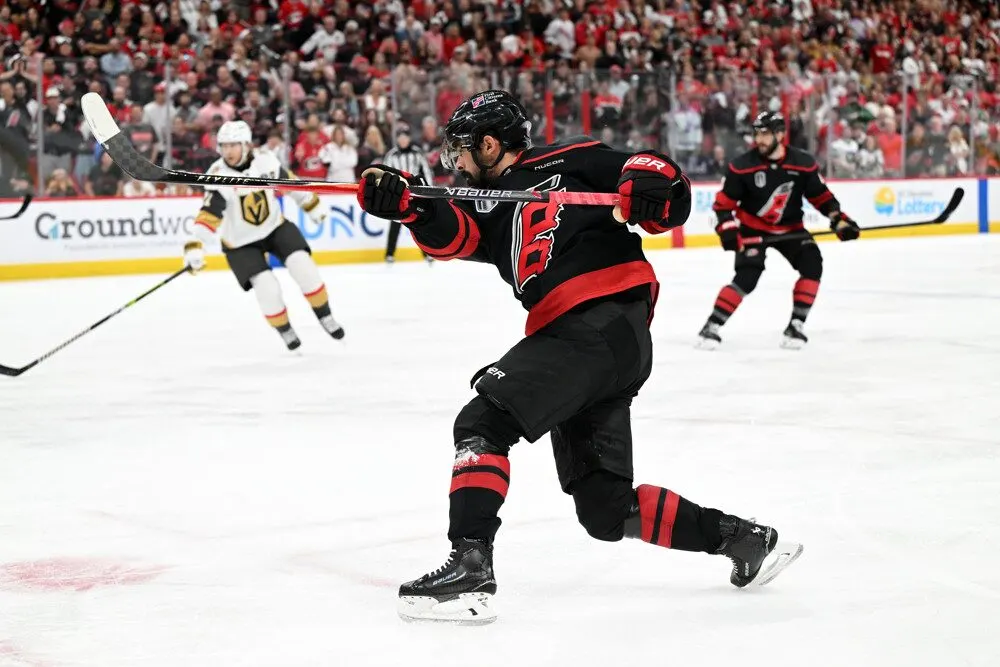

Most teams that win it all spend the summer terrified of standing still. Carolina has the opposite problem, and it is a good one: the Hurricanes are already the best team in hockey by the underlying numbers, and their most important development this offseason is not an addition at all. It is a 24-year-old already on the roster entering the prime of his career. Seth Jarvis is the reason the champions might not just repeat, but improve.
| Player | Goals | Points | On-ice xGF% |
|---|---|---|---|
| Sebastian Aho | 27 | 80 | 59% |
| Andrei Svechnikov | 31 | 70 | 63% |
| Nikolaj Ehlers | 26 | 71 | 64% |
| Seth Jarvis | 32 | 66 | 61% |
Look at that table and then remember it does not include the whole roster. Carolina controlled 56 percent of the expected goals last season and out-scored opponents 291 to 236, one of the most dominant two-way profiles in the league. This is the team I called the repeat favorite, and the case has only strengthened. When a champion's underlying numbers are this good, the offseason question is not how to fix it. It is how to keep it together and let it grow.
Jarvis is the ascending piece
Jarvis is the part of the roster still trending up. He scored 32 goals and 66 points and drove a 61 percent on-ice share, and he did it at an age where the best players make their leap from very good to genuinely elite. Carolina does not need him to carry the team; it needs him to keep climbing, and the difference between a 66-point Jarvis and an 80-point Jarvis is the difference between a great Hurricanes team and a terrifying one. He is the internal upgrade most contenders would have to trade a first-round pick to acquire.
The depth is the real weapon
What separates Carolina is not a single superstar but the sheer number of players driving play. Sebastian Aho remains the underrated engine at 80 points, Andrei Svechnikov scored 31, Nikolaj Ehlers added 71 at a ludicrous 64 percent share, and the waves keep coming through Jackson Blake, Logan Stankoven and Taylor Hall. This is a lineup with no soft spots, the kind of depth that wins a long series because there is no line an opponent can hide from. Jarvis rising just makes the deepest team in hockey deeper.
The one question every year
There is only one caveat with Carolina, and it is the same one every year: goaltending in the spring. A team that dominates the regular season this thoroughly has occasionally seen its process betrayed by a cold crease at the worst possible time, and the Hurricanes' ceiling in any given playoff run rests on getting saves when the margins tighten. The skaters are not the question and never have been. Whether the goaltending holds up in May is the only thing standing between this roster and a second straight parade.
Why the process should win out
The optimistic read, and the one the data supports, is that a team this dominant gives itself the most chances to survive a shaky goaltending night. When you out-chance opponents by the margin Carolina does, you can absorb a soft goal or two and still win, and over a seven-game series the better team's edge tends to show. The Hurricanes have been undone by variance before, but variance cuts both ways, and a 56 percent team is built to withstand more of it than anyone else in the league.
The honest counter
The fair pushback is that repeating is the hardest thing in the sport, and dominance in August means nothing by May. Carolina spent years as the analytics darling that fell short before finally breaking through, and one banner does not make the spring variance disappear: a cold crease or a slumping power play can still undo a 56 percent team in seven games, and every opponent now circles the champion on the calendar. The Hurricanes have proven they can win it all. They have not yet proven they can do it twice, and the list of teams that failed that exact test is long.
The contract angle
The quiet reason Carolina can keep a roster this deep is not just scouting; it is cost control. The Hurricanes have made a habit of identifying young players and locking them in before their prices explode, and Jarvis is the model of it. A 32-goal, play-driving forward entering his prime on a team-friendly deal is one of the most valuable assets in the sport, because he delivers first-line production at a fraction of a first-line price, and that surplus is what lets Carolina afford the depth that makes it so dangerous.
This is the part rivals struggle to copy. Any team can spend to the cap; the trick is getting more value than you pay for, and the Hurricanes' willingness to bet early on their own young players is how they keep six and seven legitimate drivers in the same lineup. Jarvis at his number, alongside Aho, Svechnikov and Ehlers, gives Carolina a top of the roster that would cost most teams far more, freeing the space to keep the bottom nine deeper than anyone else. The champagne problem of too many good players is a function of smart contracts as much as smart drafting.
It also insulates the Hurricanes against the exact market forces squeezing the rest of the league. While other teams scramble to afford their ascending stars into a rising cap, Carolina has already secured its young core at yesterday's prices, turning the leaguewide contract chaos into a competitive advantage. The Jarvis deal is not just good for this season; it is good for the three or four after it, and it is the kind of foresight that separates a one-year winner from a sustained power.
That sustainability is the real story of the champions, and Jarvis embodies it. A team gets better not only by adding talent but by keeping the talent it has at a price that lets it add more, and Carolina has mastered the second half of that equation. The Hurricanes are dominant because their best players are excellent, young and affordable all at once, and Jarvis rising into stardom on a value contract is the clearest sign the dominance is built to last rather than borrowed for a season.
What it means
Carolina is in the enviable position of being the best team in hockey and getting better from within, and Seth Jarvis is the clearest reason why. A dominant champion with a 24-year-old still ascending does not need to gamble on a splashy summer; it needs to run it back and let its young star climb. The only question is the one that has always followed this team, whether the goaltending cooperates when the season is on the line. Everything else is already in place, and this year, the everything else might be even better.