
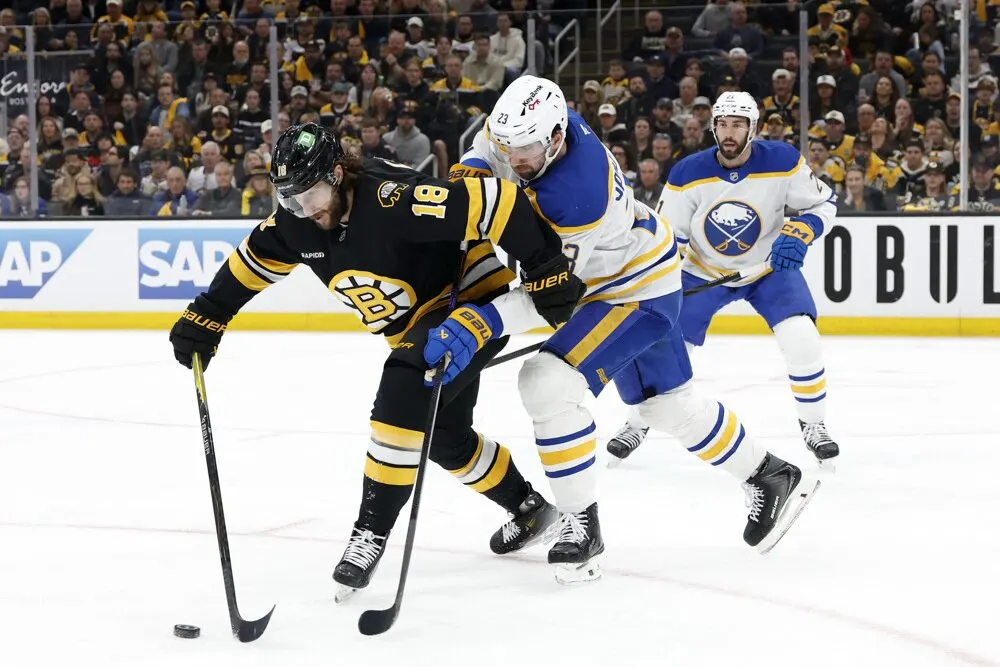

The hardest question in hockey is not how to build a contender. It is how to admit you are no longer one. Boston enters this season stuck in the murky space between competing and retooling, and the clearest signal of which way it leans will not be a splashy signing. It will be what the Bruins do with Pavel Zacha, a good, movable veteran on a team that has to figure out whether it is buying or selling.
| Player | Goals | Points | On-ice xGF% |
|---|---|---|---|
| David Pastrnak | 29 | 100 | 56% |
| Morgan Geekie | 39 | 68 | 55% |
| Pavel Zacha | 30 | 65 | 54% |
| Charlie McAvoy | 11 | 61 | 49% |
Start with the team around him, because it frames the decision. Boston controlled just 47 percent of the expected goals last season, the profile of a club being out-chanced more often than not, carried at the top by David Pastrnak's 100 points and not much behind him beyond a strong Morgan Geekie year. I called the Bruins' defensive picture a mirage propped up by goaltending, and nothing about a 47 percent team screams contender. This is a group closer to the middle than the top, with an aging core and a thinning supporting cast.
Zacha is exactly what contenders want
Which is what makes Zacha valuable. He scored 30 goals and 65 points and drove a 54 percent share, the profile of a versatile middle-six centre who can move up a lineup in a pinch, and players like that are precisely what buyers overpay for at the deadline. He is not a rental problem or a declining name; he is a useful, playable piece with real trade value right now. On a team that has to decide its direction, he is the asset whose price is highest while the Bruins are still ambiguous about who they are.
The case for selling
If Boston is honest about the 47 percent, the logic points toward selling. A retooling team converts good veterans into futures before their value dips, and Zacha is exactly the kind of piece a contender pays a premium for. Moving him now, while he is productive and other teams are desperate for centre depth, would restock a system that needs young talent and accelerate the transition to the next competitive Bruins team. That is the disciplined move for a club that has slipped out of the top tier.
The case for holding
The counterargument is Pastrnak. As long as a genuine superstar is in his prime and under contract, tearing down around him wastes the very seasons he has left, and Boston may reasonably decide it owes one more push to a player still producing at a 100-point clip. Geekie's 39-goal season and a few younger pieces offer a thread to pull on, and a team with that top end is not obligated to blow it up just because the underlying numbers slipped. Holding Zacha, in that reading, is a bet that the Bruins can retool on the fly rather than bottom out.
Why Zacha is the tell
This is why Zacha, of all players, is the test case. He is good enough to help a contender and valuable enough to bring back a real return, which means the decision to keep or trade him is really a decision about which team Boston believes it is. Hold him, and the Bruins are signaling one more run around Pastrnak. Move him, and they are admitting the window has narrowed and the rebuild has quietly begun. The player is the message.
The honest counter
To be fair, this does not have to be binary, and the best front offices resist the pressure to pick a lane too early. Boston could hold Zacha into the season, reassess at the deadline, and let the standings make the call, keeping optionality rather than committing to buy or sell in August. A 47 percent team is not doomed, and a strong start could legitimately reopen the window; a bad one makes the sell obvious. Waiting is not indecision. Sometimes it is the smartest read of an uncertain situation.
The comparables for selling high
History is unkind to teams that hold their useful veterans a year too long, and kind to the ones that sell a year early. The deadline market for a productive middle-six centre is reliably inflated, because contenders convince themselves that one more forward is the piece that puts them over the top, and they pay in futures for the privilege. A player with Zacha's profile, a 30-goal scorer who can play up the lineup, is exactly the kind of chip that returns a first-round pick or a good prospect from a desperate buyer in March.
The discipline is in acting before the value dips. A veteran's trade price is highest when he is productive and signed at a reasonable number, and it erodes the moment his production slips or his contract winds down. Boston, if it accepts that it is closer to the middle than the top, has a narrow window to convert Zacha into the kind of young asset a retool actually needs, and every month it waits to make up its mind is a month that window narrows. Selling high is a skill, and it requires admitting where you are before the standings force the admission.
There is a cautionary version of this the Bruins know well, because plenty of teams have clung to their veterans out of a stubborn belief they were still contenders, only to watch those assets walk for nothing or fetch pennies at the deadline. The graveyard of aging teams is full of good players who were kept too long, traded too late, or re-signed out of loyalty rather than logic. Boston's front office has to be honest enough to avoid that trap, and a Zacha trade, executed from a position of value rather than desperation, would be the clearest sign it has.
None of this requires panic, only clarity. If the Bruins genuinely believe a healthy roster around Pastrnak can climb back into the top tier, holding Zacha is defensible. But if the 47 percent is the truth, then the productive veteran on a fair contract is an asset to be cashed, and the smart move is to do it before the market and the calendar do it for them. Selling high is not surrender. It is how the next good Boston team gets built.
What it means
Boston is at the crossroads every aging contender eventually reaches, and Pavel Zacha is the clearest instrument for reading which way it turns. The underlying numbers say this is a middling team with one star and a thinning cast, the kind of group that usually benefits from selling high on its useful veterans. Whether the Bruins accept that, or bet on one more push around Pastrnak, will define their season before it starts. The banner years are receding. What Boston does with its most movable good player will tell everyone, including itself, whether it is ready to admit it.