
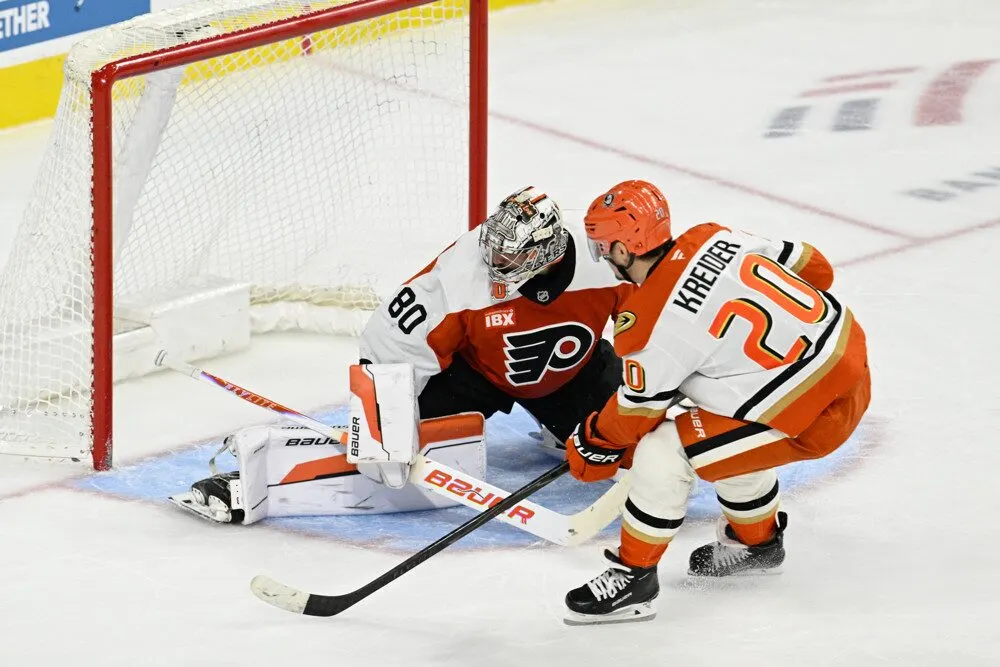

Adding a proven veteran to a rising young team is one of the oldest moves in the book, and usually a sensible one. Anaheim just made it, bringing in Chris Kreider to give an ascending roster some scoring and some spine. The logic is clean and the player is useful. The complication is that the Ducks' actual problem is not the one Kreider solves, and on a team this young, a veteran forward's minutes are never free.
| Player | Goals | Points | On-ice xGF% |
|---|---|---|---|
| Cutter Gauthier | 41 | 69 | 58% |
| Leo Carlsson | 29 | 67 | 57% |
| Chris Kreider | 22 | 50 | 59% |
| Mason McTavish | 17 | 41 | 56% |
Kreider is not a spent name, which is what makes the fit tempting. He scored 22 goals and 50 points and drove a 59 percent on-ice share, still a productive net-front presence and power-play weapon who can finish around the crease. Dropped onto a young roster, he adds real scoring and a veteran habit-setter, and there is a version of this where he stabilizes a top six and helps the kids learn how to win. The player, on his own terms, is a perfectly reasonable acquisition.
The problem is where Anaheim was already strong
The trouble is that Anaheim did not need more forwards. When I wrote about Cutter Gauthier and the blue line, the whole point was that the Ducks already control play up front, led by Gauthier's 41 goals and Leo Carlsson's rising two-way game, and that their young core had already made the leap. Anaheim was a 51 percent team that scored plenty. What sank it was the back end: 288 goals against, a leaky blue line and inconsistent goaltending. Kreider does nothing for any of that.
The blocking risk is real
Here is where a good-player signing becomes a questionable roster move. A veteran winger who plays top-six minutes on a team overflowing with young forwards is, by definition, taking those minutes from someone younger who needs them to develop. Anaheim's path forward runs through the continued growth of Gauthier, Carlsson, Mason McTavish and the prospects behind them, and every night Kreider soaks up power-play time and scoring-line shifts is a night one of those players does not. On a rebuild, developmental minutes are an asset, and spending them on a veteran has a cost.
Where Kreider genuinely helps
To be fair, there are real uses for him that do not block anyone. A net-front specialist on the power play fills a specific role young teams often lack, and a veteran presence in the room has value that does not show up in a shot-share table. If Anaheim deploys him as a complementary finisher and a mentor rather than an anchor at the top of the lineup, he can add without subtracting, and his 59 percent share suggests he can still play a positive complementary game. Usage, as ever, decides whether he is a help or a hindrance.
The deadline flexibility argument
There is also a version of this that is quietly shrewd. A productive veteran on a short commitment is exactly the kind of player a contender covets in March, and if Anaheim is not in the race, Kreider becomes a trade chip who can return a pick or a prospect. Signing a useful veteran and flipping him for futures is a legitimate rebuild tactic, and it turns a redundant forward into an asset. The move only backfires if the Ducks hold him too long out of a misplaced belief they are closer than they are.
The honest counter
The strongest case for the signing is simply that young teams can be too young, and a veteran or two accelerates the messy transition from promising to competitive. Anaheim has been bad for a long time, and adding a proven scorer who sets a professional standard is not nothing, especially for a group that needs to learn how to close games. If Kreider helps the kids take the next step rather than displacing them, the criticism here looks overcautious. The line between blocking a prospect and mentoring one is thin, and coaching decides which side it lands on.
The blueprint Anaheim should have followed
The frustrating part is that the correct move was obvious and available. A team that controls play up front and bleeds goals from its own end needs to spend on defence, and the same resources that brought in Kreider could have gone toward a top-pairing defenceman or a genuine starting goaltender, the two things Anaheim's 288-goals-against blue line actually lacked. That is the addition that would have raised the team's floor, because it would have addressed the flaw rather than reinforcing the strength.
The value of a shutdown defenceman on a young team goes beyond the standings, too. A defender who can log heavy minutes against the other team's best line does not just prevent goals; he shelters the young forwards, lets the coaching staff deploy the kids in favorable situations, and accelerates development by taking the hardest matchups off their plates. That is the kind of veteran addition that helps a rebuild in every direction at once, and it is precisely the profile Anaheim passed on to add a winger it did not need.
There is an opportunity cost in cap and roster terms as well. Every dollar and every top-six slot spent on Kreider is a dollar and a slot not available for the defensive help the team required, and on a roster this young, those are not trivial trade-offs. The Ducks are not so flush with resources that they can afford to solve a non-problem and leave the real one open, and a rebuild advances fastest when every addition is aimed at the actual need. This one was aimed at the wrong end of the ice.
None of this makes Kreider a bad player or the move indefensible, but it does make it a curious use of a rare chance to improve. Anaheim had a clear, specific weakness and the means to address it, and it chose instead to deepen an area that was already a strength. The blueprint for a team in the Ducks' position is to fortify the blue line and the crease and let the young forwards grow; the move they made does neither. If the season exposes the same defensive leaks as last year, the reason will be easy to trace back to an offseason that answered the wrong question.
What it means
Chris Kreider is a good player, and this is not a bad signing so much as a curious one. Anaheim spent an addition on the area it was already strong, forwards, while its actual flaw, a blue line that surrendered 288 goals, went unaddressed. Whether the move helps or hurts comes down to usage: deploy Kreider as a complementary finisher and future trade chip, and he adds value; hand him top-six minutes over developing kids, and he slows the very rebuild he was brought in to speed up. The Ducks needed a defenceman. They bought a winger. The season will tell whether that was a detour or a mistake.