
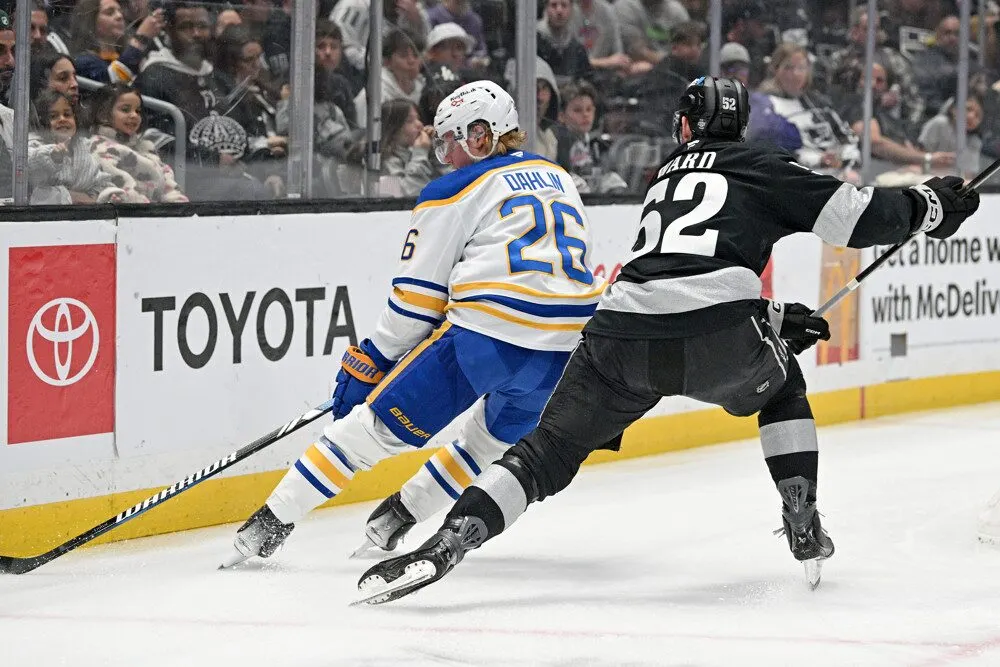

Buffalo finally ended the drought, and the celebration was earned. The sobering part, which I laid out at the time, is that the season was built on roughly 50 goals of finishing and goaltending luck stacked on top of a 49 percent team. Which frames the question that defines the Sabres' year: with that luck likely to regress, can the roster's actual driver, Rasmus Dahlin, carry them back?
| Metric | Number | The read |
|---|---|---|
| Points | 74 | Elite production from the back end |
| On-ice xGF% | 57% | A plus-13 on-off swing |
| Team 5-on-5 share | 49% | Below break-even without him |
| The bet | Regression | Buffalo banked about 50 goals of luck last year |
Start with the captain, because he is the real thing. Dahlin put up 74 points from the blue line and drove a 57 percent on-ice share against a team that was 44 without him, a plus-13 swing that marks him as a genuine number-one defenceman and one of the best in the world. On a Buffalo team below break-even overall, Dahlin was the one dragging the underlying game toward respectable. He is exactly the kind of player you build a bounce-back around, and the exact kind who cannot do it alone.
The problem is the luck around him
The uncomfortable math is the reason for the question mark. Buffalo's playoff season came from a 49 percent group that scored about 25 goals more than expected and got about 25 goals of above-average goaltending from Ukko-Pekka Luukkonen and Alex Lyon. Both of those are the most volatile inputs in hockey, and both tend to regress toward the middle. Strip them back toward normal and the Sabres are the 49 percent team the underlying numbers describe, not the 109-point team the standings did. Dahlin and Tage Thompson's 40 goals are the genuine drivers; the rest of the record was borrowed, and the bill tends to come due.
Can Dahlin drag them back?
A defenceman this good can lift a team a few points of share on his own, but not from below break-even to comfortably good; no single player does that. For Buffalo to hold its ground rather than slide, the rest of the roster has to improve the actual run of play, and the optimistic case is that it can, organically. Dahlin is in his prime, Thompson is a genuine weapon, and a young supporting cast can mature into better possession numbers. If that happens, the underlying game climbs to meet the record rather than the record falling to meet the game.
The regression math
The pessimistic case is just arithmetic. If the finishing and goaltending give back the 30 to 40 goals they overshot by, and the 49 percent structure does not improve, Buffalo drops from 109 points toward the bubble, and a feel-good breakthrough becomes a frustrating step back. That is the default path for a team that overachieved its underlying numbers this dramatically, and pretending 109 points is the new floor is exactly the mistake that gets front offices in trouble.
The honest counter
To be fair to the optimists, young teams are the ones most likely to close a gap like this, because their underlying numbers are still improving as their best players enter their primes. Dahlin and Thompson are not finished products, and a maturing group can legitimately turn a 49 percent team into a 51 or 52 percent one, which would absorb much of the regression. And there is real, unmeasurable value in ending a drought: confidence, buy-in, a building that believes. Those things are not on the spreadsheet, and they are not nothing.
What Buffalo should do
The productive move is to treat the breakthrough as a head start, not a destination. Improve the five-on-five structure, particularly the shot suppression that kept the Sabres below break-even, rather than assuming the goaltending and finishing repeat. Lean on Dahlin as the anchor and build the middle of the roster to support him and Thompson. Do that, and the underlying game rises toward the record. Coast on the assumption that 109 points is who they are, and the regression does the talking.
What history says about teams like this
Buffalo's situation is not unusual, and the history of teams that overachieved their underlying numbers this dramatically is sobering. Clubs that ride a big finishing and goaltending surge to a surprise season almost always give a chunk of it back the following year, because the two inputs that drove the leap, shooting percentage and save percentage, are the least sticky in the sport. The Sabres banked roughly 50 goals of that kind of luck on top of a 49 percent team, and the base rate for holding all of it is close to zero.
That does not doom them, and this is where Buffalo differs from the average cautionary tale. The teams that absorb regression best are the young ones still improving their actual play, and the Sabres have the profile: a franchise defenceman in his prime, a genuine scoring threat down the middle, and a supporting cast young enough to get better at driving play as it matures. If the underlying 49 percent climbs to 51 or 52 as the kids develop, that improvement offsets much of the luck coming out, and the record holds up better than the pure regression math suggests.
The failure mode is complacency, treating a lucky season as the new baseline and standing pat. A team that assumes the goaltending and finishing repeat, and does not push to improve its five-on-five structure, is the one that falls hardest, because it gets the regression without the growth. Buffalo's task is to bank the confidence of ending the drought while quietly acknowledging that the process underneath was not yet good enough, and to spend the offseason improving the shot suppression that kept it below break-even. Do that, and Dahlin's brilliance has something to build on. Ignore it, and the second act is a step back.
What it means
Rasmus Dahlin is elite, and he is carrying Buffalo in the way a franchise defenceman should. The question of the Sabres' season is not about him. It is whether the team's real level, that 49 percent, climbs to meet last year's result, or whether the luck that inflated the record regresses and drops them back. The drought-breaker's second act is the test, and Dahlin, for all his brilliance, cannot pass it by himself.