
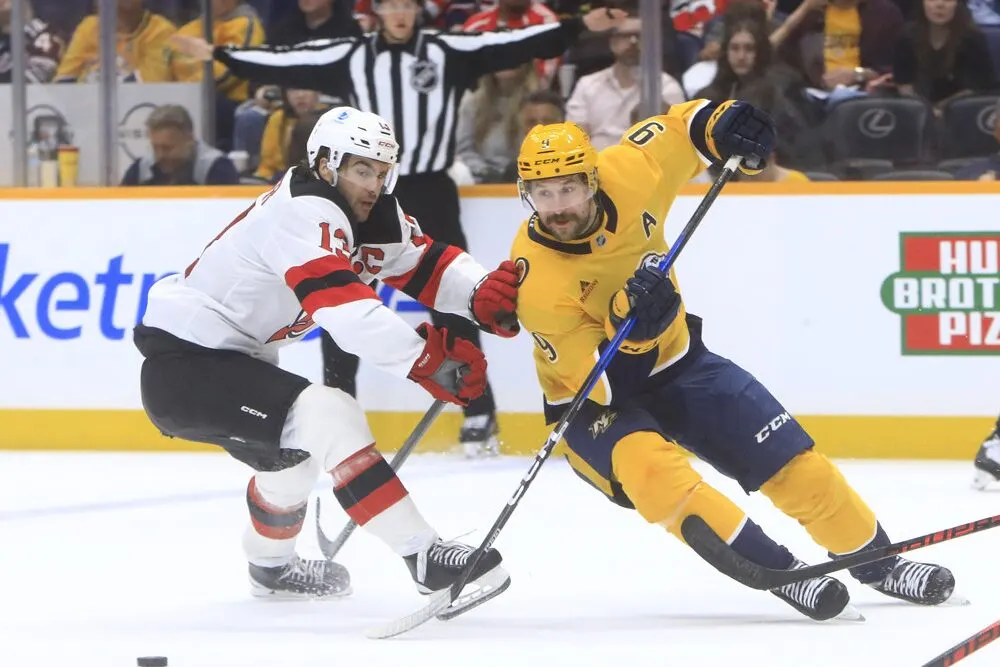

Nashville spent big to win now and then did not, and the offseason leaves the hardest question a front office faces: double down or begin to let go. The Predators are built around a veteran core that is genuinely good and genuinely aging, and the data says there is probably one more competitive season in it, if the pieces around it cooperate. The catch is that betting on a window this narrow, with this little margin, is how teams end up old and bad at the same time.
| Player | Points | On-ice xGF% | Note |
|---|---|---|---|
| Filip Forsberg | 75 | 56% | 40 goals and still the engine |
| Ryan O'Reilly | 74 | 52% | Two-way veteran centre |
| Steven Stamkos | 66 | 57% | 42 goals in his late thirties |
| Roman Josi | 55 | 54% | The blue-line anchor now aging |
Start with the man on the cover, because he is not the problem. Filip Forsberg scored 40 goals and 75 points and drove a 56 percent on-ice share, a genuinely elite season, the kind of production that proves the Predators' best players can still play. Around him, Ryan O'Reilly remains a useful two-way centre at 74 points, Steven Stamkos defied his age with 42 goals, and Roman Josi anchored the blue line at 55. This is not a hollow roster. It is a good top end, which is exactly what makes the decision hard.
The problem is the age, and the crease
Two things shadow the good top end. The first is time: O'Reilly, Stamkos and Josi are all past their primes, and cores like that do not decline gradually so much as fall off together once one or two pieces go. The second is the net. Nashville was a 48 percent team last season, and its goaltending made a middling group worse, with Juuse Saros finishing nine goals below expected, a collapse I broke down in full. A 48 percent team with declining veterans and a leaky crease is not one addition from contention. It is a team whose window is cracking, whatever the point totals of its stars suggest.
Why running it back is tempting
The pull toward one more push is real, and it is not irrational. Forsberg at 40 goals and a plus-twelve share is a legitimate top-line winger, Stamkos can still finish, and a good goaltending season would flip the whole equation, because the skater group is closer to break-even than the record implies. If Saros bounces back to his career norm or Justus Annunen seizes the net, a 48 percent team with this much finishing talent could climb back into the picture for a year. The temptation is to bet that the crease was the whole problem.
Why a teardown is premature
At the same time, tearing it all down would be its own mistake. A team with Forsberg in his prime and a functional veteran core is not bad enough to blow up, and trading its best players for futures would waste the very seasons those players have left. Nashville is caught between two extremes, neither of which fits: it is too good to rebuild and too flawed to simply run back and expect a different result.
The realistic play
The honest path is the hedged one. Fix the crease first, because it is the single biggest lever and the cheapest thing to change, whether that means committing to Annunen or adding a goaltender. Inject some youth and speed into a slowing lineup. And give the core one genuine shot while keeping the flexibility to pivot: if the season goes sideways by the deadline, O'Reilly and Josi are exactly the kind of veterans a contender pays a premium for, and Nashville should be willing to sell rather than waste their value chasing a lost year.
The honest counter
The risk in all of this is that aging cores rarely bounce back on cue, and the data on 48 percent teams leaning on scorers in their late thirties is not encouraging. There is a real chance this window has already closed and the Predators are talking themselves into one more year they will regret. Betting on a Saros rebound and a healthy, productive veteran core is stacking two uncertain outcomes, and if either fails, Nashville is old, expensive and out of the race by January.
The comparables cut both ways
History offers Nashville two cautionary tales, and they point in opposite directions. For every aging core that ran it back and stole one more deep run on the strength of veteran habits and a hot goaltender, there is another that convinced itself the window was still open, paid the price in dead cap and lost picks, and emerged years older with nothing to show for it. The Predators are staring directly at both outcomes, and the difference between them usually comes down to one thing: whether the goaltending cooperates.
That is what makes the crease the hinge of the whole decision. A veteran-heavy team with competent goaltending can paper over a lot of aging legs, because it steals the games its skaters no longer dominate. The same team with a leaky net gets exposed on exactly the nights it can least afford it, and last season's 48 percent group with a nine-goals-below-expected crease is the version that ages badly. Fix the net and the comparables tilt toward the teams that squeezed out one more good year. Leave it and Nashville becomes the cautionary tale.
The other lesson from teams in this spot is to keep the exits open. The franchises that handled a closing window best were the ones willing to pivot mid-season, selling a veteran or two for futures the moment the year went sideways rather than doubling down out of stubbornness. Nashville's veterans are assets precisely because they are good and other contenders want them, and that optionality is worth more than a doomed insistence on running it back. The smart version of this season keeps one hand on the wheel and one on the eject lever.
What it means
Nashville's crossroads is as much a goaltending question as a core question, and the smart version of the season starts by fixing the net and giving the veterans one honest, flexible shot. Forsberg proved the stars can still carry their end. Whether the Predators bet on them again, and whether they are disciplined enough to pivot if it fails, is the decision that defines not just this season but how gracefully this era ends.