
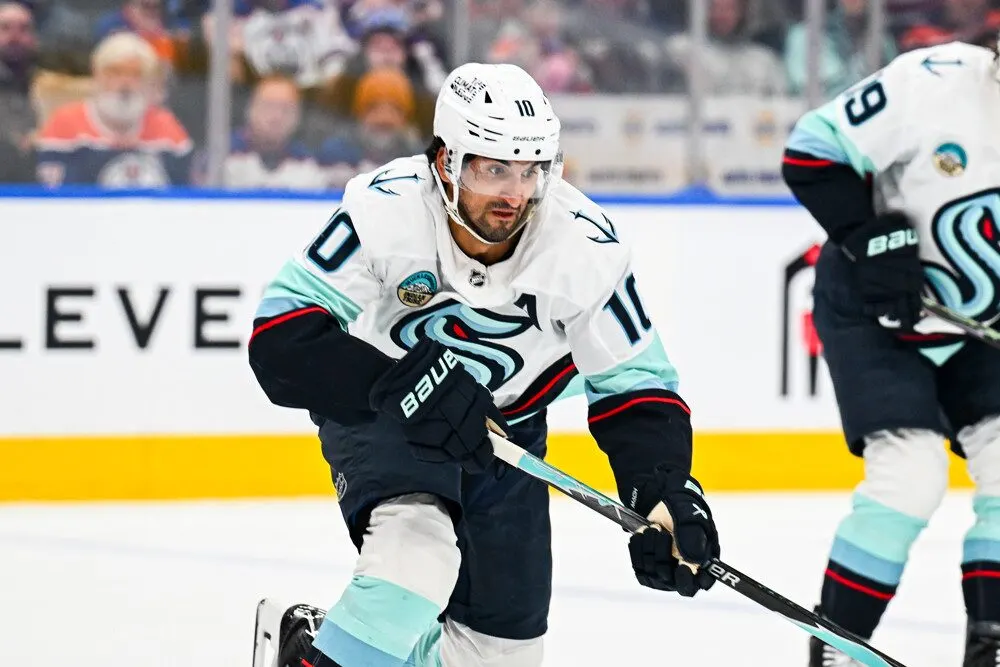

The Kraken have settled into the quietest kind of purgatory: not bad enough to rebuild, not good enough to matter, a team that surfaces in the standings' murky middle and vanishes from the national conversation. The Seattle problem is specific and fixable, and its solution has a name. The Kraken cannot score, and the player most capable of changing that is Matty Beniers.
| Metric | Number | The read |
|---|---|---|
| Goals scored | 224 | Among the fewest in the league |
| 5-on-5 expected-goals share | 46% | Out-chanced most nights |
| Matty Beniers on/off swing | +11 | Already a positive driver |
| Beniers points | 50 | Not yet the number-one output they need |
Start with the flaw, because it is stark. Seattle scored just 224 goals last season, among the fewest in the league, on a 46 percent expected-goals share that says the Kraken got out-chanced most nights. This is not a goaltending problem or a bad-luck problem; it is a genuine shortage of high-end offence, a roster of useful complementary players without enough drivers at the top. Jordan Eberle and Jared McCann are good scorers, and McCann in particular was excellent when healthy, but a team needs a centre who bends games, and Seattle's is still becoming one.
Beniers is closer than the point total shows
Here is the encouraging part. Beniers scored a modest 50 points, but Seattle controlled 54 percent of the expected goals with him on the ice and 43 without him, an eleven-point on-off swing that marks him as a genuine positive driver already. The gap between his impact and his production is the whole story: he is doing the hard part, tilting the ice, and has not yet added the finishing and volume of a true number-one centre. That is a much better problem to have than the reverse, because play-driving is the skill that is hard to teach and points are the part that tends to follow.
Why the leap matters so much
A 46 percent team with no top-line driver is stuck almost by definition, because it has no one to win the games its structure loses. If Beniers takes the step from good two-way centre to point-per-game force, Seattle suddenly has a spine to build around and a reason to add rather than tread water. The Kraken's scoring problem is really a no-number-one-centre problem, and the cheapest, most likely solution is the one already on the roster growing into the role. Everything about Seattle's ceiling runs through whether Beniers becomes a star or settles as a very good complementary piece.
The supporting cast is fine, not enough
Around Beniers, Seattle is competent and unspectacular. Eberle put up 55 points, McCann 40 in an injury-shortened 52 games at a strong 61 percent share, and Vince Dunn quarterbacks the blue line. Those are useful players, the kind that fill out a good team's middle. What they are not is a group that can carry an offence on its own, which is why the Kraken need a genuine driver at the top rather than more of the same in the middle. The goaltending did not help either, with Joey Daccord finishing below average, so Seattle cannot simply lean on its crease to mask the scoring drought.
The honest counter
The risk is that Beniers tops out as exactly what he is now: a very good two-way centre who drives play but never becomes a 30-goal, point-per-game number one. If that is his ceiling, Seattle's problem does not solve itself, and the Kraken are left trying to acquire a top-line driver, which is the hardest thing to find and a tall order for a newer, smaller-market franchise. And a 46 percent team has more than one hole; even a Beniers leap does not, by itself, make Seattle a contender. It just makes them relevant.
What Seattle should do
The path is patience plus purpose. Build around Beniers, add a scoring winger or a second driver rather than more depth, and resist the pull of treading water, which is the worst outcome for a team in Seattle's spot. The Kraken have cap flexibility and a competent base; what they lack is high-end offence, and the plan should be organized entirely around solving that, starting with the young centre who is already halfway there.
What a leap actually looks like
The encouraging thing for Seattle is that the exact leap it needs from Beniers has a clear template around the league. Young two-way centres who already drive play, who tilt the ice before they pile up points, are the ones most likely to add the finishing later, because the hard, unteachable part is already there. The pattern repeats: a centre posts a modest point total while quietly controlling play in his early twenties, then adds ten or fifteen goals and twenty points as his shot, his confidence and his usage grow. Beniers fits that profile almost exactly.
What the leap requires, beyond time, is opportunity and support. A young centre becomes a number one faster when he is given the minutes, the power-play time and a finisher on his wing who converts the chances he creates. That is where Seattle's roster construction matters: pairing Beniers with a genuine scoring winger would do more to unlock his production than anything he changes in his own game, because a play-driver without a finisher is a stat line that undersells the impact. The Kraken have the driver. They have under-invested in the finisher.
The risk in banking on a leap is real, and Seattle should hedge it rather than assume it. Not every play-driving young centre becomes a star; some settle in as excellent complementary pieces, and if that is Beniers's ceiling, the Kraken need a plan at the top of the lineup that does not depend on him alone. But the odds favour a player who is already doing the difficult half of the job, and the cheapest, most likely path to fixing Seattle's scoring is the one already on the roster growing into the role the team is quietly begging him to fill.
What it means
Seattle's ceiling is Matty Beniers's ceiling. The franchise is stuck in the middle because it cannot score, and the likeliest way out is a 23-year-old centre who already drives play taking the leap to driving the scoreboard. If he does, the Kraken have their foundation. If he does not, Seattle faces the much harder task of buying what it cannot grow. Either way, the most important development in the organization this season is not in the standings. It is in whether Beniers becomes the star the roster is quietly begging for.