
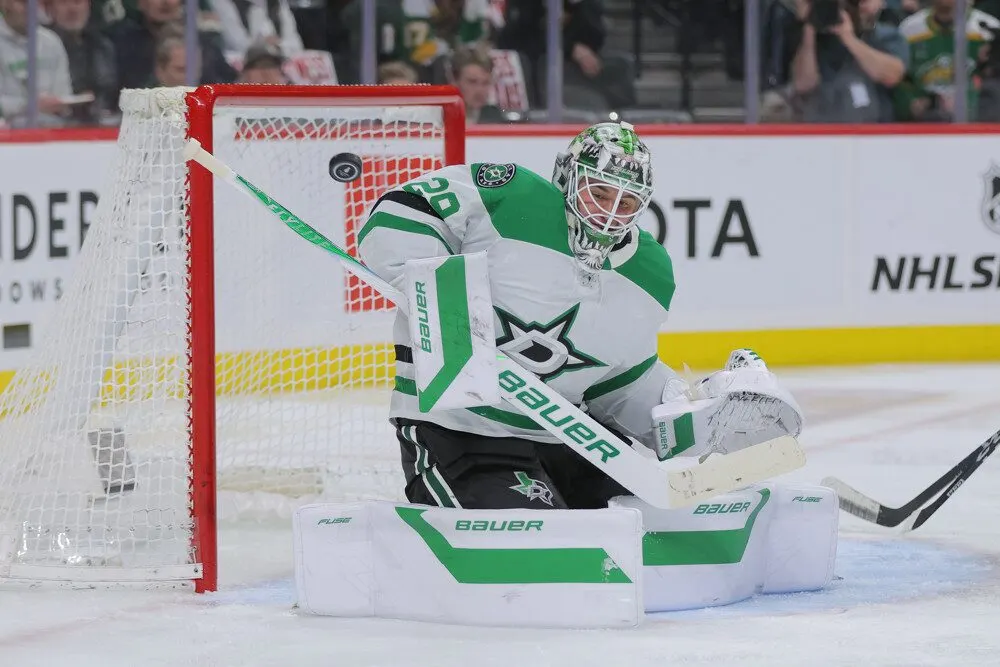

Dallas has spent years as one of the deepest, most talented teams in hockey, and it enters this season the same way: loaded up front, sound on the blue line, a genuine Cup-caliber roster. There is one uncomfortable question hovering over all of it, the same one that hovers over every very good team that has not quite won, and it lives in the crease. Is Jake Oettinger actually elite enough to win it all?
| Goalie | Games | Goals saved above expected | The read |
|---|---|---|---|
| Jake Oettinger | 54 | +5.7 | Solid but not elite |
| Casey DeSmith | 30 | +10.5 | The backup outperformed the starter rate |
Start with the roster, because it is the reason the question matters at all. Jason Robertson scored 96 points, Wyatt Johnston added 86, Mikko Rantanen drove play like a monster, and the Stars controlled 52 percent of the expected goals as a team. This is a contender by every skater measure, the kind of roster that should play deep into the spring. Which is exactly why the goaltending question is not a nitpick. When everything else is in place, the crease becomes the variable that decides whether a very good team becomes a champion.
The Oettinger numbers, honestly
Oettinger saved 5.7 goals above expected, which is solid, above-average, genuinely useful goaltending. It is not, however, the elite tier, the plus-20-to-25 range where Andrei Vasilevskiy, Logan Thompson and Ilya Sorokin operated, the level that actually steals playoff series. And there is an uncomfortable detail in Dallas's own crease: backup Casey DeSmith outperformed Oettinger on a rate basis, saving 10.5 above expected in 30 games. That does not mean DeSmith is the better goaltender or should start; small samples lie. But it does sharpen the question of whether Oettinger is a true difference-maker or merely a good goalie on a great team.
Why good might not be enough
The math of contention is unforgiving here. A 52 percent team with elite goaltending is a Cup favourite; a 52 percent team with merely good goaltending is a very good team that can lose a seven-game series to a hot goalie on the other side. Dallas has assembled the skaters. What it has not established is that its crease can be the thing that wins a series rather than the thing that does not lose it. In the spring, when the ice tightens and every game turns on two or three saves, the gap between good and elite in net is the difference between a parade and another close-but-not-quite exit.
The counter: Oettinger's pedigree
In fairness, this is a question, not an indictment. Oettinger has been a strong playoff goaltender before, has the pedigree and the physical tools of an elite one, and a single season at plus-6 is not damning, because goaltending numbers are noisy year to year and a good goalie can post a great playoff run out of a merely-good regular season. The DeSmith gap is a small-sample curiosity more than a red flag. It is entirely possible Oettinger is better than last season's number and delivers the spring Dallas needs. The point is only that the Stars are assuming it rather than knowing it.
What Dallas should do
The Stars do not need a new starter, and chasing one would be an overreaction. What they need is to treat the crease as the one untested assumption on an otherwise complete roster: trust Oettinger to be his best version, keep a capable 1B like DeSmith as genuine insurance rather than an afterthought, and resist the temptation to spend elsewhere on the theory that the goaltending will simply take care of itself. On a team this close, the margin is the crease, and margins deserve attention even when they are not obvious weaknesses.
The bigger picture
There is a version of this Dallas team that wins the Cup, and in almost every telling of it, Oettinger is very good to great in the spring. That is the bet the Stars are making, and it is a reasonable one, because he has the talent to be exactly that. But it is a bet, and the honest framing heading into the season is that Dallas's ceiling is not set by its forwards, who are excellent, or its structure, which is sound. It is set by whether the goaltender reaches the tier his teammates already occupy.
The playoff sample
The fairest way to judge a goaltender's ceiling is the postseason, and Oettinger's record there complicates the tidy regular-season worry in both directions. He has stolen playoff series before, posted the kind of spring where he looked every bit an elite starter, and that pedigree is real evidence that last season's modest number understates him. A goaltender who has already delivered a great playoff run is a different bet than one who never has, and Dallas is right to trust that the version capable of it still exists.
The complication is that he has also been ordinary in the spring, and the gap between his best postseasons and his lesser ones is exactly the uncertainty that makes the crease Dallas's defining question. A team this good needs to know which Oettinger shows up in a Game 7, and the honest answer is that nobody does, including the Stars. That is the nature of goaltending: even the elite ones are streaky, and a merely good regular season followed by a hot playoff run is a common and entirely plausible outcome. It is just not one a front office can plan around with any confidence.
Which is why the sober framing is not that Oettinger is a problem, but that he is the variable. Dallas has removed almost every other source of doubt from its roster; the skaters are excellent, the structure is sound, the depth is real. What remains is a goaltender good enough to win a Cup and inconsistent enough that it is not assured, and on a team this complete, that single uncertainty is the whole story. The Stars have built a champion everywhere but the crease. Whether they lift the trophy comes down to which Oettinger arrives in June.
What it means
Dallas has everything a Cup team needs except certainty in net. Jake Oettinger is good, and he may well be great, but last season he was a notch below the elite standard that wins championships, and his own backup quietly posted a better rate. None of that makes him a problem. It makes him the question, the one variable standing between a loaded, 52 percent team and the parade its roster is good enough to earn. The Stars built everything else. Whether they win comes down to the position they are trusting most and have proven least.