
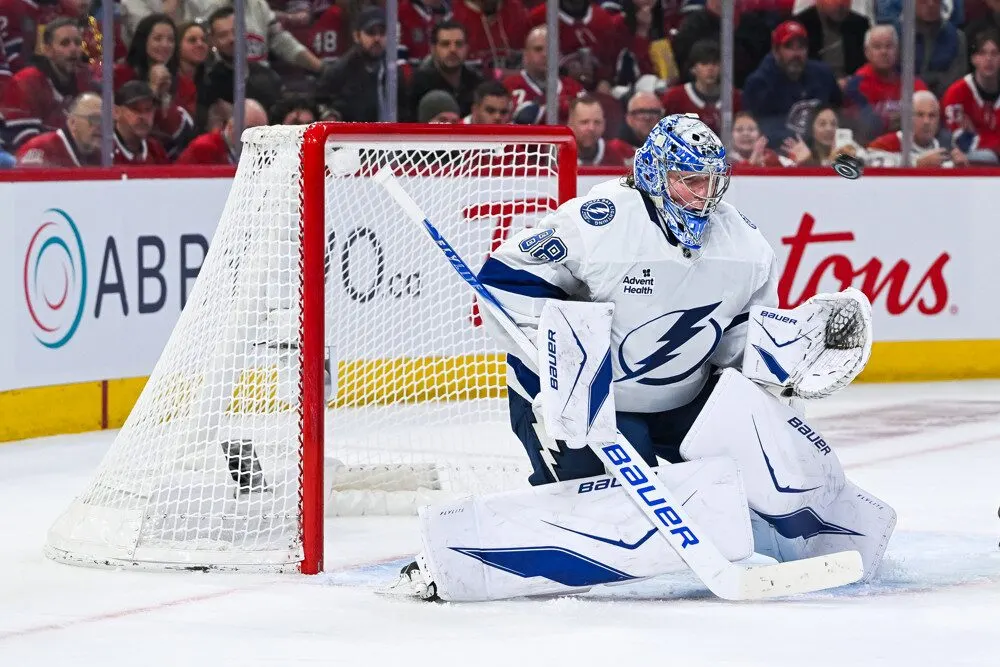

Every contender has a load-bearing wall, the one piece that, if it goes, brings the whole structure down. For Tampa Bay it is not the superstar winger or the deep forward group. It is the goaltender. Andrei Vasilevskiy saved nearly 25 goals above expected last season, one of the best marks in the league, and that crease is doing more than winning games. It is holding an aging, cap-strapped contender together.
| Metric | Number | The read |
|---|---|---|
| Goals saved above expected | +24.7 | Among the best in the league |
| Games played | 58 | A true workhorse starter |
| Tampa 5-on-5 share | 54% | Strong up top and thinning below |
| The role | Window-keeper | The margin that hides the cap crunch |
Start with the number, because it is elite and it is not slowing down. A goaltender saving 24.7 above expected across 58 games is a workhorse having a genuinely great season, the kind that turns a good team into a dangerous one and steals the playoff games that swing series. Paired with Nikita Kucherov's 130 points, it gives the Lightning the two things that travel deepest into the spring: a player who can win a game with the puck, and one who can win it without.
Why the crease matters more here than most places
Tampa is a 54 percent team, strong at the top of the lineup, but it is thinning underneath as the cap squeezes the supporting cast tighter every year. Vasilevskiy's brilliance is the thing papering over that erosion. A lesser goaltender, and the Lightning's depth problems show up in the standings; with him, they are hidden behind a crease that erases mistakes and steals nights the roster no longer wins on its own. He is not just a great goalie on a good team. He is the margin that lets a top-heavy, aging contender keep contending.
The age question, doubled
Here is the risk baked into the whole operation. Tampa's window rests on two aging pillars defying time at once, Kucherov up front and Vasilevskiy in net, and goaltending is the most volatile, least predictable position in the sport. Goalies do not decline on a schedule; they are elite until, one season, they are merely good, and there is rarely much warning. If Vasilevskiy slips even to very good, the Lightning's thinning support gets exposed in a way a 54 percent structure cannot fully hide. The team is betting that both pillars hold simultaneously, and that is a bet with two ways to lose.
The honest counter
To be fair, it is a better bet than most. Vasilevskiy has been elite for the better part of a decade, and betting on an established, workhorse goaltender to keep performing is far safer than betting on a one-year wonder. Kucherov, for his part, shows no signs of slowing. The pillars are holding, and there is no specific evidence either is about to give. This is a caution about how the structure is built, not a prediction that it collapses this year.
What Tampa should do
The smart play is to protect the load-bearing wall. That means a capable backup so Vasilevskiy is not run into the ground across 60-plus starts, and it means spending what limited cap flexibility exists on reinforcing the thinning middle of the roster rather than adding at the top, so the crease is not asked to be superhuman just to break even. The window is open as long as Vasilevskiy is elite. The job is to make sure the rest of the team does enough that his greatness is a luxury rather than a life raft.
The bigger picture
There is something quietly remarkable about what Vasilevskiy is doing, and it deserves to be named. Sustaining this level of goaltending this deep into a career, on a team that leans on him harder every season, is one of the more impressive ongoing feats in the league. It is also precarious by nature, because it depends on a single player at the sport's most volatile position continuing to defy the odds. Tampa has built its contention on that, knowingly, because the alternative, tearing down around Kucherov and Vasilevskiy, is unthinkable while both are still this good.
The succession question
The quiet worry hanging over Tampa's crease is what happens after Vasilevskiy, because there is no obvious answer. A franchise that has leaned this heavily on one goaltender for this long has, by necessity, built everything around his availability, and it has not developed or acquired a genuine heir to the net. That is a defensible way to operate while the starter is elite, but it leaves the Lightning acutely exposed to the one outcome they cannot control: an injury, or the ordinary decline that eventually finds every goaltender, arriving before a replacement is in place.
This is the hidden cost of a load-bearing goaltender. The better Vasilevskiy plays, the easier it is to defer the succession problem another year, and the more catastrophic it becomes when the bill finally comes due. Contenders that survive the end of a great goaltender's peak are the ones that saw it coming and had a plan, whether a developing prospect or a veteran bridge, rather than the ones caught flat-footed when the save percentage dipped. Tampa, by every indication, is running the risk rather than hedging it.
None of this is an argument to move on early, which would be its own mistake while Vasilevskiy is still saving 25 goals above expected. It is an argument for the front office to treat the crease as the single point of failure it is, and to spend some of its limited resources building insurance behind the wall rather than assuming the wall never cracks. The window is open because of one player at the most volatile position in sports. Planning for the day that changes is not pessimism. It is the only responsible way to run a team built on a foundation this narrow.
What it means
Andrei Vasilevskiy is the load-bearing wall of the Tampa Bay Lightning, and the team contends exactly as long as he stays elite. His plus-25 crease is what turns a top-heavy, cap-strapped roster into a genuine threat, and the day it slips even slightly, the depth problems and the age catch up all at once. Enjoy the window while the goalie holds it open, because in Tampa, more than anywhere, the goalie is the window.