
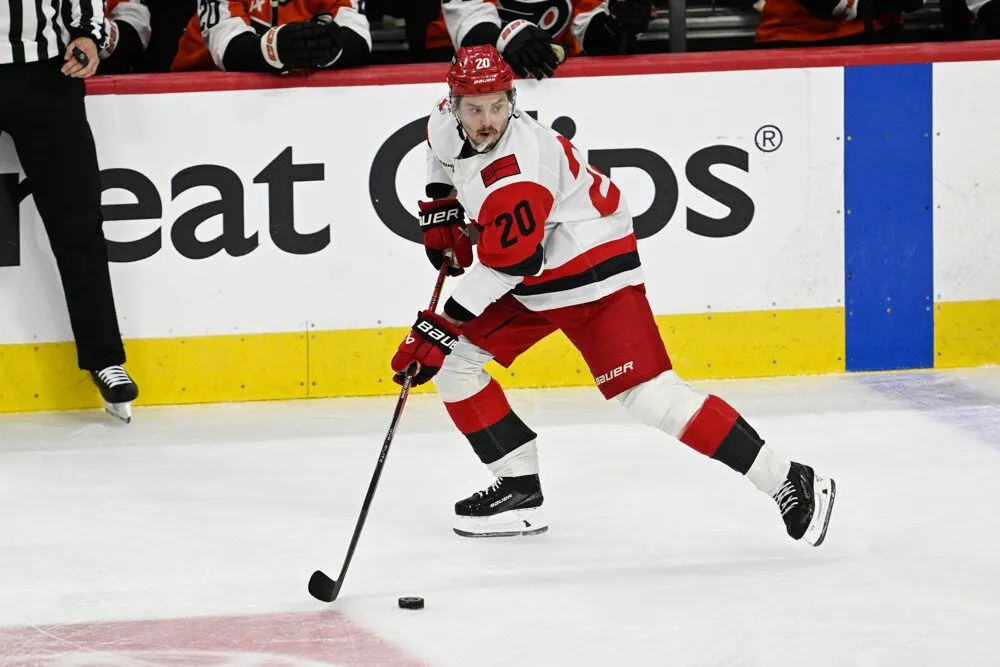

Carolina won the Cup, and when a team wins, the credit tends to pool at the extremes: the flashy scorer, the hot goalie, the coach with the system. The player who does a bit of everything, every night, in every situation, gets described as solid and moved past. That is the Sebastian Aho problem. He is the two-way spine of the Carolina machine, and he is underrated for the most ironic reason in hockey: he is so good at the parts that do not make highlight reels that the highlight reels forget him.
| Player | Points | On-ice xGF% | Note |
|---|---|---|---|
| Sebastian Aho | 80 | 59% | Two-way No. 1 centre |
| Nikolaj Ehlers | 71 | 64% | The prized free-agent add |
| Andrei Svechnikov | 70 | 63% | Power on the wing |
| Seth Jarvis | 66 | 61% | Two-way winger in his prime |
Start with the counting stats, which are quietly excellent. Aho put up 80 points centering the top line of the best possession team in the sport. Carolina controlled 59 percent of the expected goals with him on the ice, and he does it while taking the hard matchups, killing penalties, winning the faceoffs that start the systems Carolina lives on, and defending the situations the coach trusts to almost no one else. This is a genuine number-one two-way centre, the kind teams spend a decade failing to draft and then overpay to acquire, and Carolina has had him humming in the middle of everything for years.
Why his on-off looks modest, and why that is a compliment
Here is the stat that gets used against him and should not. Aho's on-off swing is a relatively modest plus-five: 59 percent with him, 54 without. On most teams a number like that would suggest a good-not-great player. On Carolina it means something entirely different, because the without-him number is 54 percent. The Hurricanes are an elite possession team even when their best centre is on the bench, because the system and the depth are that good. Aho is not being measured against replacement-level teammates; he is being measured against a roster that controls play without him, and he still lifts it. Judging him by his on-off on this team is like judging a great pitcher by his run support on a team that scores ten a game. The context swallows the individual number, and the individual is better than the number lets on.
The depth around him is the real luxury
What makes Carolina terrifying, and Aho's job easier, is the company he keeps. Nikolaj Ehlers, the prized free-agent addition, posted 71 points and a 64 percent share, giving the Hurricanes a second line that would headline weaker teams. Andrei Svechnikov brought 70 points and power on the wing at 63 percent. Seth Jarvis, a two-way winger entering his prime, added 66 at 61. This is four legitimate top-six forwards all controlling upward of 59 percent of the chances, which is the depth that won a championship and the depth that makes Aho's steady brilliance easy to overlook. When everyone drives play, the man driving it the hardest in the toughest minutes blends in.
The blueprint he embodies
There is a bigger point buried in Aho's season, which is that Carolina has built the most sustainable kind of contender. Teams anchored to a single 100-point superstar live and die with that player's health and hot streaks. Teams built like the Hurricanes, around a two-way metronome centre and four lines that all control play, have a floor that does not move. Aho is the human version of that philosophy: not the loudest player on the roster, but the one whose steadiness makes the whole system trustworthy. It is why Carolina is a machine rather than a fireworks show, and machines are what win in a sport where the margins shrink every round.
The season-preview question
Going into the new year, the Hurricanes are the defending champions and, as I argued when breaking down the repeat case, the favourites to do it again. Aho is the reason the projection is so stable. Championship windows usually hinge on something fragile, a goalie who might regress, a star who might age, a core that might fracture under the cap. Carolina's window rests instead on a 56 percent team structure and a two-way centre in his prime who does the unglamorous things that travel into the playoffs. Systems teams built around a metronome centre do not have loud, obvious weaknesses. They have a floor, and the floor is Aho.
The honest caveat
There is one, and it is the same one every Carolina season carries. The Hurricanes' regular-season dominance has not always translated to the deepest runs, and the recurring question mark has been the crease rather than the skaters. Aho and the possession machine get Carolina to the spring as the better team on paper almost every year; whether the goaltending holds up over four rounds is the variable a centre cannot control. That is the one thing standing between another very good Carolina season and another parade, and it has nothing to do with the player carrying the middle of the ice.
The contract nobody complains about
It is worth noting what Aho costs, because it is part of why Carolina is built to last. In an era where 100-point wingers command franchise-altering cap hits and two-way centres are the most overpaid position in the sport, Aho's deal has aged into a bargain relative to his impact, a top-line, all-situations centre at a number that leaves the Hurricanes room to keep the depth around him. That is the quiet genius of Carolina's roster construction: not one crushing max contract that boxes everything else out, but a spine of good-value deals that lets the front office ice four scoring lines and a functional blue line under the cap. Aho is the centerpiece of that model, the player good enough to anchor a Cup team without a cap hit that prevents the team from being deep. In a league where the champions are usually the teams that get their stars at a discount, Carolina has exactly that in the middle of its lineup, and it is a big reason the window does not look like it is closing.
What it adds up to
Sebastian Aho will not lead the league in scoring, and he will not win the popularity contests that go to the 50-goal men and the highlight machines. What he will do is exactly what he has done for years: center the best two-way team in hockey, drive play in the minutes that matter most, and quietly make a championship roster function. The champions are the champions in large part because of him, and the fact that he is still described as merely solid is less a verdict on Aho than on how hard it is to see the player who does everything at once. Watch the whole game, not the goals, and he is impossible to miss.