
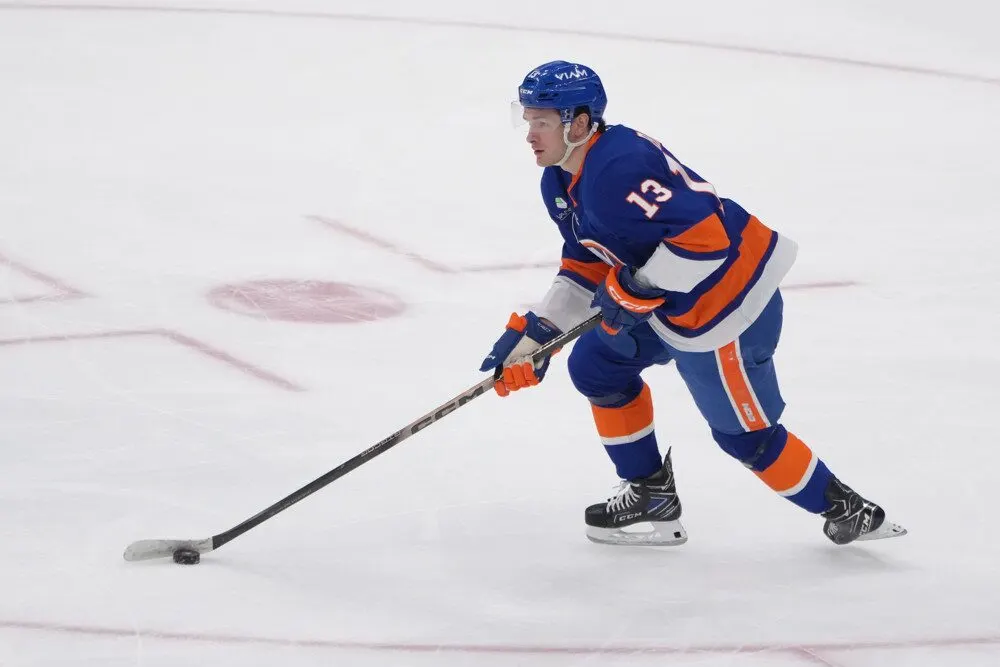

The New York Islanders finished last season looking respectable, and respectable is the most dangerous word in hockey, because it hides everything. A tidy goals-against number and a spot near the playoff picture read as a solid team. Underneath, the Islanders were a 48 percent expected-goals team, out-chanced across the year, and the only reasons the record looked fine were a goaltender having one of the best seasons in the league and a centre quietly dragging the run of play uphill by himself. The goaltender got the headlines. The centre deserves them more.
| Metric | Number | The read |
|---|---|---|
| Points | 72 | A quietly excellent season |
| On-ice xGF% | 58% | The Islanders control play with him out there |
| Team without him | 42% | A sixteen-point on-off swing |
| Games played | 81 | Durable and heavily leaned on |
Start with Mathew Barzal, because his season is the one that gets lost. He posted 72 points, which in a vacuum reads as a good-not-great year for a player of his profile. But look at what happened to the Islanders when he stepped on the ice: they controlled 58 percent of the expected goals with Barzal out there, and 42 without him, a sixteen-point on-off swing that is among the largest of any forward in the league. That is not a compiler padding assists on a good team. That is a driver making a mediocre one dangerous every shift, across a full 81-game workload. Barzal has spent years being talked about as a flashy, frustrating, does-he-do-enough player. The underlying numbers say he is one of the most impactful two-way forwards in the sport, and it is not particularly close.
The Sorokin mirage
Here is why nobody noticed, and it is not complicated.
| Piece | Number | The read |
|---|---|---|
| Team 5-on-5 xGF% | 48% | Out-chanced across the season |
| Ilya Sorokin goals saved above expected | +25.3 | One of the best crease seasons in hockey |
| Barzal on-off swing | +16 | The one skater genuinely tilting the ice |
Ilya Sorokin saved more than 25 goals above expected, one of the three or four best goaltending seasons in the entire league. A crease that good does something specific to a team's record: it turns a 48 percent group into one that finishes with a respectable goals-against total and a plausible-looking spot in the standings. The Islanders allowed 236 goals not because they defended well, but because Sorokin erased the chances they surrendered. Strip his heroics back toward a normal season and the same roster is a lottery team, because the underlying play, the 48 percent, is what the Islanders actually are.
This is the trap the front office has to see clearly. A team that overachieves on goaltending looks, in the standings, exactly like a team that is genuinely good, and the temptation is to run it back and expect the same result. Sorokin is 30. Asking him to save 25 goals above expected every year just to keep the Islanders at the cut line is not a plan. It is a wish, and wishes at the goaltending position have a way of expiring at the worst possible time.
The one genuinely encouraging development
If there is a reason for optimism beyond Barzal and the crease, it is on the blue line, and it is young. Matthew Schaefer, the defenceman the Islanders are about to pay franchise money, posted 59 points and a 54 percent share as essentially a rookie, dragging the back end uphill the way Barzal does the forward group. Two players tilting the ice against the current is more than most bad-possession teams have. The problem is everyone else.
The rest of the roster is the problem
Look past Barzal, Schaefer and a solid Bo Horvat season (57 points, 31 goals) and the Islanders thin out fast. Jean-Gabriel Pageau was on the ice for just 38 percent of the expected goals against a team that was 51 without him. Ryan Pulock, a trusted top-four defenceman, sat at 39. Anders Lee remains a useful net-front presence but is deep into his thirties, and the depth scoring behind Horvat is ordinary. This is a roster with two genuine drivers, a competent veteran core, and a bottom half that hands the chances back, which is the exact recipe for a 48 percent team that only looks fine because of its goalie.
Bo Horvat and the money question
There is a live contract subplot here too. Bo Horvat carries a heavy cap hit and is the kind of good-not-great veteran centre whose deal looks weightier every year, and the Islanders have to decide whether he is part of the solution or a movable asset that could return the middle-six help and draft capital a thin roster needs. In a vacuum, 57 points and 31 goals is a fine season. On a 48 percent team with two young drivers to build around, the more useful question is whether that money is better spent reinforcing the bottom six that keeps giving the play back. These are the decisions that separate a team that turns a Barzal-and-Sorokin core into something real from one that keeps treading water and calling it progress.
The fixable version
It is worth spelling out what the good version of this team looks like, because it is closer than the 48 percent suggests. The Islanders already have the two hardest things to acquire: a driving forward in Barzal and a driving young defenceman in Schaefer, both signed and both entering their primes. The gap is the middle of the roster, the second scoring line and the third pair that currently hand the play back. Those are addressable with cap space and a trade or two, and a front office that reads the underlying numbers correctly would spend this year converting the Horvat contract and the aging depth into the shot-suppression and secondary scoring the team lacks. Do that, and Sorokin stops being a life raft and becomes a luxury on a team that no longer needs saving. The raw material for a real playoff club is here. It just has to be assembled around the two players actually driving the bus, rather than around the goaltender papering over everyone else.
What it means going into the season
The Islanders enter the year with an uncomfortable choice about their own identity. The optimistic read is that Barzal and Schaefer are both entering their primes, that a full season of the two of them tilting the ice pulls the underlying number up, and that Sorokin does not have to be superhuman if the team in front of him improves. The pessimistic read is that this is a middling possession team that has been papering over the cracks with an elite goaltender, and that when he regresses even to merely very good, the whole thing sags toward the bottom of the East.
Both can be managed, but only if the front office is honest about which team it has. What should not be in doubt any longer is Barzal himself. He is not the enigma the narrative made him. He is one of the best drivers in hockey, stuck on a team that needed a historic goaltending season to look average, and the sooner the Islanders build around that truth instead of the mirage, the better their chances of being genuinely good rather than merely looking it.