
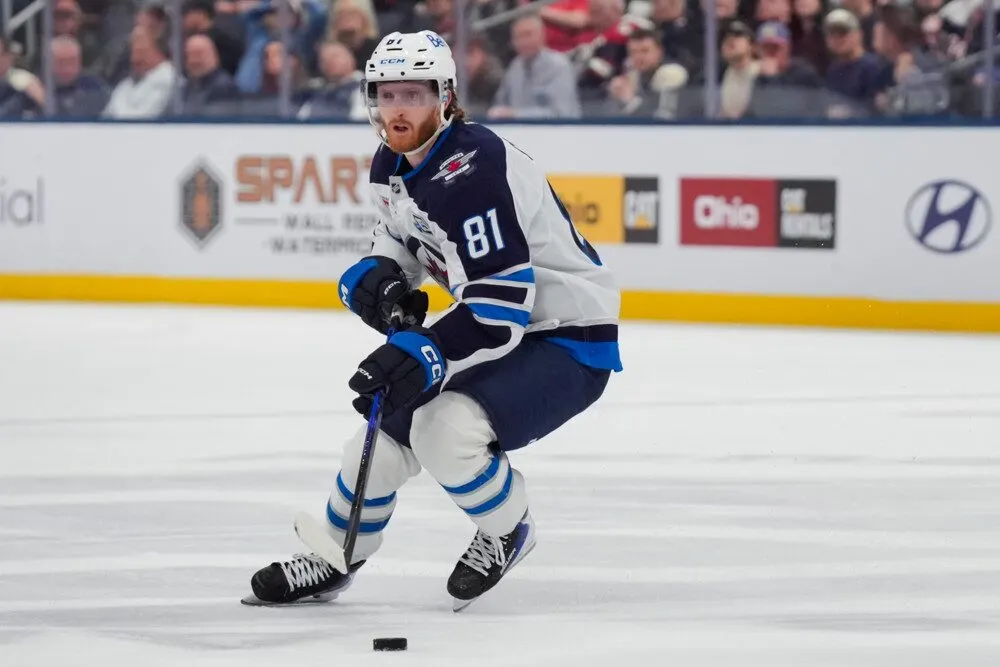

Winnipeg's collapse from the Presidents' Trophy to the lottery was the story of the offseason, and I have spent a fair bit of it explaining the reasons: a goaltender who came back to earth and a 103-point centre who barely moved the even-strength needle. It is worth finishing the thought with the Jet whose game did not crater, because in the wreckage of a lost season, Kyle Connor quietly made the strongest case of anyone on the roster for being the man Winnipeg builds around.
| Player | Points | Goals | On-ice xGF% |
|---|---|---|---|
| Mark Scheifele | 103 | 36 | 55% |
| Kyle Connor | 92 | 39 | 54% |
| Gabriel Vilardi | 69 | 30 | 56% |
| Josh Morrissey | 55 | 14 | 54% |
Connor scored 92 points and 39 goals, which alone makes him one of the better wingers in the league. But the number that matters is what happened around him. With Connor on the ice across all situations, Winnipeg controlled 54 percent of the expected goals and 44 without him, a plus-ten swing. Set that beside Mark Scheifele, who posted more points but whose even-strength impact was essentially neutral, and the picture sharpens. Winnipeg has two stars who score in bunches. The one whose all-around game held up better as the team fell apart was the winger, not the centre everyone names first.
The contrast that should reshape Winnipeg's thinking
Be precise here, because it matters. Neither of Winnipeg's stars is a shutdown, Selke-track force at five-on-five; both are finishers first. But Connor's all-situations impact outpaces Scheifele's, and his 39-goal shot is the more portable weapon, the kind of skill that keeps producing even when a team around it is struggling. When I broke down Scheifele, the point was that his 103 points hid a neutral even-strength driver on a sheltered, power-play-fuelled diet. Connor's profile is the healthier one: elite goal-scoring, a genuinely positive on-off, and a game that did not evaporate when Winnipeg's season did. If the Jets are quietly asking themselves which forward to prioritise as they retool, the data leans toward Connor, and that is not the intuitive answer.
The team around them is still the problem
None of this means Winnipeg is a Connor away from fixing itself. The Jets were a 48 percent team, which is to say even Connor's positive on-off came on a mediocre group, and the collapse was real and structural. The goaltending regressed from otherworldly to human, the depth thinned, and losing Nikolaj Ehlers to Carolina in free agency took a genuine driver out of the top six. Gabriel Vilardi (69 points, a 56 percent share) and Josh Morrissey on the back end are real pieces, but the bottom of the roster is where the Jets bled, and no single winger patches that. Winnipeg's problem was never a lack of high-end scoring. It was everything underneath it.
The season-preview question
Which is why the Jets enter the season at a genuine crossroads, the same one that has kept Connor Hellebuyck's name in trade rumours all summer. Winnipeg has to decide what it is: a team that retools quickly around its best players and chases another window, or one that acknowledges the Presidents' Trophy core has peaked and begins to reshape. Either path runs through getting the priorities right, and the first priority is recognising that Connor, not Scheifele, is the forward whose game most clearly justifies a long-term build. Pair that with a stabilised crease and reinforced depth, and the Jets bounce back. Cling to the old hierarchy, and they misallocate their way into another disappointing year.
The honest caveat
Fairness demands two notes. Connor's edge over Scheifele narrows at five-on-five, where a chunk of his all-situations shine comes from the power play, so this is a matter of degree, not a night-and-day gap. And one strong underlying season on a bad team is a data point, not a coronation; a single year does not overturn everything. But across the wreckage of Winnipeg's collapse, the winger is the star whose game held up, and that is worth weighing more heavily than the point totals or the depth-chart order suggest.
The cornerstone question, in plain terms
Strip away the Scheifele comparison and the core decision is simple. Connor is a 39-goal scorer with a positive underlying impact, signed for term, in the meat of his prime, and he is the safest long-term bet among Winnipeg's forwards to keep producing as the roster changes around him. Elite goal-scoring is the most portable skill in hockey; it survives coaching changes, linemate churn and rebuilds in a way that playmaking-dependent or possession-dependent games do not. If the Jets are choosing where to point their cap and their identity over the next five years, a winger who scores 40 and lifts his line is a more durable foundation than a centre whose value is tied to a power play and a specific supporting cast.
What the bounce-back actually requires
None of this is a one-move fix, and it is worth being concrete about the work. Winnipeg needs to settle the Hellebuyck question rather than let it hang over another season, because a team cannot retool while its most valuable trade asset and its goaltending floor are the same unresolved rumour. It needs to replace the two-way presence Nikolaj Ehlers took to Carolina, and it needs to rebuild a bottom six that stopped holding up once the goaltending regressed. Those are solvable problems for a team with this much high-end scoring, but only if the front office spends the next year addressing them instead of assuming last season was a fluke. The Presidents' Trophy version of the Jets was real, and so was the collapse; the truth of what this team is sits somewhere in between, and getting back to the good version starts with building around the right star and fixing the structure beneath him.
What it means
Kyle Connor is the Jet to build around, and the numbers say so even when the narrative and the lineup card point at the centre beside him. Winnipeg's bounce-back does not start with adding a star; it starts with correctly identifying the one it already has, and then rebuilding the supporting structure that fell apart around him. Get that order right, and the collapse was a bad year. Get it wrong, and it was the start of something longer.