
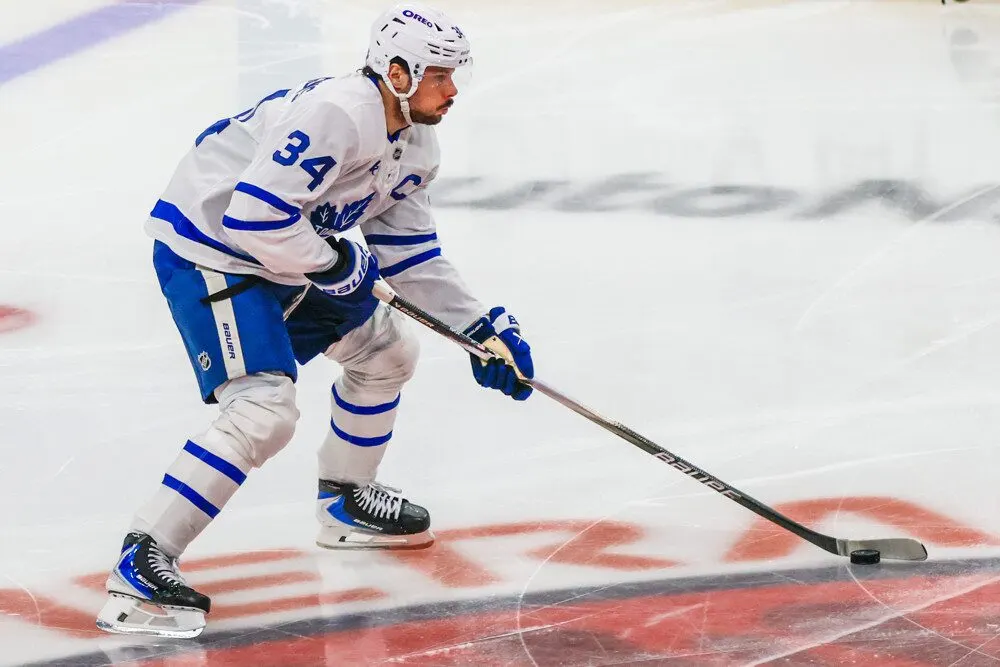

For most of a decade the Toronto conversation has started and ended with its stars, so it is worth being careful here, because last season the stars are the easiest thing to misread. Auston Matthews scored 53 points in 60 games, a total that looks alarming next to a player who has led the league in goals more than once, and the instinct is to reach for a decline narrative or a locker-room story. The numbers point somewhere less dramatic and more useful. Matthews was hurt, he was still good when he played, and the reason the Leafs collapsed has almost nothing to do with him.
| Metric | Number | The read |
|---|---|---|
| Games played | 60 | A season interrupted by injury |
| Points | 53 | Down from his standard on a shortened year |
| On-ice xGF% | 52% | Still driving play at plus-eight on-off |
| Even-strength finishing | In line | 27 goals on 28.7 expected |
The down year is mostly a health year
Matthews played 60 games, not 82, and a counting-stat dip is what missing a quarter of a season looks like. The underlying game held up: with him on the ice, Toronto controlled 52 percent of the expected goals and 44 without him, an eight-point swing that is exactly what you want from a number-one centre. His finishing did not collapse either; he scored 27 goals on 28.7 expected, right in line with the quality of his chances. This is not a player whose skills evaporated. It is a star who missed time and produced like himself when available, and a healthy 82-game version of him remains one of the two or three best two-way centres in the sport.
The stars were not the failure
The Leafs' best players kept doing their jobs. William Nylander posted 79 points and a preposterous 16-point on-ice swing, one of the widest of any forward in the league. John Tavares, deep into his thirties, still drove play at 56 percent. Matthew Knies kept developing into a genuine top-six power forward. Matthews at plus-eight, Nylander at plus-sixteen, Tavares comfortably above water: the top of this lineup tilted the ice hard in Toronto's favour. And the team still controlled just 46 percent of the expected goals overall and allowed 295 goals, the second-most in the entire NHL. When the stars are that good and the team is that bad, the problem is not the stars. It is arithmetic pointing at everyone else.
The blue line is the wound
Here is where 295 goals against comes from, and it is worth naming in detail. Morgan Rielly was the only Toronto defenceman who finished meaningfully above water, at 52 percent, and even that is an offensive defenceman being carried by the forwards in front of him rather than a shutdown anchor. Beneath him the group collapses: Jake McCabe at 44 percent, Oliver Ekman-Larsson at 48, Brandon Carlo at 40, Simon Benoit at 36. A blue line where four of the top six defenders control barely 40 percent of the chances is not a unit any goalie could rescue. It is a structural hole, and it is the actual story of Toronto's season, sitting underneath every headline about the stars.
The crease made it worse
The goaltending offered no cover. Joseph Woll finished nearly seven goals below average and Anthony Stolarz nearly seven below on top of him, which means the Leafs got below-replacement netminding behind a defence that was already leaking. A bad blue line and a bad crease is how a team with this much offensive talent surrenders 295 goals and misses the playoffs. Neither of those failures has anything to do with Auston Matthews, and neither gets solved by asking him to score more.
The cap is pointed at the wrong end of the ice
There is a structural reason the blue line looks like that, and it is a choice. Toronto has spent years committing the bulk of its cap to the forward group, tying up enormous money in Matthews, Nylander, Tavares and a rising Knies, and it has paid for that concentration everywhere else. The result is a defence corps assembled from mid-tier veterans and reclamation projects rather than a real top pair, and a goaltending tandem built on hope. You cannot pay four forwards like franchise players and also ice a championship blue line under a hard cap; something has to give, and in Toronto the thing that gives has always been the same. It is the inheritance the front office keeps declining to confront.
Which is why the McKenna era starts with a caveat
Toronto's answer to the collapse arrived at the draft in Gavin McKenna, a genuine franchise talent. But as I wrote when the pick landed, a rookie winger does not repair a bottom-five defence or a crease that surrendered nearly 300 goals. McKenna makes an already-good offence better and does nothing for the two-thirds of the ice where Toronto actually broke, which means he deepens precisely the part of the roster that was already the strength. It will be spectacular to watch and largely beside the point in the goals-against column.
What a fix actually costs
The uncomfortable part is that fixing Toronto is expensive and specific. This is not a team a depth signing repairs. It needs a genuine top-pair defenceman who can take the hardest minutes off Morgan Rielly, and it needs a starting goaltender who is a plus rather than a minus, and both cost real money or real assets in a market where Toronto has little cap room and a thin prospect cupboard after years of win-now moves. That likely means trading from the forward surplus, the one place the Leafs are overstocked, to buy the defence they lack. It is the trade the team has flinched from for years, because making it means admitting the roster was built lopsided. Until the front office does, the pattern simply repeats: elite offence, porous defence, an early exit, and a summer spent asking why.
What it means
The honest read cuts both ways. Do not overreact to Matthews; the down year was a health year, and a healthy version of him is still elite. But do not let his bounce-back paper over the real issue. Toronto can get 82 games and 45 goals from Matthews, a Calder season from McKenna, and 80 more points from Nylander, and still miss if it allows 290 goals again. The stars are not the question. Whether the front office finally spends on the blue line and the crease instead of the forward group is. Matthews can carry a lot. He cannot carry a defence that is not there, and until Toronto builds him one, the most talented offence in the division will keep watching the spring from home.