
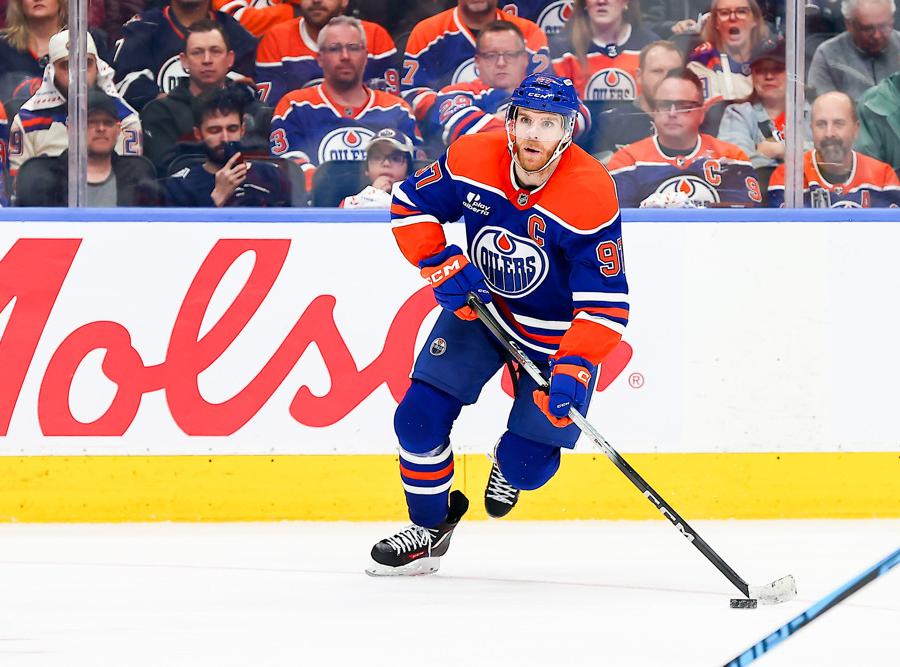

The biggest question hanging over the offseason answered itself quietly: Connor McDavid re-signed in Edmonton, and he did it on a short, team-friendly deal rather than a max-term fortress of a contract. Two years, structured to give the Oilers room to build. Read past the cap gymnastics and the message is blunt. McDavid is not asking for patience anymore. He has handed the franchise a deadline, and the number that matters is not his salary. It is the two.
| Metric | Number | The read |
|---|---|---|
| McDavid points | 138 | Led the league by a distance |
| Oilers with McDavid on the ice (xGF%) | 62% | A juggernaut whenever he plays |
| Oilers as a 5-on-5 team | 52% | Good not great once he sits |
| Oilers without McDavid (xGF%) | 42% | The floor falls out |
He has never been the problem
Let us put one lazy narrative to bed. Whatever has gone wrong in Edmonton the last two springs, it has not been the captain. McDavid put up 138 points and, more tellingly, the Oilers controlled 62 percent of the expected goals with him on the ice, the kind of number that belongs to a title team. The instant he steps off, Edmonton falls to 42 percent, a twenty-point collapse that is among the most dramatic in the league. That is not a player being carried. That is a player carrying a roster that cannot hold the rope when he rests.
The rest of the team is only good
Here is the uncomfortable middle of the story. Edmonton as a whole controlled 52 percent of the expected goals last season. That is a fine number, and a pedestrian one for a team built around two of the best offensive players of their generation, and it is down for the second year running. Leon Draisaitl remains a monster in his own right, a 97-point force who posts the same kind of on-ice dominance McDavid does. And yet the team-level share keeps sliding toward the middle of the pack, because the supporting cast, the depth scoring and the defensive structure behind the stars, has thinned while the top of the roster stayed historically great. The Oilers have been papering over an ordinary team with two extraordinary players, and last season the paper started to show.
The crease was a patch, not a cure
Give the front office credit for naming one problem: it spent the summer trying to fix a goaltending picture that had quietly cost the team, bringing in new options to stabilize the net. That helps. It also does not touch the deeper issue, which is not who stops the puck but how many quality chances Edmonton surrenders to begin with. A 52 percent team with better goaltending is still a 52 percent team, and 52 percent is not what a McDavid-Draisaitl core is supposed to produce. The save percentage was a symptom. The chances against are the disease.
A two-year window, by design
That is what makes the short extension so pointed. McDavid could have taken the security. Instead he took the term that keeps the pressure on, and the front office now has a hard, self-imposed clock: build a genuine contender around him in the next two years, or watch the most valuable asset in hockey approach another decision with far less goodwill. The good news is that the fix is not the hard part of team-building. Edmonton does not need to manufacture a superstar; it has two. It needs the boring, expensive middle, the shutdown defencemen and the two-way depth that turn a 52 percent team into a 55 percent one, which in a league this tight is the difference between a second round and a parade.
What the number is really saying
Strip away the contract news and the season-preview chatter, and the data leaves Edmonton with a clean, brutal summary. The stars are still the best in the world. The team around them is average and drifting. And the player who could have spent this summer protecting himself instead bet two more years on the people whose job is to fix that. He has done his part, again. The next move belongs entirely to the Oilers, and this time McDavid has made sure they cannot take their time.