
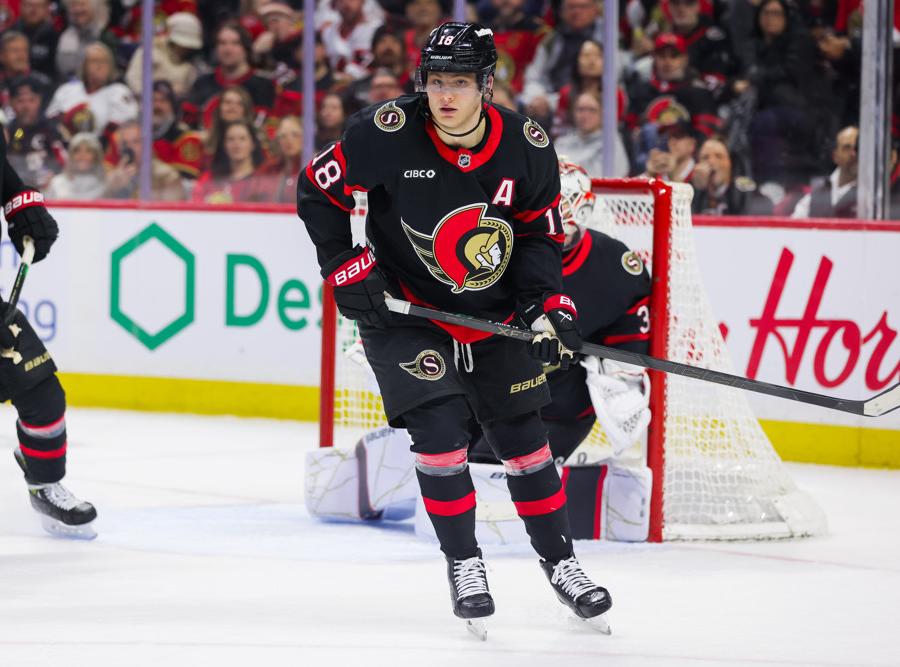

If you ranked all 32 teams by the single stat that best predicts future success, the share of expected goals a team controls at five-on-five, you would find the usual suspects at the top. Colorado. Carolina. And then, higher than almost anyone outside the city expects, Ottawa.
The Senators posted the third-best expected-goals share in the entire league last season. Not third in their division, not third among the up-and-comers. Third in hockey, ahead of Vegas, ahead of Dallas, ahead of every team but the two that met deep in the spring. A team most people file under "young and promising" actually drove play like a finished contender. And it finished with 99 points and a wild-card seed, because one thing dragged the whole enterprise down.
| Metric | Number | What it means |
|---|---|---|
| 5-on-5 expected-goals share | 55% | 3rd in the NHL |
| Standings points | 99 | Good not great - a wild-card seed |
| Goals against vs expected | -24 | Goaltending cost them two dozen goals |
| The fixable flaw | Ullmark | A former Vezina winner due to bounce back |
There is the culprit, third row. Ottawa allowed roughly 24 more goals than the quality of the chances it gave up would predict. That is not a defence problem, the Senators suppressed chances at a top-three rate. That is a goaltending problem, and it has a name: Linus Ullmark, a former Vezina winner, posted a genuinely poor season by his own high standard, and the team paid for it in the standings one soft goal at a time. Twenty-four goals is the gap between a 99-point wild card and a division winner. Ottawa left an entire tier of the standings in its own crease.
Why this is the good kind of problem
Every team has a flaw. What separates the sleepers from the pretenders is which flaw. If Ottawa's problem were the opposite, a team that got out-chanced but got bailed out by hot goaltending, you would tell them to panic, because chance-suppression is hard to build and goaltending is impossible to count on. The Senators have exactly the reverse. They have already built the hard thing, a genuine, repeatable, top-three ability to control the run of play, and their flaw is the one input in hockey most likely to correct itself.
Goaltending regresses toward the mean harder than anything else in the sport, and it regresses in both directions. Just as Buffalo's elite crease is likely to cool, Ottawa's poor one is likely to warm. Ullmark has a Vezina on his shelf; goalies of that pedigree rarely follow a down year with another one. Even a return to merely league-average goaltending, forget his ceiling, would add most of those two dozen goals back, and a 55 percent team that gets average goaltending is not a wild card. It is a contender.
The team underneath is real
This is not a projection built on one number. Ottawa's play-driving is powered by a forward group that is arriving all at once. Brady Tkachuk was on the ice for 62 percent of the expected goals at five-on-five, one of the very best marks of any forward in the league, the total-package power forward every contender covets. Dylan Cozens drove play at a 61 percent clip. Claude Giroux, in his veteran years, still tilted the ice at 58 percent. That is not one line getting hot. That is a deep, deliberate, two-way group that controls games from the top of the lineup down, the kind of core that wins playoff rounds once the goaltending stops actively working against it.
The honest caveat
Betting on a bounce-back is still a bet. Ullmark is on the wrong side of 30, and there is a version where his down year was the start of a decline rather than a blip. If the goaltending does not recover and the front office does not address it, Ottawa can absolutely run back a 99-point season and call it a plateau. The point is not that improvement is guaranteed. It is that the Senators need only ordinary goaltending, not a miracle, to jump a tier, whereas most teams chasing them need to build something from scratch.
The bottom line
Ottawa is the most interesting sleeper in hockey, and it is not close. Most teams that want to take a leap have to build something, a defence, a second scoring line, a franchise goalie. The Senators have already built the thing that is hardest to build and easiest to trust, a top-three ability to control play, and their only real weakness is the one that most reliably fixes itself. Bet on goaltending regression breaking Ottawa's way, and a 99-point wild card turns into a team nobody in the East wants to see in April. The standings called them good. The numbers underneath call them dangerous, and the numbers underneath are usually right first.