
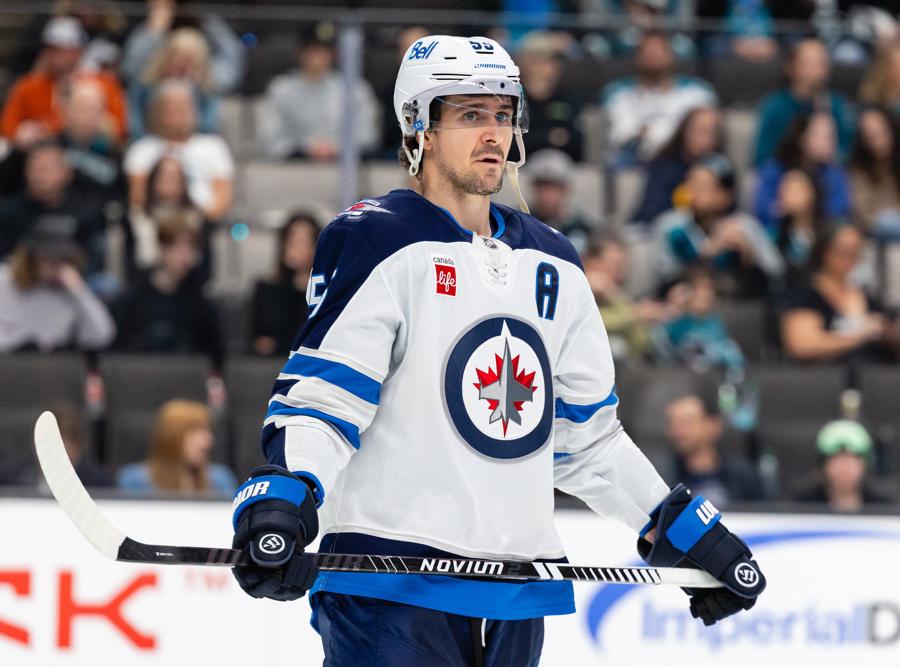

A week ago I made the case that Connor Hellebuyck wasn't the reason the Jets collapsed, that behind the ugly .895, he was still a good goalie drowning in volume. Which leaves an obvious follow-up: if it wasn't the goalie, what sank a team that had won the Presidents' Trophy the year before? Start with the guy who scored 103 points.
That sounds backwards. Stay with me.
| Situation | Points | On-ice xGF% | The read |
|---|---|---|---|
| All situations | 103 | 55% | Elite production - top 10 in the NHL |
| Power play | 21 | 91% | An elite man-advantage weapon |
| 5-on-5 | 65 | 48% | Below break-even - on 70% offensive-zone starts |
Mark Scheifele had a monster season on the scoresheet, 103 points, 36 goals, a top-ten finish in league scoring. On the surface he was Winnipeg's engine, the franchise centre doing franchise-centre things. Under the hood, the picture is stranger and more revealing: at five-on-five, the Jets controlled just 48 percent of the expected goals with Scheifele on the ice. Below break-even. For their best forward.
The shelter makes it worse, not better
The instinct is to blame the team around him. Fair, except the deployment cuts the other way. Winnipeg did not ask Scheifele to grind through tough defensive minutes; they buried him in the offensive zone. Seventy percent of his five-on-five shifts started in the attacking end, the plum assignment you hand a player you want feasting on offense while someone else takes the hard starts. And even from that head start, the Jets got out-chanced with him out there.
Then there is the tell that should worry Winnipeg most. When Scheifele was off the ice at five-on-five, the Jets ran a 47 percent expected-goals share. On the ice, 48. He barely moved the needle. Their franchise centre did not tilt the ice; he stood on it while the team played about as well, or as poorly, as it did without him.
So where did the 103 come from?
Two places, and both are genuine skills that flatter the underlying game. First, the power play, where Scheifele is legitimately elite, 21 points on a unit that ran a 91 percent expected-goals share. That is the number dragging his all-situations mark up to a respectable-looking 55 percent. Strip the man advantage away and the even-strength truth is that 48.
Second, finishing. Scheifele scored 36 goals on 27.8 expected, beating his chances by eight, the kind of elite sniping that turns good looks into goals. Also real. Also not the same as driving play. Put it together and you get a portrait of a specific kind of player: a sheltered, elite-finishing, power-play-dependent scorer whose even-strength impact is roughly neutral. That is a very valuable hockey player. It is not the two-way, ice-tilting number-one centre that "103 points" makes you picture.
This is a roster pattern, not a takedown
And it is not just him, which is the actual point. Kyle Connor scored 92 points on the same team with the same profile, a 48 percent on-ice share at five-on-five, a 47 without him. Winnipeg's two best forwards combined for 195 points and, at even strength, moved the play almost not at all.
That is the diagnosis the Presidents' Trophy hid. A team can win a mountain of regular-season games when its stars are burying their chances and its goalie is stopping everything, and Winnipeg did exactly that the year before, riding elite finishing and vintage Hellebuyck to the best record in hockey. But an offense built on sheltered scorers who do not control the run of play has no floor under it. The moment the shooting cooled and Hellebuyck's save percentage regressed to merely human, there was nothing holding the team up, because the underlying five-on-five game was never as good as the banner suggested. The collapse was not a fluke. It was the bill for a roster that scored more than it deserved to, and then stopped.
Why it matters now
This is the real backdrop to Winnipeg's crossroads summer. The Hellebuyck trade talk, the Stuart Skinner signing, the sense of a team unsure what it is, all of it traces back to a group that has to decide whether its expensive, aging, high-scoring core is a foundation or a very good-looking ceiling. Scheifele is 33. He will keep scoring; elite finishers and power-play brains age better than most players. But if Winnipeg is waiting for him to start driving even-strength play at this stage of his career, that is not a bet the numbers support.
The fix is not trading the 103-point man, you do not give away production like that. It is being honest about what he is and building the rest of the roster to cover for it: adding the two-way centres and shot-suppressing defencemen who tilt the ice, so the stars can keep doing the one thing they do brilliantly without the entire team's floor depending on the puck going in.
The bottom line
Mark Scheifele's 103 points were real, and so was Winnipeg's collapse, and the reason both can be true is that scoring and play-driving are different things, and the Jets, for a while, got to pretend they were the same. They are not. Scheifele is an elite scorer and a neutral even-strength player, sheltered and power-play-fueled, and a team leaning on him and Kyle Connor to be its engine looks like a juggernaut when the shooting is hot and a lottery club when it is not. Winnipeg has now been both, two years running. The 103 points were never the thing to watch. The 48 percent was.