

 Colorado Avalanche
 Buffalo Sabres
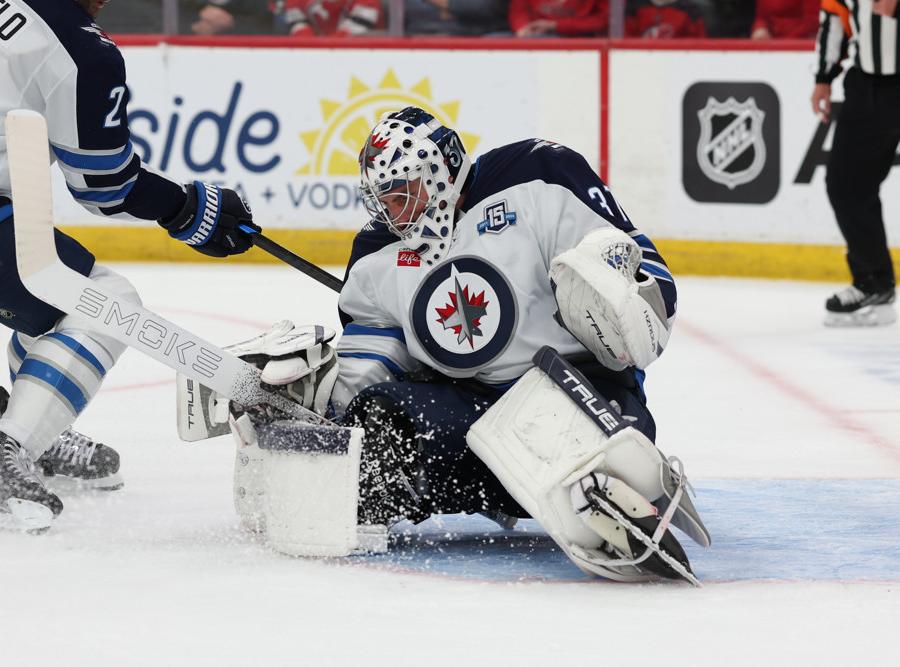
Every trade conversation about Connor Hellebuyck starts with the same number, and it is the wrong one. Point eight nine five. His save percentage last season, the worst of his career by a distance, the stat that turned a reigning MVP into a "what's wrong with him" story and knocked the floor out of his trade value. Buyers see .895 and see a 33-year-old sliding off the back of his prime. The Winnipeg Jets see a three-time Vezina winner and want a return to match. The truth is somewhere in that gap, and it is stranger and more useful than either side is letting on.
Because here is what the .895 does not tell you: by the expected-goals math, Hellebuyck still stopped more pucks than an average goalie would have on the same shots. He just did it in the weirdest way imaginable - and the weirdness is the whole story.
First, the fall is real
No sense pretending otherwise. This was not a blip.
| Season | GP | Save % | GAA |
|---|---|---|---|
| 2020-21 | 45 | .916 | 2.58 |
| 2021-22 | 66 | .910 | 2.97 |
| 2022-23 | 64 | .920 | 2.49 |
| 2023-24 | 60 | .921 | 2.39 |
| 2024-25 (Hart Trophy) | 63 | .925 | 2.00 |
| 2025-26 | 57 | .895 | 2.86 |
That is a thirty-point save-percentage drop in a single year, from a .925 that won him the Hart Trophy to a .895 that would not crack the league's top thirty. You do not wave that away with "small sample." Something happened. The question every GM is actually asking - the one his price depends on - is whether that something is Hellebuyck, or everything in front of him.
And notice the five years above that bottom line. From 2020-21 through his MVP season, he never once dipped below .910. Half a decade of elite, boring consistency, then one cliff. When a track record that long meets a single outlier, the smart money interrogates the outlier before it rewrites the book on the player.
The number that flips it
Save percentage is a blunt instrument. It treats a harmless wrist shot from the point the same as a cross-ice one-timer off a broken play, which is madness, because those are not the same save. Expected goals fixes that. It looks at every shot a goalie faced, asks how likely an average netminder was to stop it, and totals it up. The gap between that number and the goals actually allowed is Goals Saved Above Expected - the closest thing hockey has to an honest goalie grade.
Winnipeg bled shots and chances as it cratered from a Presidents' Trophy to out of the playoffs, and Hellebuyck faced 1,547 of them. He was expected to allow 167.5 goals. He allowed 162. That is a plus-5.5. Above average, on a .895, behind a team falling apart.
Let me be honest about what plus-5.5 is and is not, because this is where lazy analysis picks a side and runs. It is not elite. The goalies who actually stole the league last year lived in a different tier - Washington's Logan Thompson at plus-29, Boston's Jeremy Swayman right behind him, Andrei Vasilevskiy in Tampa Bay and Ilya Sorokin on Long Island north of plus-24. Vintage Hellebuyck belongs in that group. Last year's did not. So this was not secretly a great season wearing a bad disguise. It was a genuinely down year. Both things are true at once: below his standard, and still better than the average starter. The .895 makes it look like a collapse. It was a dip.
The reason it is a recoverable dip is in how the goals actually got scored.
He saved the hard ones and leaked the easy ones
This is the part nobody is talking about, and it is the part that should set his price.
| Shot type | Shots faced | Goals allowed | Expected | Saved vs expected |
|---|---|---|---|---|
| High-danger | 194 | 39 | 60.6 | +21.6 |
| Medium & low | 1353 | 123 | 106.9 | -16.1 |
| Total | 1547 | 162 | 167.5 | +5.5 |
Start with the top line. Hellebuyck faced 194 of the nastiest chances in the sport - point-blank, cross-crease, broken-play stuff - and allowed 39 goals against an expected 60.6. He saved twenty-two more than expected on exactly the shots that are supposed to beat a goalie. That is not good. That is elite. That is prime-Vezina work on the chances that decide games.
Now the bottom line. On the medium- and low-danger shots - the ones a starting goalie is simply supposed to stop - he allowed sixteen more than expected. He leaked on the gimmes.
Sit with how backwards that is. When a goalie genuinely declines, he loses the hard saves first. The reflexes dull, the post-to-post push slows, and the highlight-reel chances start finding twine. The routine stuff is the last thing to go. Hellebuyck did the opposite. He was still Superman on the plays that demand Superman and merely human on the ones a backup handles half-asleep. That is not the signature of a body breaking down. It is the signature of a goalie drinking from a firehose of high-danger volume on a bad team - a career-heavy diet of quality chances - and losing a half-step of focus on the forgettable shots in between. Fatigue, volume and a little variance look exactly like this. Skill erosion looks like the reverse.
There is one more tell in the situational split. At five-on-five, Hellebuyck graded out almost dead even - a hair above expected. Which means the bulk of his positive number came shorthanded, on a penalty kill that was on the ice constantly as Winnipeg took penalties and chased the game. A goalie losing it does not hold the fort on the kill. He did.
I will not tell you a bounce-back is guaranteed - goalies are voodoo, and anyone speaking in certainties about them is selling something. But if you are betting, you bet on the netminder who kept his rarest, hardest skill and misplaced his most replaceable one, behind the worst version of his team in a decade. That bet cashes more than it burns.
So who actually wants him?
Here is where the consensus gets sloppy. The dream landing spot everyone floated was Colorado - the 121-point juggernaut whose one eternal flaw is goaltending. Except that story is a year stale. Colorado's Scott Wedgewood quietly posted a plus-23 GSAx last season, better than all but a handful of goalies alive. The Avalanche do not need to hand over a king's ransom for a bounce-back when they already have someone playing like a top-five goalie. If they call, it is a luxury, not a need - and luxuries do not pay retail.
Buffalo is the cleaner fit, and it is not close. The Sabres just clawed back into the playoffs and have nothing in net within a postal code of Hellebuyck's ceiling. A rising team with a goaltending hole and a window worth forcing open is exactly who should be aggressive here - which is precisely why the deal that nearly happened before the draft was a Buffalo deal, not a Colorado one. If it flickers back to life, that is the marriage that makes sense.
The rest of the market is doing what markets always do with a down year: pricing the twelve months they can see and ignoring the eight seasons before them. Winnipeg's problem is that it is trying to sell the .925 while everyone else is buying the .895, and the actual player - a still-excellent goalie who had a hard, recoverable year behind a broken team - sits in a spot neither number captures. That is why nothing has closed. Both sides are arguing about the wrong stat.
The bottom line
Connor Hellebuyck had the worst season of his career, and it was not a fluke - the underlying numbers agree he was ordinary by his own towering standard. But ordinary by Hellebuyck's standard is still an above-average NHL starter, and the shape of the year - elite where it is hard, leaky where it is easy, buried in volume, steady on the kill - is the recoverable kind, not the terminal kind. Whoever lands him is not buying the .895 or the .925. They are buying the bet that a great goalie behind a real defense looks a lot more like the man who won the Hart than the one who missed the playoffs.
On this evidence, that is a bet worth making. Winnipeg just has to decide whether it believes it too, because right now the Jets are the only team in the league still pricing him like the MVP he was rather than the reclamation project the box score says he became. He is neither. He is a very good goalie who had a bad year for reasons that mostly were not him - and somebody is going to get paid for figuring that out first.