

 Anaheim Ducks
For eight years the Edmonton Oilers had the same problem and never solved it. This season they chased it in real time - benched the goalie who backstopped two Cup runs, brought in another and waived him, made an emergency trade for a third, handed the net to a fourth - and still lost in the first round, and still fired the coach. And then, across nine days in late June and early July, Stan Bowman did what no Edmonton regime had done in the McDavid era: he hired a new bench boss, moved the contract everyone said was immovable, and rebuilt the crease around a goaltender who had just won the Stanley Cup.
Whether it's enough is the only question left. But for the first time in years, Edmonton's summer attacked the actual problems instead of the margins. This is the story of a season that exposed the flaw, and an offseason that finally went after it.
The Two Best Players in Hockey, and the Lowest Points Percentage in Eight Years
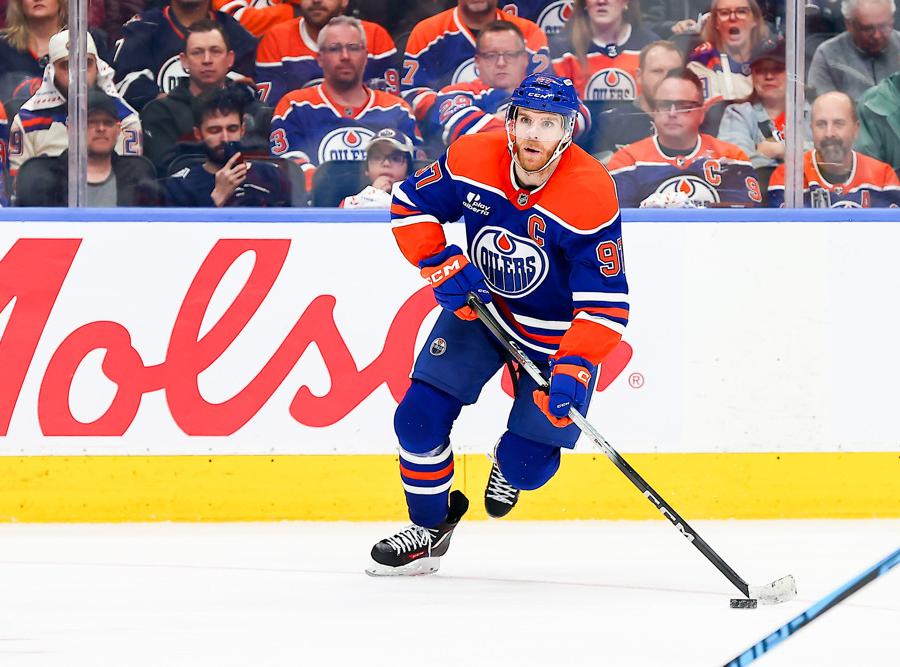
The talent was never in doubt. McDavid scored 48 goals and added 90 assists for 138 points - a sixth Art Ross, his 400th career goal, a ninth 100-point season. Leon Draisaitl reached the 1,000th point of his career and was running at a 97-point pace in 65 games before a lower-body injury cost him the final 14 of the regular season. Their 235 combined points were the most of any duo in the Western Conference, and the power play they drive finished first in the NHL at 30.6 percent.
And the team around them finished 41-30-11 - 93 points, the lowest points percentage of the entire McDavid era. The tell was underneath the scoring: Edmonton's five-on-five expected-goals share fell from 55.1 percent the year before to 50.8 percent, a coin flip. The league's best power play concealed a merely average even-strength team all winter. In the playoffs, when the power play went quiet, there was nothing underneath it.
Four Goalies, One Emergency Trade, and an Answer That Arrived Too Late
Give the front office this: they never pretended the crease was fine. They spent the whole year auditioning it. Stuart Skinner opened as the starter and lost the job during the season. Calvin Pickard was brought in to compete and placed on waivers in February. When the position cratered, Edmonton made an emergency trade for Tristan Jarry - who would start Game 4 of the first round and allow four goals on 38 shots in an overtime loss. Only on March 15, the very day Draisaitl went down, did Connor Ingram finally settle the net, good enough in the regular season (16-10-3, 2.60 GAA, .899) to earn a Bill Masterton nomination.
Then the playoffs came and his numbers fell off a cliff: a 3.86 goals-against average and a .876 save percentage across five starts. That is the whole eight-year problem in one line. The goalies themselves weren't the failure - the failure was that a Cup contender needed four of them in a season and still didn't have an answer standing when it mattered.
A Franchise Can React All Year and Still Not Fix the Thing That Breaks It
Skinner benched. Pickard waived. Jarry acquired in an emergency and shelled in Game 4. Ingram handed the crease in March, four months too late to settle it before the playoffs. Four goalies is not depth - it's a season-long search party that never found what it was looking for. The in-season churn didn't fix the crease; it documented, in exhaustive detail, that the crease had to be fixed from outside. That's the job the summer inherited.
Anaheim Scored on Half Its Power Plays. That Was the Series.
The first round didn't turn on goaltending in a vacuum. It turned on a penalty kill that collapsed and a roster that ran out of healthy bodies. The younger, cheaper Anaheim Ducks - coached by Peter Quenneville, backstopped by Lukas Dostal - won the series four games to two while scoring on 8 of 16 power plays, a preposterous 50 percent, with a power-play goal in every game. Edmonton's kill, one of the league's best in the regular season, broke the moment its key penalty-kill forwards went down: Adam Henrique was hurt in Game 1 and never returned, and Jason Dickinson played through injury.
The stars were compromised too. McDavid played on an ankle injury. Draisaitl returned from his lower-body issue but wasn't at full health. Hyman was hurt. Ekholm was limited. Two of the best players alive, dragging an injured, penalty-kill-broken team against a healthy opponent that scored every time it had a man advantage - it did not work, and the way the roster was built, it was never going to.
Nine Days That Attacked Every Problem the Season Exposed
Here is where the story turns. Start behind the bench: on June 23, Edmonton hired Mike Babcock as head coach, with D.J. Smith joining as associate - a decisive, and yes controversial, tactical answer to a team whose structure had regressed for two years. That was the easy lever. The hard ones came next.
On July 1, Bowman solved the contract this very publication would have told you was stuck. Darnell Nurse - traded to the San Jose Sharks, his full $9.25 million cap hit cleared with no salary retained, with young defenceman Shakir Mukhamadullin and prospect Zack Sharp coming back. The minus-12, big-money albatross was simply gone, and the cap space it freed did the rest of the work. Then he rebuilt the crease from outside, exactly as the season demanded: he acquired 24-year-old Devon Levi from Buffalo for a third-round pick, and a day later signed Frederik Andersen - 36 years old, a career .913 save percentage, and the reigning Stanley Cup champion in net for Carolina - to a one-year deal. Add Ryan Shea, one of the league's better penalty-killing defencemen, on a five-year deal, and the exact hole Anaheim exploited got addressed too.
| Move | Player | Detail |
|---|---|---|
| Hired | Mike Babcock | New head coach · D.J. Smith associate (Jun 23) |
| Traded out | Darnell Nurse | To San Jose · full $9.25M cleared · no retention |
| Acquired | Mukhamadullin + Sharp | Young defenceman + prospect back in the Nurse deal |
| Acquired | Devon Levi | Goalie · 24 · from Buffalo for a 3rd-round pick |
| Signed | Frederik Andersen | Goalie · 1yr/$2.8M · reigning Cup champion |
| Signed | Ryan Shea | Defence · 5yr/$4M · elite penalty killer |
| Re-signed | Kapanen / Murphy / Dickinson | Depth locked up (Murphy & Dickinson five years each) |
“We're certainly trading away a very good player in Darnell who ate up a lot of minutes, so we've got two defencemen now coming in who bring different elements to the table. All in all, it's going to be a big boost for our defence.”
— Stan Bowman, Oilers GM, on the Nurse trade and the July 1 reset
They Finally Went After the Right Problems. Now It Has to Work.
For once, the summer's to-do list and the summer's moves match. The goaltending that has haunted every McDavid-era spring got a genuine outside answer in Andersen, with Levi's upside and a returning Tristan Jarry behind him. The Nurse contract that looked immovable is off the books entirely, no retention. The penalty kill that Anaheim torched added a specialist in Shea. The coach who couldn't stabilise the structure was replaced by one whose whole reputation is structure. That is not tinkering at the margins. That is the hard reset the last eight years kept asking for.
The bet is not risk-free. Andersen is 36 and durability has never been his friend; Levi has spent his recent success in the American League, not the NHL; Babcock is a gamble on tactics over temperature. But the alternative - running it back with the same crease and the same contract and the same system - is exactly what produced a first-round exit. McDavid is 29. Draisaitl is 30. The window that produced two runner-up banners is narrowing, and this is the summer Edmonton finally spent it on the problems that actually lost the series, rather than the ones that were easy to fix. Whether it's enough is 2026-27's question. That the Oilers asked the right one, at last, is this summer's answer.
Edmonton's summer was not a rebuild, or even a retool. It was a single, specific, eight-years-overdue repair - and this time, they made it. New goalies, a new coach, the immovable contract moved, the penalty kill addressed. McDavid is 138 points into the back half of his prime, and for the first time in years, the offseason around him went after the things that actually cost the Oilers in May. Now Andersen, Levi and Babcock have to prove it was the right hard thing. But it was, at long last, the hard thing.