
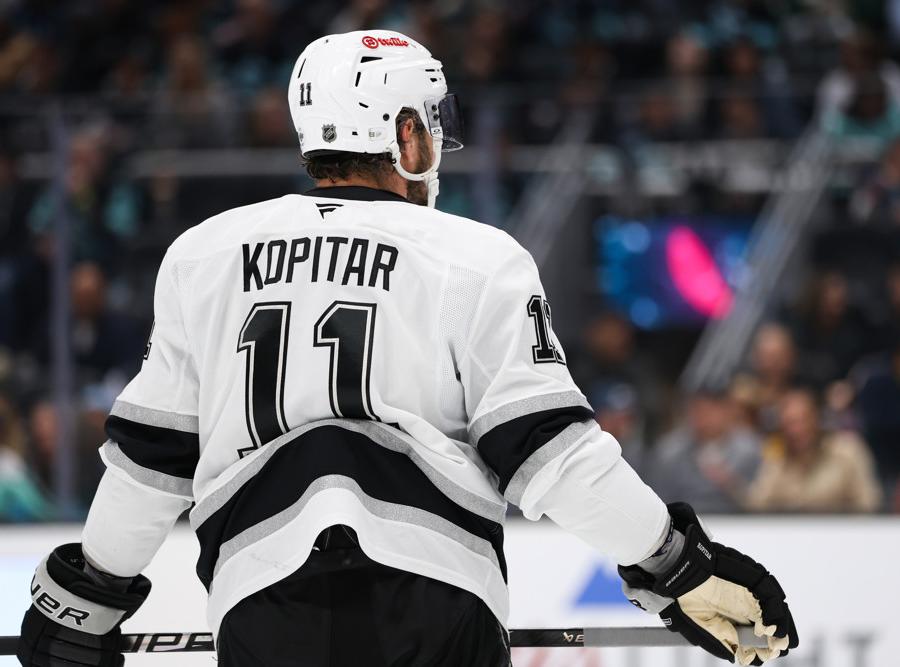
Anze Kopitar played his final NHL season. The Kings barely qualified as the Western Conference's eighth seed with 90 points - fifteen fewer than the prior year. Jim Hiller was fired on March 1. D.J. Smith coached the team into the playoffs. Colorado swept them in four. Artemi Panarin arrived, Adrian Kempe signed eight years, the youth is developing. The Kopitar era is over. Everything else is still being written.
By Mike Holloway · June 2026 · 2025–26 Season Review Series · #9 of 32 · Playoff Teams · End of an Era
Phase 1 · Oct–Feb: Struggling Below .500
15-17-9 at home. Offence dried up. 225 goals for - one of the league's lowest. Hiller under pressure from late October onward as the home record kept the team below the line the prior year's 105-point campaign had set as the new standard.
Phase 2 · Mar 1: Hiller Fired · Smith In
Interim D.J. Smith takes over. The 20-10-11 road record sustained the season when the home performances would not. A coaching change initiated mid-season rather than deferred, in a year that demanded accountability.
Phase 3 · Late Apr: 8th Seed - Just Squeaked In
35-27-20. 4th in the Pacific. 90 points. In as the last wild card from the West. The team that qualified for the playoffs was a different team from the one that started the season - and the transition cost too much context to reverse in four games.
Phase 4 · R1 vs COL: Swept 0-4
Colorado (121 points, best record in the NHL) dominated the series. Kopitar's final games. The top line of Panarin-Kopitar-Kempe was broken apart in Game 4 when the matchups were failing. Season ends in four.
Anze Kopitar played his final NHL game in April 2026, in a Kings uniform, in a first-round sweep at the hands of the Colorado Avalanche. He was 38. He had been the captain, the franchise cornerstone, and the most important player in Los Angeles Kings history for nineteen seasons - two Stanley Cups, one Hart Trophy, two Selke Trophies, and a brand of professional excellence that never required volume or drama to make itself known. He was simply, consistently, the best two-way centre of his era at his peak, and still the team's most reliable individual contributor at its decline. The farewell was not the sendoff he deserved. The five-game sweep - the Kings' fifth consecutive first-round exit and the worst performance of that consecutive run - was the ending the season had been building toward since October. That does not make it easier to write. The franchise he led for two decades must now answer the question his presence had deferred for years: what does a Los Angeles Kings team look like without Anze Kopitar at its centre?
Nineteen Seasons. All With the Kings. Two Cups. One Hart. Two Selkes. The Most Important Player in the History of the Franchise Since Gretzky.
Two Stanley Cups. One Hart Trophy. Two Selke Trophies. The most important player in the history of a franchise that traces its identity through Gretzky and then through Kopitar. He was the first Slovenian player to win the Stanley Cup, and then he did it again three years later.
He was, at his peak, the best two-way centre in the NHL - not the flashiest, not the loudest, not the one who needed the spotlight to find the game. He was the one who made everyone around him quieter and better simultaneously. In his final season, even at 38, he led the team in plus-minus (+17).
The game he played in his last years was different from the game he played at 26 - slower, more positional, less explosive. It was still better than most of the centres who will replace him in the lineup. The franchise he served for nineteen years owes him a debt that two banners and a career of sustained excellence have partially repaid. His farewell was quieter than it deserved to be. That is the season's most significant human fact.
The pattern is not ambiguous. Five consecutive playoff appearances; five consecutive first-round exits. The first four were competitive in varying degrees - the 2024-25 team won the first two games before losing four straight to Edmonton. The 2025-26 team was swept by the Presidents' Trophy runner-up in four games without winning one. The trend moved in the wrong direction this year. A team that had 104-105 points three years running dropped to 90 and qualified as the eighth and final Western Conference seed.
The performance gap between the Kings and the teams they've faced in five straight first rounds is the most specific organisational challenge the franchise now confronts with Ken Holland as its new architect.
35-27-20. The Lowest Points Total in Five Years. A Coach Fired in March. Swept in Four. But: Kempe Signed Eight Years. Panarin Arrived. Byfield, Clarke, and Laferriere Are Developing. The Foundation for What Comes Next Exists. The 2025-26 Season Just Wasn't It.
The regression from 48-25-9 (105 points) in 2024-25 to 35-27-20 (90 points) in 2025-26 was the starkest single-season decline the franchise has produced in the five-year playoff run. Goals for dropped from 250 to 225 - one of the lowest totals in the Western Conference. Goals against climbed from 206 to 247, producing a negative goal differential for the first time in that stretch. The home record (15-17-9) was the inverse of the extraordinary 31-6-4 home record from the prior season. Jim Hiller, who had built the prior year's excellent team, could not find the adjustments that kept the season on track and was fired on March 1 with D.J. Smith taking over as interim.
Under Smith, the Kings were competitive enough to scrape into the postseason as the eighth seed. The 20-10-11 road record - oddly excellent for a team with 15 home wins - kept them alive when the home performances were consistently below what the roster should have produced. The team that qualified for the playoffs was a different team from the one that started the year, and the transition cost too much context for four games against Colorado to reverse.
The positives are genuine and should be acknowledged alongside the negatives. Adrian Kempe signed an eight-year contract extension - the commitment that makes the franchise's offensive identity stable for the next decade. Artemi Panarin arrived and proved he is still a first-line offensive talent who gives whoever plays alongside him better opportunities than they'd have otherwise. Quinton Byfield, Brandt Clarke, and Alex Laferriere all developed in ways that the 2026-27 Kings will benefit from. Panarin's assessment of the youth: "We have very good depth on the team, such as Mooresie, Laf and Q, who played very well." He was right about the youth. The season around them was wrong.

 COL
COLColorado went 3-0-0 against LA in the regular season and the playoff opener produced the same result. The gap between a 121-point Avalanche team and a 90-point Kings team that had qualified as the eighth seed was visible from the opening shift.
The Kings' approach - lean on Kuemper, generate enough chances through the Kempe-Kopitar-Panarin line, keep the score close - was the same approach that had worked against weaker opponents during the road-heavy stretch run. Against Colorado, it was insufficient.
The regular-season head-to-head record (3-0-0 Colorado) was an honest signal of what Game 1 would produce - and what the series would.
COLDown 0-2 to a 121-point team with Nathan MacKinnon and Mikko Rantanen. Colorado's top-end pace exposed the limitations of a Kings defensive structure that had spent the season papering over its weaknesses with goaltending that was no longer at the prior year's level.
The Avalanche dictated possession, dictated shot quality, and put the series on the trajectory that would not change. Kopitar's last-stand performance was real - he was the team's best two-way forward on both road nights - but the gap between his contribution and what the rest of the roster produced was the series in miniature.
Down 0-2 on the road against the best team in the NHL is the kind of hole even the dynasty-era Kings of 2012 and 2014 would have struggled to climb out of. This roster did not.
COLAt Crypto.com Arena, in front of a home crowd that had watched 15-17-9 unfold over the regular season, the Kings could not find the response that the moment required. The home ice that had been a dynasty-era advantage was no longer functioning as one.
The series moved from competitive to ceremonial in the second period of Game 3. The structure that had carried the team into the postseason did not survive sustained contact with a Colorado roster operating at championship level.
The home playoff record - 0-2 in this series at Crypto.com - reaching the point where the building was no longer the advantage the franchise had assumed it would be.
COLSeason ends. Kopitar plays his final NHL game. The top line of Panarin-Kopitar-Kempe was broken apart in the final period as the matchups failed. The Kings went home.
The captain's last shift was not the dramatic farewell the franchise's history required. It was, instead, the quiet ending that the 2025-26 season had been building toward since the home record began to slip in November. Kopitar walked off the ice for the final time as an NHL player in a sweep.
Kopitar's final NHL shift - ending without a win, in a sweep, at home, against the team that finished with the league's best record. The career is the permanent record. The exit is the playoff result.
The matchup was the most lopsided of the entire first round: the 8th Western seed (90 pts, negative goal differential) against the team that finished with 121 points and the league's best record, led by Nathan MacKinnon and a Colorado roster that went on to reach the Western Conference Final. Colorado won all three regular-season games against LA before the playoffs and went 4-0 in the series. The goaltending decision heading into the series - Darcy Kuemper or Anton Forsberg - reflected the uncertainty that defined the team's identity all season. Kopitar's final NHL shift ended without a win. The franchise he led for nineteen years will carry him into the banner-raising night that eventually comes as an honour, not a footnote. The sweep is the playoff result. The career is the permanent record.
2025–26 Individual Season Grades
32G–37A–69 pts · led team in all three categories · signed 8-year extension · franchise's future anchor
The most important individual transaction of the season was Kempe's eight-year contract extension - the commitment that anchors the franchise's offensive identity through the entire transition out of the Kopitar era. His 69 points led the team. His reliability - in good seasons and difficult ones - is the most consistent individual fact about the Los Angeles Kings across five consecutive playoff years. The grade reflects a strong season on a team that collectively underperformed. He was the team's best player in 2025-26 as he has been in each of the prior four as well.
First season in LA · played on Kopitar line · "very sad that Kopitar is leaving, but we have a very good team here"
Panarin's arrival was the offseason's most significant acquisition and his first year in Los Angeles produced exactly the kind of first-line offensive contribution the organisation needed from him. His quote at the exit interview - expressing sadness about Kopitar's departure alongside genuine confidence in the remaining roster - is the honest assessment of a player who understands what he joined and what it now needs to become. The grade is limited by the team's collective underperformance but reflects his individual contribution to whatever competitive identity survived the 2025-26 season.
+17 (team leader) · final season · led team in plus-minus at 38 · 19 seasons, all with the Kings
The grade for the final season is separate from the grade for the career. The career grade is an A-plus by any honest measure. The final season grade is for a 38-year-old captain who led his team in plus-minus, was part of a top line that the coaching staff eventually had to break up against Colorado, and played his last NHL shift in a sweep without a win. The B-minus reflects what he produced in 2025-26 specifically - still the team's best defensive forward, still a plus player in a negative-differential season. That is not nothing at 38. That is Kopitar.
Second-line centre role · developing into franchise piece · praised by Panarin for playoff presence
Byfield is the long-term answer to the Kopitar question. Not immediately - he is not yet at the point where he drives a line the way Kopitar did in his prime - but on the trajectory the organisation needs him on. His development in 2025-26, playing significant minutes alongside Alex Laferriere and others, is the most important individual hockey result of the season for what the franchise looks like in 2027-28. He is the reason the Kopitar retirement, while sad, is not a structural catastrophe.
61 PIM (led team) · offensive D developing · scored in last regular-season game vs COL
Clarke is the offensive defenceman the franchise has been developing since the second-overall pick in 2021. His 61 PIM reflects an aggressive, physical game that is still being refined - the edge that makes him dangerous also makes him undisciplined in ways that cost the team at critical moments. The development arc is positive. His scoring in the late-season Colorado game before the playoffs was a brief moment of encouragement before the series erased it. At 22, he is exactly where a high-end defensive prospect should be - ahead of the curve, not yet at the destination.
19W (down from 31 prior year) · no longer the goaltender who posted 2.02 GAA in 2024-25
The most dramatic individual regression on the roster. From 31 wins and a 2.02 GAA in 2024-25 to 19 wins in 2025-26 is the steepest single-season goaltending decline of any team's starter this year. The regression is partially explained by the team's broader defensive breakdown (247 goals against, up from 206 the prior year) - even an elite goaltender produces worse numbers on a worse defensive team. But the win total drop (31 to 19) and the GAA increase reflect individual performance decline alongside systemic failure. Anton Forsberg's stronger April (5-1-0, 2.74 GAA) complicated the goaltending decision heading into the playoffs, which is never a position the franchise wants to be in against a 121-point opponent.
Hiller fired March 1 · Smith interim · qualified as 8th seed · swept in R1
Hiller's firing on March 1 reflects an organisation that identified a systemic problem mid-season and acted on it rather than letting the season conclude without accountability. The problem he could not solve - offence (225 GF) and home ice (15-17-9) - remained unsolved under Smith, but the team stayed competitive enough to qualify. Smith's interim record kept the season alive. The coaching transition, combined with Ken Holland's new front office mandate, makes the 2026-27 hiring process the most consequential organisational decision since Blake was hired as GM. Peter Laviolette was hired as the new head coach. The grade reflects the combined coaching product: a team that regressed significantly and was swept in the first round.
| Player | POS | GP | G | A | PTS | Note |
|---|---|---|---|---|---|---|
| Adrian Kempe | LW | 80 | 32 | 37 | 69 | Led team all categories · signed 8-yr extension · franchise anchor |
| Anze Kopitar | C | 78 | - | - | +17 | Team plus/minus leader · final NHL season · retired post-sweep |
| Artemi Panarin | LW | 78 | - | - | ~65 | First year in LA · top line with Kopitar and Kempe |
| Kevin Fiala | RW | 70 | - | - | - | Injuries disrupted season · still producing when available |
| Quinton Byfield | C | 78 | - | - | - | Developing franchise centre · praised by Panarin post-season |
| Brandt Clarke | D | 75 | - | - | 61 PIM | Offensive D development · scored vs COL pre-playoffs |
| Darcy Kuemper | G | 45 | - | - | 19W | Down from 31W and 2.02 GAA prior year · significant regression |
| Anton Forsberg | G | 35 | - | - | 2.74 | Team-best GAA · 5-1-0 in April · complicated G1 decision |
“It's very sad that Kopitar is leaving, but like I said before, we have a very good team here. We have very good depth on the team, such as Mooresie, Laf and Q, who played very well.”
— Artemi Panarin, exit interview - the most honest positive assessment of what remains after the most significant individual departure in franchise history since Wayne Gretzky
The captain question - who succeeds Kopitar - is the first decision Holland and the new head coach must make that goes beyond roster construction. Mikey Anderson, Drew Doughty, and Adrian Kempe are the three candidates identified at the exit interviews. Kempe is the most natural choice given his eight-year extension and his status as the team's most consistent player across five consecutive seasons. Doughty is the most senior voice. Anderson is the most likely long-term captain given the organisation's trajectory. The decision is not urgent, which is itself the correct response to a question about a 19-year institution that cannot be replaced in a single offseason press release.
Five Consecutive First-Round Exits
The pattern is the structural problem. Four against Edmonton (each one closer to competitive than the next year was), one against Colorado that produced no wins. The 2026-27 team must produce a different April or the question being asked about Tampa Bay's core - is this group capable of winning a playoff series - becomes the question being asked here.
The Home Ice Collapse
From 31-6-4 at home in 2024-25 to 15-17-9 in 2025-26. The inverse of a dynasty-era advantage. No coaching change or roster tweak fixes a home record that has fallen this far without an honest organisational diagnosis. Holland and the new head coach must produce one.
Kempe Signed Eight Years
The most important contract on the roster since Kopitar's own. The franchise's offensive identity for the next decade is anchored. The next coach builds around him, not toward replacing him.
Byfield, Clarke, Laferriere Developing
The next era is being built rather than deferred. Byfield is the long-term Kopitar answer. Clarke is the offensive defenceman. Laferriere is the depth winger who can produce. Panarin singled them out at the exit interview for a reason.
Goaltending Going Forward
Kuemper's regression (31W to 19W, 2.02 GAA to a much worse number) is the most uncomfortable individual storyline. Forsberg outperformed him in April. The 2026-27 starter is not yet determined. The summer must produce clarity.
The Captaincy
Anderson, Doughty, Kempe. The most natural choice is Kempe. The most senior voice is Doughty. The most likely long-term answer is Anderson. The decision is not urgent. The decision is also unavoidable.
The 2025-26 Los Angeles Kings were, in the standings, the worst team to qualify for the Western Conference playoffs. In human terms, they were a franchise navigating the end of its most important era since Gretzky, with the players who will define the next era still learning what that means. Kempe signed eight years. Panarin arrived and confirmed the offence still works when he is in it. Byfield, Clarke, and Laferriere showed enough that the future is being built rather than being deferred. The season around all of that was difficult. The foundation under all of that is more solid than 90 points and a first-round sweep suggest.
Season Review Verdict
Kopitar's last game ended in a sweep. Five straight first-round exits. Ninety points - the worst total of the five-year run. A coach fired in March. Swept by the best team in the NHL. And a franchise that must now answer, for the first time in nineteen years, what it looks like without its captain.
The C-minus is the honest grade for a season that produced the franchise's worst standings result in five years, its worst playoff exit of the five-year run, its most significant individual departure in a generation, and a coaching change that the organisation initiated mid-season rather than pretend the problems weren't there.
The positives are real. Kempe's eight-year extension is the franchise's most important contract since Kopitar's own. Panarin proved he belongs on a first line. Byfield, Clarke, and Laferriere showed why the next era is worth waiting for. The foundation exists. The 2025-26 season around it was not good enough.
Five first-round exits in five years is a pattern that demands a structural answer, not a roster adjustment. Ken Holland was hired to find that answer. A new head coach will be hired to implement it. The captain who held everything together for nineteen years is gone. What comes next is the most genuinely open question in Los Angeles hockey since the day they traded for Gretzky and began to wonder what they were doing with him. They knew what they were doing with him. They need to figure out what they're doing now.