
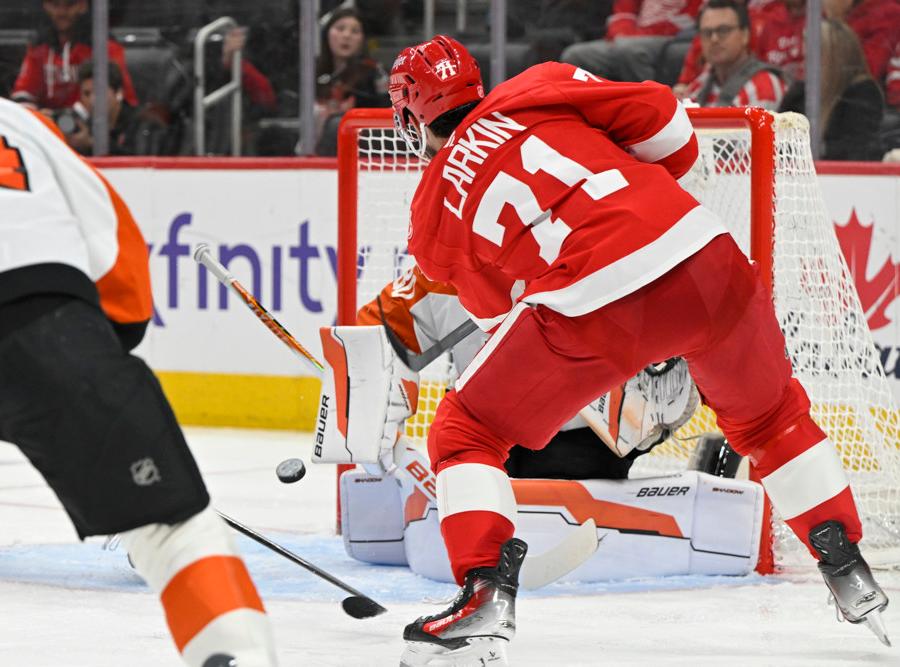

Alex DeBrincat scored 41 goals. Moritz Seider was a Norris Trophy finalist. John Gibson posted four shutouts. Dylan Larkin won Olympic gold. And then the Olympics ended, and the Red Wings lost 16 of their last 24 games and fell from first in the Atlantic Division to sixth. For the third consecutive year. For the tenth consecutive missed playoff. In their hundredth season.
By Mike Holloway · May 2026 · 2025–26 Season Review Series · Detroit's 100th NHL Season
Phase 1 · Oct–Jan 25: First in the Atlantic
Atop the division as late as Jan 25. DeBrincat scoring at an All-Star pace, Gibson with four shutouts, Seider leading the division in plus-minus. The centennial season looked like the year the drought finally ended.
Phase 2 · Feb 4–20: Olympic Break
Still 2nd in the Atlantic when the break began. Larkin, Seider and Raymond left for Italy. Larkin returned with a gold medal - the first American Olympic hockey gold since 1980 - and walked back into a team that had lost its grip on first place.
Phase 3 · Feb–Apr: The Collapse
Lost 16 of their last 24. Slid from first to sixth in the Atlantic. The same March pattern that ended 2023-24 and 2024-25 - except this time from a higher starting point, and with the franchise's 100th season as the backdrop.
The Detroit Red Wings' 100th NHL season ended the same way the ninth, eighth and seventh consecutive missed playoff seasons ended. The same way. Fading in March. Losing games they needed to win. Watching teams with inferior early-season records accumulate points in the stretch run while Detroit could not. "This is the third straight year the team has faltered in the final weeks of the regular season," WDET reported. That sentence, stated plainly and without editorialising, is the most damning single observation about this franchise's current identity. Not that they lost. That they lost the same way, again, for the third time in a row, in their centennial season, having been first in the Atlantic Division as late as January 25.
The talent at the top of the roster is real. Alex DeBrincat scored 41 goals and 85 points - one of the better individual offensive seasons in the Atlantic Division. Moritz Seider was a Norris Trophy finalist with a +19 plus-minus and 60 points as the franchise's best defenceman since Nicklas Lidstrom. John Gibson, acquired from Anaheim before the season, won 29 games with four shutouts and a 2.72 GAA that was significantly better than the prior year's goaltending. Lucas Raymond led the team in assists (51) and posted 76 points. Dylan Larkin won Olympic gold with Team USA and returned to Detroit with 34 goals and 67 points. Patrick Kane at 37 contributed 16 goals and 41 assists. This is not a roster without talent. It is a roster without depth - and depth is what decides March.
How the Season's Promise Became the Season's Pattern - Again
From the top of the Atlantic to sixth place in twelve weeks. The most predictable implosion in the league, executed by the team that should have known better than anyone how to prevent it.
Three consecutive seasons of the same ending. In 2023-24, they competed for a wild card spot before fading in March. In 2024-25, the same. In 2025-26, they were first in the entire Atlantic Division and still couldn't hold it. The problem is not a bad team. The problem is a team whose top six is excellent and whose depth collapses under the sustained pressure of a March playoff push. Every team Detroit faced in the final stretch was competing for something. The Red Wings' bottom six could not keep pace. The same bottom six that had been insufficient for three consecutive springs was insufficient for a fourth - except this time the fall was longer and more painful, from a higher starting point.
Dylan Larkin Had 9 Five-on-Five Goals. That Ranked 220th in the NHL. The Bottom Six Had One Player Break Double Digits at Even Strength. The Collapse Was Structural, Not Random.
The Hockey Writers' deep dive on the 2025-26 Red Wings identified the specific mechanism of the collapse: five-on-five scoring. Larkin - 34 goals overall, 67 points, a legitimate top-line centre by any external measure - scored only 9 five-on-five goals, tying him with Evander Kane and Connor Brown for 220th in the NHL. The implication is that nearly all of his production came from power-play situations or fortuitous even-strength opportunities, not from the sustained puck-carrying and zone-entry dominance that produces five-on-five goals in the modern NHL.
In the bottom six, J.T. Compher led with 11 five-on-five goals. No other depth forward reached double digits. "The bottom six featured several players who just can't keep up with the modern NHL." Michael Rasmussen - on the roster since before Yzerman became GM - "has not made an impact for them in three years." The same Rasmussen and Larkin who were on the roster before Yzerman arrived are still there. Everyone else has been added by the new regime. The depth issue is not new. It is the thing Yzerman has been unable to solve across four offseasons of trying.
The solution is not complicated to identify: acquire depth forwards who can produce at five-on-five, survive physical play against opposing checking lines, and win faceoffs in defensive zone situations. The solution is complicated to execute: depth forwards who win five-on-five do not become available at prices that allow a team to also keep DeBrincat, Raymond, Larkin, Seider and Gibson. The cap structure that supports four elite-to-very-good players at the top of the lineup compresses what is available for the bottom six. Yzerman's summer problem is not identifying the solution. It is finding a way to afford it.
Dylan Larkin is a Detroit Red Wing. He won the Olympic gold medal for Team USA. He scored 34 goals and 67 points. He has been the franchise's most important forward for most of the past decade and the only player remaining from the pre-Yzerman era alongside Michael Rasmussen. He has also, according to reporting cited throughout this season and in the offseason discussion, requested a trade from Detroit.
The request is the most consequential individual story in the franchise's offseason. Larkin at 30 is the captain of a team that has missed the playoffs in all ten years of his career. His eight-year, well-structured extension was signed under the assumption that the rebuild would produce playoff hockey before it expired. It has not produced it yet. Ten straight missed playoffs is a weight that eventually becomes heavy enough to shift even the most committed individual's perspective.
Yzerman's decision - honour the request and acquire significant assets, or convince Larkin that 2026-27 is finally the year - is the most important decision the franchise makes this summer. The case for keeping him: DeBrincat, Raymond and Seider are all elite. Gibson was good. The depth problem is solvable in a way that a top-line centre hole is not. The case for trading him: if his commitment to the process has genuinely eroded, a captain who has asked out is not the same captain who leads the team through the pressure of the stretch run. Los Angeles has been mentioned as a destination; many have speculated. Yzerman will resolve it before training camp. The resolution will define the franchise's direction for the next three years.
2025–26 Individual Season Grades
Individual Assessment
2025–26 Individual Season Grades
41G–44A–85 pts · team offensive MVP · led the team in goals, assists and points
The team's most important individual performer. 41 goals is the kind of production that should make a team competitive - and on most rosters, it does. On Detroit, it was the most important number on a team that still couldn't make the playoffs. His power-play production was elite. His even-strength consistency was the one reliable offensive anchor through the stretch run. He is the player around whom Yzerman builds the next version of the roster regardless of what happens with Larkin.
60 pts (10G–50A) · +19 (team leader) · Norris Trophy finalist
"Seider should be a Norris Trophy finalist" - the Hockey Writers' assessment is the right one. His +19 on a team that missed the playoffs by eight points is the most impressive defensive individual number in the franchise since Lidstrom's prime. His 50 assists from the blue line drove the power play and enabled the team's transitional offence. He and Edvinsson together were one of the better defensive pairs in the Atlantic Division. At 24, he is the franchise's most important player after DeBrincat and the individual most likely to be a Detroit Red Wing for the next decade regardless of what else changes.
29W · 2.72 GAA · .901 SV% · 4 SO · acquired from Anaheim
The Gibson acquisition from Anaheim was one of Yzerman's best moves in recent memory. Four shutouts. 29 wins on a team that went 8-16 in its last 24 - meaning he was excellent when the team around him was still functioning. His late-season numbers (3.74 GAA over his final seven starts) reflect the defensive collapse rather than individual decline. The prior year's goaltenders were the team's weakest position. Gibson transformed it. He enters 2026-27 as one of the more reliable starters in the Eastern Conference.
25G–51A–76 pts · led the team in assists · 4th overall pick still developing at 23
Raymond is becoming what the 4th overall pick was supposed to become - a genuine top-six producer who creates for teammates as consistently as he scores. His 51 assists led the team and reflect his development from goal-scorer into a complete offensive forward. At 23, his ceiling has not been reached. He is the third piece of a DeBrincat-Raymond-Seider franchise spine that Yzerman has assembled and needs to finally build a competitive team around.
34G–33A–67 pts in 74 GP · Olympic gold (USA) · 9 five-on-five goals (220th in NHL) · trade request reported
His individual season - 34 goals, gold medal - is a legitimate B-minus performance on a non-playoff team. His 9 five-on-five goals (220th in the NHL) is the uncomfortable analytical footnote. The reported trade request is the B-minus ceiling - a captain whose personal production is solid but whose combination of five-on-five impact and reported desire to leave makes the grade more complicated than the goal total alone suggests. He is still the franchise's most important centre. What happens with his future is the summer's most consequential single decision.
16G–41A–57 pts · 37 years old · elite vision intact
At 37, Patrick Kane produced 41 assists and 57 points on a non-playoff team. That is a legitimate B-minus contribution from a veteran aging out of his prime production years while still finding ways to contribute. His 41 assists demonstrate that his vision and puck-distribution have not declined even as his skating and physical game have. Whether he returns for 2026-27 or retires is the secondary individual question of the offseason after Larkin.
"Outstanding in shutting down opponents" · elite defensive partner to Seider · 6th overall pick (2021)
The 6th overall pick from 2021 has developed into exactly what the team needed alongside Seider - a physical, defensive-first defender who competes against the opposition's best players and enables Seider's offensive activation. His development is one of the rebuild's genuine successes and gives Detroit a blue-line pair that competes with any in the Atlantic Division. He is one of the few reasons the team's defensive numbers were not worse given the late-season collapse.
only J.T. Compher in double digits at 5v5 · Rasmussen "has not made an impact in three years"
The collective grade for the depth forwards who produced the collapse. Not individual players but the collective - "several players who just can't keep up with the modern NHL." One player reached double figures in five-on-five goals. The depth centre Michael Rasmussen - on the roster since before Yzerman arrived - has not made an impact in three years. The D represents the group's contribution to the franchise's tenth consecutive missed playoff. Yzerman must address this comprehensively in the summer. One targeted free-agent signing is insufficient.
| Player | POS | GP | G | A | PTS | Note |
|---|---|---|---|---|---|---|
| Alex DeBrincat | LW | 82 | 41 | 44 | 85 | Team offensive MVP · led G/A/Pts |
| Lucas Raymond | RW | 82 | 25 | 51 | 76 | Led team in assists · 4th overall developing |
| Dylan Larkin | C | 74 | 34 | 33 | 67 | Olympic gold (USA) · 9 5v5 goals (220th NHL) |
| Moritz Seider | D | 82 | 10 | 50 | 60 | +19 (team leader) · Norris finalist |
| Patrick Kane | RW | - | 16 | 41 | 57 | 37 years old · elite vision intact |
| John Gibson | G | ~55 | - | - | 29W | 2.72 GAA · 4 SO · .901 SV% |
| Axel Sandin-Pellikka | D | 68 | 7 | 14 | 21 | Rookie · 17th overall 2023 · developing |
The Bottom Six - Non-Negotiable Fix
One five-on-five double-digit scorer is a playoff-elimination level problem. Yzerman has addressed the top six excellently. The summer must bring at minimum two depth forwards capable of winning five-on-five minutes against opposing checking lines. Without them, 2026-27 ends the same way.
The Larkin Decision
A captain who has reportedly asked out for the tenth year of missed playoffs is a destabilising presence regardless of production. Trade him for significant assets or convince him 2026-27 is finally the year. Either path requires a decision before camp.
The Griffins - Loaded With Prospects
Grand Rapids won the AHL Central Division and is among the Calder Cup favourites. "Loaded with young talent," per WDET. Danielson, Brandsegg-Nygard, Kasper, Sandin-Pellikka (already getting NHL games), Carter Bear (2025 13th overall). If two graduate to meaningful NHL roles in 2026-27, the depth problem becomes more manageable.
DeBrincat-Raymond-Seider Spine
Three legitimate Atlantic Division stars. 41 goals, 76 points and a Norris Trophy finalist as three of your top players is not the profile of a rebuilding team. The foundation is real. The depth that converts top-six excellence into March wins is the missing piece.
The Late-Season Pattern
Three consecutive years of fading in the stretch run is a pattern, not a coincidence. If Yzerman makes the same depth additions and gets the same result, the pattern continues. Whether Todd McLellan's system is part of the problem is the coaching question three consecutive collapses make legitimate to ask.
The 100th Season Legacy
Detroit made 25 consecutive playoff appearances from 1991 to 2016. Missing the playoffs in the franchise's 100th year - after being first in the Atlantic in January - is the kind of institutional failure that creates pressure for change at every level. The 101st year must produce differently.
“This is the third straight year the team has faltered in the final weeks of the regular season. They were competing for a wild card spot before fading in March 2024 and 2025. But this collapse might be the worst of all. The Wings were in good shape on February 4. They stood in second place in the NHL's Atlantic Division. Then things fell apart. Again.”
— WDET 101.9 FM, April 17, 2026 - the most precise summary of ten years of the same ending
Again. That word, in that sentence, is the entire review. Detroit has now missed the playoffs for ten consecutive seasons - the longest active drought in the NHL, longer than any other franchise has gone without postseason hockey in the modern era. The talent at the top is not the problem. The depth below it is. The solution is known. The execution has consistently fallen short.
Yzerman built DeBrincat to 41 goals. He built Gibson to four shutouts. He built Seider to Norris Trophy candidacy. He built Raymond to 51 assists at 23. He has not built the bottom six that makes those four contributions produce wins in March instead of April regret. That is the final piece of a rebuild that has produced everything except the one thing it was rebuilt to produce. The 101st season begins in October. Something must be different. For three straight years, something has been the same.
Season Review Verdict
First in the Atlantic. Lost 16 of the last 24. Ten straight missed playoffs. The same collapse, in the franchise's hundredth year. The C+ reflects genuine individual excellence from four legitimate top-six contributors, a meaningful improvement in goaltending (Gibson's four shutouts vs. the prior year's tandem), and a roster that was first in the Atlantic Division as late as January. That team deserves more than a D. The C+ ceiling is the third consecutive late-season collapse - the bottom six that had one player in double figures for five-on-five goals, the ten consecutive missed playoffs in the franchise's 100th season, the Larkin trade request that clouds the summer. These are not bad-luck occurrences. They are the same structural problem, recurring. Yzerman must fix the bottom six. He must resolve the Larkin question. He must decide whether McLellan's system is contributing to the pattern or managing it. The 101st year begins in October. Every year since 2015, October has promised something the spring has not delivered. The franchise's most urgent need is not talent. It is depth. It has been depth for three consecutive springs. The summer is the chance to finally provide it.