
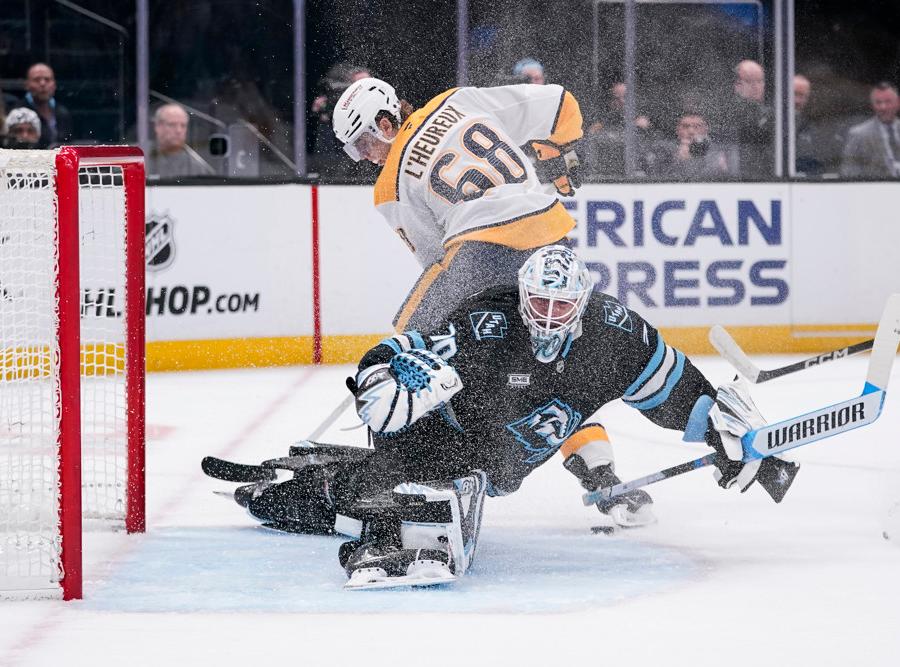

They set franchise records in wins, points, and points percentage. Dylan Guenther scored 40 goals. Karel Vejmelka won 38 games. John Marino was +42. Clayton Keller set a career high in assists. They clinched with a five-game winning streak, went into the playoffs confident, won their first home playoff game ever as Utah, and lost to the team that made the Stanley Cup Final in six games. Year One delivered everything except the series win.
By Mike Holloway · June 2026 · 2025–26 Season Review Series · Playoff Teams
Oct–Jan · Establishing Identity
Keller slow start. Guenther emerging. Vejmelka excellent. A new city adjusting to its first NHL season and a roster figuring out what the Utah identity was going to look like.
Feb–Apr · Five-Win Clinch Streak
"We rattled off five in a row and made a statement" - Keller. The Wild Card secured. The team entering April confident rather than relieved.
R1 G1–G2 · At Vegas · Down 0-2
Competitive losses at T-Mobile Arena. Utah proving they belonged on the postseason stage without yet proving they could win on it.
R1 G3–G6 · First Home Playoff Win
Won Game 3 at the Delta Center 4-2. Won Game 5. Lost Game 6 to the eventual Cup finalist. The first playoff series in franchise history under the Utah Mammoth name.
In May 2025, the franchise that had played for nineteen years as the Phoenix Coyotes and one as the Arizona Hockey Club was renamed the Utah Mammoth. The Delta Center in Salt Lake City became their home. The colour scheme changed. The name changed. The city changed. What didn't change was the core of the roster that Bill Armstrong had been building through a long and frequently painful reconstruction - Clayton Keller as captain, Karel Vejmelka in goal, Dylan Guenther developing into one of the league's better young wingers, and Logan Cooley arriving as the heir apparent at centre.
The 2025-26 season was the first time those pieces played together under the banner of the Utah Mammoth, and what they produced was a franchise record in wins, a franchise record in points, a franchise record in points percentage, a first-round playoff series against the Vegas Golden Knights that went six games, a first-ever home playoff win at the Delta Center, and the clearest possible statement that whatever this franchise was before - the Coyotes, the Hockey Club, the team that played 1,700-person crowds in an arena outside Phoenix - it is something different now.
43 Wins. 92 Points. .561 Points Percentage. Every One a Franchise Best.
The prior franchise record in wins was set during the 2011-12 Phoenix Coyotes season - the year they reached the Western Conference Final under Dave Tippett. Everything the 2025-26 Utah Mammoth produced in the standings surpassed what that team did. Setting franchise records in all three primary standings categories in Year One of a new identity is not a coincidence. The Salt Lake City environment, the full roster health, the emergence of Guenther, and Vejmelka's career year all contributed. The foundation Armstrong built through the lean years produced something the team's prior incarnations only briefly achieved.
Year One is a success story in every number that matters.
40 Goals at 22. The 9th Overall Pick in 2021 Has Arrived as a Genuine First-Line Winger in the NHL.
Guenther was selected 9th overall in 2021. In Arizona he was developing - promising, occasionally brilliant, never quite consistent enough to be called a genuine NHL first-liner. In 2025-26, playing in a new city with an organisation that had arrived at its first genuine competitive moment, he scored 40 goals. That is not a fluke. A player who scores 40 goals in a full NHL season is a legitimate top-six winger, full stop. He received the franchise's Three Stars Award - the team's internal recognition for its most outstanding individual performer - and, by any external measure, deserved it.
The 40-goal season changes the team's competitive conversation in two important ways. First: it confirms that Keller and Guenther are a legitimate top-two offensive pairing that can drive a genuine playoff team rather than a bubble team. Second: it establishes Guenther's market value as a restricted free agent in a way that makes his extension conversation the franchise's most consequential individual contract decision. Getting him signed at a reasonable rate before he reaches the UFA years - while demonstrating the loyalty of a franchise that supported his development - is the single most important transaction Armstrong executes this summer.
Vegas 4, Utah 2 - The Delta Center Got Its First Playoff Win
Utah went into the series as an underdog and competed like a team that had been waiting years for exactly this moment - because they had. The Delta Center crowd for Games 3 and 5 delivered the kind of atmosphere the franchise had never experienced in Phoenix. Logan Cooley became the youngest American-born player to score in his first two postseason games. Keller produced - his career-high regular-season assists translated into playoff contributions on the power play and in transition. The series was decided by the experience gap: the Golden Knights had been to three Cup Finals, had a roster that had played deep into May in multiple consecutive seasons, and knew how to close out a competitive opponent. Utah did not have that knowledge yet. In 2026-27, they will have played it.
2025–26 Individual Season Grades
38 wins (franchise record) · 2.75 GAA · most important individual player on the roster
The most underappreciated individual performance in the Western Conference this season. Thirty-eight wins on a 43-win team means Vejmelka was the starter for nearly every victory the franchise recorded in their first season. His 2.75 GAA reflects the workload and the defensive structure around him rather than his individual ceiling. He has been the franchise's most reliable individual asset for two consecutive seasons. His extension - signed or to be signed - is the most important contract on the roster after Guenther. A goaltender who wins 38 games is not available on the open market at any price. He is here. He is theirs.
40G · Three Stars Award (team MVP) · breakout season that changes the franchise's ceiling
The grade is for what 40 goals means. Not just for this season - for what it establishes. A 22-year-old who scores 40 goals in the NHL, in a season where his team is simultaneously establishing a new identity in a new city, has done something that changes the conversation about this franchise permanently. He and Keller are now a legitimate top-two offensive pairing. He is an RFA. Armstrong must extend him immediately.
88 pts (26G, 62A) · career-high assists · led franchise in points for 10-game streak · slow start
Eighty-eight points on a 92-point team is the kind of individual output that makes a franchise competitive. The career-high 62 assists reflect how Keller's game has matured - from a volume shooter into a genuine playmaker who creates for others as naturally as he scores himself. His slow start (one point in four games) was the only meaningful early-season concern, and he erased it by January. In the playoffs, his production matched the regular season. The B-plus ceiling is a prior season of 90 points that he narrowly missed repeating.
+42 (season leader) · elite defensive anchor · most important non-scoring contribution on the roster
A +42 plus-minus on any team in any season is one of the better individual defensive campaigns in the league. On a team that set franchise records in wins and points, Marino's defensive reliability at even strength is the structural foundation that made the offence look better than it would have without him. He is the defensive defenceman that every contending team needs - not glamorous, not a scorer, essential. His pair with Mikhail Sergachev gives Utah one of the better defensive pairings in the Western Conference.
43 pts in 54 games · youngest American-born player to score in first two playoff games · injury limited
The 3rd overall pick in 2022 played his best hockey of the season in the playoffs - which is both genuinely exciting and a reflection of how inconsistent his regular season was. Fifty-four games suggests either injury or a scratching pattern that needs to be addressed. His playoff contribution - youngest American-born player to score in his first two postseason games - is the evidence that the talent is real and the postseason environment brings out the best of it. A full 82-game season from Cooley in 2026-27 at the playoff level he showed in April changes this team's ceiling materially.
24G · 44pts (career high matched) · "All-In Award" · Arizona-era veteran embracing the Utah identity
The player who most embodies what the franchise transition from Arizona to Utah required - a veteran who played through the most difficult years of the rebuild, maintained his physicality and net-front presence, and arrived in Salt Lake City ready to be exactly the character player a new market needs to see. His 24 goals matched a career high. His All-In Award from the franchise reflected his contribution to the culture as much as the production. He is the bridge between what the franchise was and what it is becoming.
Inconsistent production · multiple line changes · potential not consistently unlocked
Acquired from Buffalo to add offensive depth, Peterka had an inconsistent year - productive stretches punctuated by droughts, multiple line changes as the coaching staff tried to find the right combination, and an inability to maintain the consistency over full months that makes an offseason acquisition justifiable at his cost. He is 22 and the individual ceiling is real. The 2025-26 season showed the gap between ceiling and floor. In 2026-27, with Cooley healthy and a settled line structure, the expectation is improvement.
| Player | POS | GP | G | A | PTS | Note |
|---|---|---|---|---|---|---|
| Clayton Keller | C | ~80 | 26 | 62 | 88 | Team pts leader · career-high assists · 10-game pt streak |
| Dylan Guenther | RW | ~80 | 40 | - | ~65 | 40 goals · Three Stars Award · RFA · breakout confirmed |
| Lawson Crouse | LW | ~80 | 24 | 20 | 44 | Career high matched · All-In Award · culture cornerstone |
| Logan Cooley | C | 54 | - | - | 43 | Youngest American to score in first 2 playoff games |
| John Marino | D | ~80 | - | - | +42 | Team season leader · elite defensive anchor |
| Mikhail Sergachev | D | ~78 | - | - | ~45 | Offensive D · PP catalyst · alt. captain |
| Karel Vejmelka | G | ~55 | - | - | 38W | 2.75 GAA · franchise wins record · most important individual |
“We were super confident leading into the playoffs. The five-game stretch where we won leading up to the playoffs - we kind of knew we needed five or six wins to get in, and we rattled off five in a row and made a statement.”
— Clayton Keller, captain, on the stretch run that clinched the Wild Card and set the tone for the playoff run
“I was impressed with how our youth was able to shine this year. And my family and I have really, really enjoyed our time here. I was really impressed with our fans - just the sheer volume.”
— Nate Schmidt, veteran defenceman, on the first season as the Utah Mammoth and what Salt Lake City delivered as an NHL market
The Utah Mammoth lost in six games to the Vegas Golden Knights, the team that went on to reach the Stanley Cup Final. They won two of those six games. They won their first-ever home playoff game at the Delta Center. They gave a Delta Center crowd the experience of an NHL playoff atmosphere that the franchise's prior home had frequently struggled to generate. They were better than the result suggests - Vejmelka was excellent, Keller was productive, Guenther scored in the playoffs - and they were also exactly as good as the result suggests: a young team in its first year of new identity, playing an experienced team that had been to three Cup Finals in nine seasons and knew exactly how to close a series out.
The six-game loss is the right starting point for the conversation about 2026-27, not the destination. A team that wins 43 games in Year One, sets three franchise records, gets a 40-goal breakout from a 22-year-old, and forces six games on a Cup finalist before bowing out is a team whose trajectory is pointed in one direction. The Guenther extension, a healthy Cooley for 80 games, and the continued development of what is now visibly one of the Western Conference's more interesting young rosters - those are the ingredients of the run that doesn't end in six games. Year One earned the right to Year Two. Year Two has to earn the right to April.
Browse the full set at Season Reviews. Previous in series: #16 Ottawa Senators.
Season Review Verdict
Year One. Franchise records. Guenther 40. Vejmelka 38 wins. A Delta Center that delivered. Six games against the team that reached the Cup Final. A first-round exit that felt nothing like failure. The B-minus reflects a successful inaugural season for a franchise that arrived in Salt Lake City with something to prove - and proved it. Franchise records in every standings category, a genuine playoff run against a Cup finalist, and the clearest possible evidence that Utah is an NHL market that works.
The deduction from an A is simple: they lost in Round 1. A team that sets franchise records and makes the playoffs is successful. A team that loses to the team that reached the Stanley Cup Final in six games is also, specifically, not a team that advanced. Both things are true.
What comes next is what matters. Guenther extended. Cooley healthy for 82 games. Vejmelka in goal for another year of franchise-record performance. The Delta Center already knows what playoff hockey sounds like. Year Two has a higher ceiling than Year One, and Year One was the best in franchise history. The Mammoth are here. They have made that clear.