
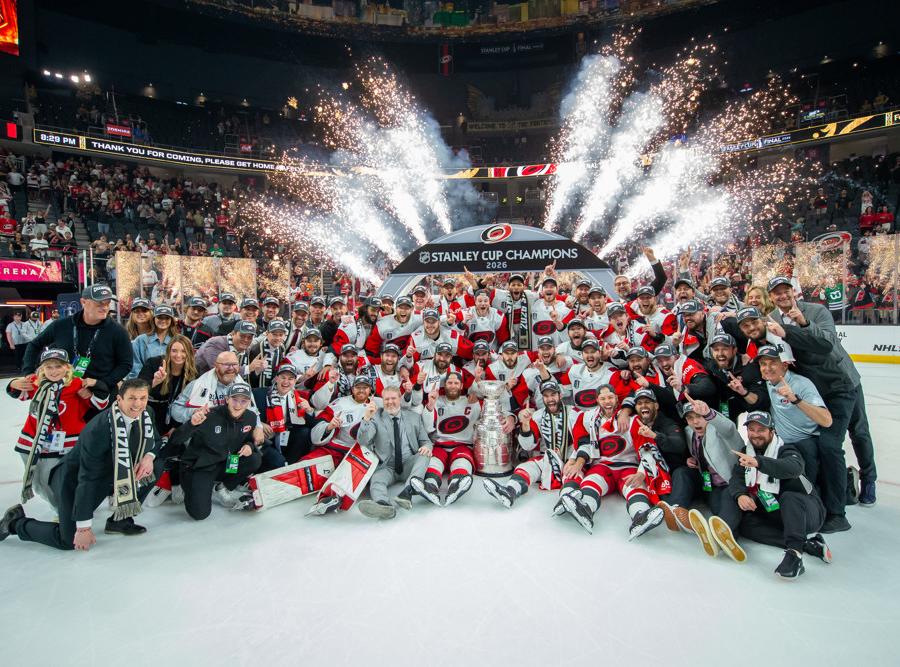


Rod Brind'Amour stood at centre ice of T-Mobile Arena in Las Vegas at 10:47 PM Eastern on June 14, 2026, and received the Stanley Cup for the second time. The first time he received it was June 19, 2006. He was the captain then, hoisting it as a player after scoring the Cup-winning empty-net goal in Game 7 against the Edmonton Oilers. The second time, he was the architect, the coach who spent eight years building exactly the kind of team that wins in June. Twenty years. Same franchise. Both sides of the greatest individual achievement in professional hockey. He is the seventh person in NHL history to win the Cup with the same franchise as both player and coach. He is only the fourth to win it as captain and then coach. The last was Toe Blake in 1968 with the Montreal Canadiens. The 2026 Carolina Hurricanes are Stanley Cup Champions. This is their full story.
They won sixteen games and lost three. They went from October 7, the opening night of the regular season in which they would finish 53-22-7, first in the Metropolitan Division, first in the Eastern Conference, to June 14, a Sunday night in Las Vegas, where Brandon Bussi recorded a shutout in his third consecutive start and Taylor Hall scored the first goal and Jackson Blake scored the second and Nikolaj Ehlers scored an empty-netter at 18:52 of the third period to seal it. Carolina won 3-0. They won the series 4-2. They won the Stanley Cup for the second time in franchise history, twenty years after the first.
Jordan Staal won the Conn Smythe Trophy as playoff most valuable player. Eight goals, four assists, twelve points in nineteen games. Six goals in the Stanley Cup Final alone, including the goal in Game 5 that tied the series when Vegas opened the scoring, as he has done in every major series of this postseason run. Staal fought Brady Tkachuk in the first minute of the first game of the first round, establishing the competitive temperature of an entire playoff run in a single two-minute penalty. He drew the toughest defensive assignments in every series. He won every single one. At 37, in his 19th NHL season, the man they call Jordo is a Stanley Cup champion for only the second time in his career, and the first time as the undisputed MVP of the run.
The Full Postseason Road
Round 1 · Carolina def. Ottawa Senators · Sweep (4-0). Carolina never trailed in a single game. Frederik Andersen posted a shutout in Game 1. Logan Stankoven scored in all four games. The Hall-Stankoven-Blake line immediately established itself as the most dangerous trio in the Eastern Conference. Andersen was otherworldly with three goals allowed across four games. The series was complete and clinical.
Round 2 · Carolina def. Philadelphia Flyers · Sweep (4-0). Carolina became the fifth team in NHL history to start a postseason 8-0. Taylor Hall scored an overtime winner in Game 2, off his knees. Jackson Blake scored the overtime winner in Game 4. Andersen continued his historic run, becoming the fourth goalie ever to allow two or fewer goals in his first eight postseason starts (Plante 1969, Sawchuk 1952, Benedict 1928). The Flyers were competitive in spurts and won zero games.
Eastern Conference Final · Carolina def. Montreal Canadiens (4-1). After 12 days off, Carolina walked into a buzz saw in Game 1, with Montreal scoring four first-period goals on the way to a 6-2 win. Then the machine restarted. Back-to-back overtime wins (Ehlers in Game 2, Andrei Svechnikov in Game 3). An 18-save Andersen shutout in Game 4 at Bell Centre with three goals in 2:46 of the first period. A 6-1 closeout in Game 5, with Andersen playing with a heavy heart after the passing of his agent and close friend. Ten unanswered goals from the Game 3 overtime through Game 5 before Cole Caufield scored. First team to reach the Final with one loss since 1983, and the only team to do it in the modern four-round format. Franchise's 100th playoff win came in Game 5.
Stanley Cup Final · Carolina def. Vegas Golden Knights (4-2). The most dramatic Stanley Cup Final in at least a decade. Three records broken in three games. A goaltender switch that changed the series. Jordan Staal scoring in every meaningful moment. Hall and Blake combining for the clinching goals. Bussi shutting out the Golden Knights to win the Cup in their building. 3-0. Six games. Done.
The Series That Won the Cup
VGKNikolaj Ehlers scored 25 seconds into the Stanley Cup Final, one of the fastest opening goals in the event's history, and added a second before the period was half over to put Carolina up 2-0. Lenovo Center was already at Stanley Cup Final volume, and the series looked like it was going to follow the script of Carolina's dominant Eastern Conference run. Then Vegas scored three consecutive goals, and everything the series would become was established in the first game: every lead surrendered, every result uncertain until the final horn.
Tomas Hertl redirected a sensational backhand pass from Colton Sissons at 56:36, with 3:24 remaining in regulation, to give Vegas the lead and eventually the win. Two Vegas goals were overturned on video review (a Stone goal for offside, an Eichel goal for goalie interference). Carolina's power play, which had been one of the best in the playoffs, went 0-for-2 with no shots. The Golden Knights stole home-ice advantage in Game 1 of the Stanley Cup Final.
CARVegas led 3-2 with 1:21 remaining in regulation. They had the series in their hands. Then John Tortorella challenged a Jordan Staal goal, a challenge that failed, drawing a penalty and producing a power play. Staal scored on it. The game was tied. Then, 3:56 into overtime, Seth Jarvis, the player every pre-series analysis had identified as needing to produce for Carolina to win, blasted a one-timer from the left faceoff circle, short side past Hart, and Carolina had the overtime win.
Carolina was 7-0 in overtime playoff games entering the game. They were 8-0 leaving it. Alex Pietrangelo took a puck to the face in the first period and didn't return, complicating Vegas's defensive deployment. Carolina's power play, invisible in Game 1, went 2-for-4. The tactical decision by Tortorella to challenge the Staal goal was the most consequential individual coaching moment of the series. What was intended to erase a goal instead produced the goal that tied the game and sent it to overtime where Carolina's record was historically dominant.
Tortorella's failed challenge. Had the challenge succeeded, Vegas leads 3-2 with under two minutes left and likely wins Game 2. Instead: penalty, power play, Staal goal, overtime, Jarvis.
VGKThe most extraordinary game in the 2026 Stanley Cup Final, and perhaps in Cup Final history since the 1942 comeback. In the second period, with Andersen in goal, Mitch Marner completed the fastest hat trick in Stanley Cup Final history, 6:10, breaking a record that had stood for 69 years. His four points in the period were the first time any player had scored four points in a single period in Cup Final history. He now held the Vegas franchise record for single-postseason scoring (28 points, breaking Eichel's 26 from the 2023 run).
Vegas led 4-0 entering the third. Brind'Amour replaced Andersen with Brandon Bussi, not played in two months, to start the third. At 4:04 of the third, Marner was sent in on a penalty shot. Bussi stopped it. Forty-three seconds later, the building was still processing what just happened. Then Jordan Martinook scored at 7:03. Hall scored at 7:25, 22 seconds later. Staal scored at 7:42, 17 seconds after that. Three goals in 39 seconds. The fastest three-goal sequence in Stanley Cup Final history. Down 4-1 just over a minute ago, tied 4-4 eight minutes later. Svechnikov tied it with 1:57 left in regulation. Carolina came within a double-overtime loss of completing the most improbable comeback in Cup Final history.
Then Shea Theodore fired a shot from the right point in the second overtime at 5:38. It hit the end boards at an unusual angle. It ricocheted into the net off Bussi's skate. "At that point of overtime you're just trying to get anything to the net and kind of hope for a bounce," Theodore said. He got one. Vegas 5-4 in double overtime. Series 2-1 Vegas.
Marner, who had just completed the fastest hat trick in Cup Final history, was sent in on a short-handed penalty shot at 4:04 of the third period. Brandon Bussi, in his first meaningful action in two months, stopped it. Three minutes later, three goals. The penalty shot stop is the reason Carolina won the Stanley Cup. The bounce that beat Bussi in double overtime is the footnote. The save that preceded it is the paragraph.
CARBrind'Amour kept Bussi in goal - "Freddie needs a little break," his goalie coach had said - and the backup goaltender who hadn't played a competitive game in two months became the first goaltender since 1961 to win his playoff debut in the Stanley Cup Final. In his first true start of the playoffs, Bussi was the better goaltender on the ice. He stopped shots that Hart couldn't. He held the game together when Vegas rallied from 3-1 down to tie it at 3-3. He controlled his crease with the composure of a veteran who had been here before, not a player who had been waived by Carolina days before the season opener.
Staal's game-winning goal was the image of the series: the 37-year-old captain, falling to the ice after being hit, chipping the puck over Hart's outstretched glove. A Shea Theodore turnover in the neutral zone had set it up. The same Theodore whose double-overtime bounce had won Game 3 for Vegas. The series was tied 2-2. The narrative had shifted completely. "He's the heart of what we're doing," Brind'Amour said of Staal after the game. He was not wrong.
Staal's game-winner while falling to the ice. The image of the series, a 37-year-old champion, already on his way down, finding a way to chip the puck over the goaltender's glove before he hit the ice.
CARCarolina led the series 3-2 and was one win from the Cup. Lenovo Center was the loudest it had been all postseason. Vegas opened the scoring, Pavel Dorofeyev on the power play, and for a moment the crowd's nerves tightened. Then Staal scored his sixth goal of the series to tie it, the same Staal who had been doing this all postseason, the same response that made this team's identity what it was. Then Svechnikov scored a go-ahead power-play goal from the left wing. Then Sebastian Aho, whose absence from the scoring sheet across the first four games had been the one legitimate question about whether every piece of Carolina's offence was functioning, snapped a wrist shot from in tight over Hart's shoulder for his first goal of the series. Bussi stopped 23 shots.
Carolina dominated faceoffs (58.5%). They controlled puck possession. They played the system Brind'Amour had been building for eight years: compression, gap control, every line contributing, nobody trying to do too much. Staal had a goal. Svechnikov had two. Aho had his first. Ehlers had three assists. The Hall-Stankoven-Blake line didn't score but drove possession and generated the chances that the secondary options converted. Brind'Amour said after: "I'm really proud of our group. We've been doing it all year, and they did it again tonight." One game from the Cup.
Sebastian Aho's first goal of the series, a snap shot from in tight that ended the one lingering question about Carolina's offence. The team that had been carrying the series without its second-best forward now had him. Everything was working.
CARBrandon Bussi pitched a shutout. He was perfect. He stopped every shot Vegas managed, including an Eichel-and-Stone 2-on-0 on the power play, the two most dangerous players in the building, unmarked in front of him, and he stopped them both. The crowd that had been trying to intimidate Carolina's backup goaltender for 60 minutes, the player who was waived before the season started, who hadn't played a game since March, who had never won a Stanley Cup Final game before Game 4, was silenced by him personally, one save at a time.
Taylor Hall scored first. The No. 1 overall pick from 2010 had never won a Stanley Cup in 15 NHL seasons with Edmonton, Buffalo, New Jersey, Arizona, Boston, St. Louis, and Chicago before arriving in Carolina. He scored the goal that opened the scoring in the game that won the 2026 Stanley Cup. Jackson Blake scored the second, the seventh of his first full playoff run, the product of a line that had been the most productive in these playoffs from the first game of the first round. Nikolaj Ehlers put an empty netter in at 18:52 of the third period to conclude the scoring. His eighth goal of the playoffs. His first season as a Hurricane. His first Stanley Cup.
The horn sounded at 3-0. Carolina won the Stanley Cup. Rod Brind'Amour walked out from behind the bench. The players piled onto Bussi. The Cup was brought to centre ice. Gary Bettman announced the Conn Smythe Trophy winner: Jordan Staal. The captain, in his final playing years, 37 years old, having played a lifetime of hockey in this league, received it with the expression of a man who has done what he set out to do and cannot quite believe it is over. Then he received the Stanley Cup from Brind'Amour, and he skated it around T-Mobile Arena, and the fans who had come to Las Vegas to watch Carolina win it cheered in a building that had expected to host a different celebration entirely.
Brandon Bussi - waived before the season, not played since March, starting his first career Stanley Cup Final game in Game 4, shutting out the team that had the NHL's leading scorer in the postseason - stops the puck for the final time. 3-0. The horn sounds. The Carolina Hurricanes are the 2026 Stanley Cup Champions. Twenty years after 2006. Same franchise. Same coach, different side of the bench.
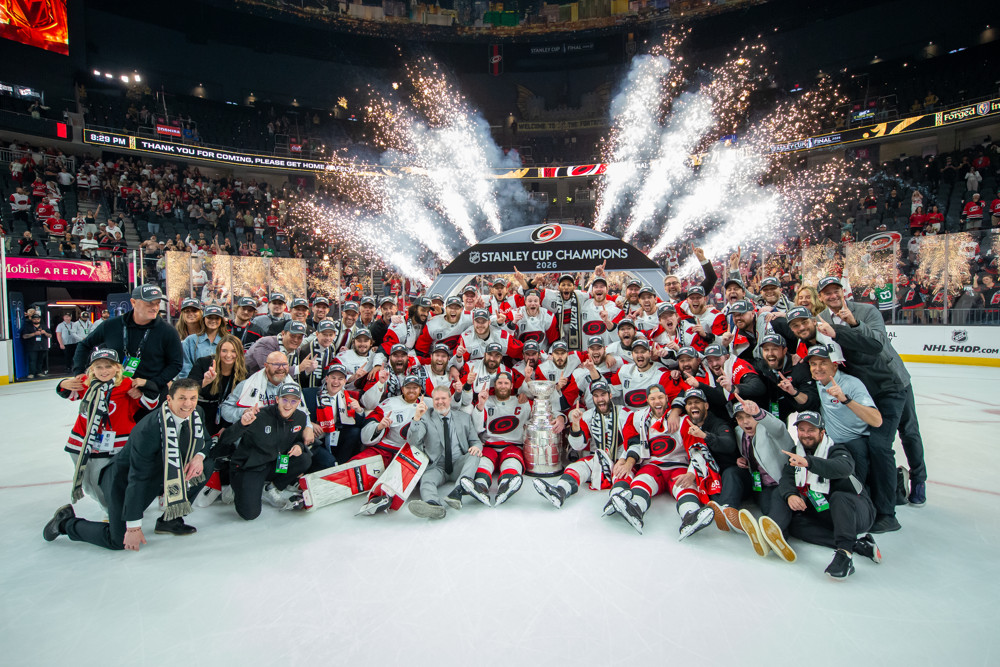 Stanley Cup Champions. The Carolina Hurricanes gather at centre ice of T-Mobile Arena, Las Vegas - June 14, 2026.
The Players Who Made It Happen
Jordan Staal · 12 pts (8G-4A) in 19 GP · 6 goals in the Stanley Cup Final
He fought Brady Tkachuk in the first minute of the first game of the first round and set the competitive temperature for an entire playoff run. He drew the toughest defensive assignments in every series and won every one. He scored six goals in the Stanley Cup Final, including the game-winner in Game 4 while falling to the ice, and the tying goal in Game 5 when Vegas scored first. He won his second Stanley Cup at 37, seventeen years removed from his first. The Conn Smythe was not a close call.
He was the player who made every game feel winnable, every deficit feel temporary, and every opponent feel like they were playing against something that would not quit regardless of the score. "It's amazing," he said at centre ice with the Cup in his hands. "What a battle, what a feeling." He had earned both.
Brandon Bussi · 3-0 in SCF starts · Game 6 Shutout · Stopped Marner's penalty shot
He was waived by Carolina days before the season opener. He didn't play a game in the regular season - Andersen was dominant, and Bussi was the backup who stayed ready and contributed nothing visible. Then Andersen allowed four goals in two periods in Game 3 of the Stanley Cup Final, and Brind'Amour sent Bussi in to start the third period of a game Carolina trailed 4-0. His first act was stopping Mitch Marner, the player who had just completed the fastest hat trick in Cup Final history, on a penalty shot.
"It's been an honor to be able to do it with this group, everyone deserves it so much," Bussi told ESPN on the ice after the Cup ceremony. He then won Game 4, Game 5, and posted the shutout in the championship clincher. Three starts. Three wins. One shutout. One Stanley Cup. No prior playoff experience before Game 4. One of the most improbable stories in goaltending history.
The Most Productive Trio in the 2026 Playoffs
The line that defined the 2026 Carolina Hurricanes. Taylor Hall, the 2010 No. 1 overall pick in his 15th NHL season playing for his first Stanley Cup, provided the playmaking vision that made the entire unit function. Logan Stankoven provided the net-front finishing: he scored in all 16 of Carolina's 2026 playoff wins, one of the most consistent individual postseason streaks in franchise history. Jackson Blake provided the clutch production: two overtime winners in the second round, the second goal in the Cup-clinching Game 6.
Hall scored the first goal in Game 6. Blake scored the second. "Championships are the ultimate goal, and they link you forever," Hall said after the game. It was the truest thing said in Las Vegas on June 14.
Rod Brind'Amour · 7th in NHL history to win the Cup as player and coach with the same franchise
He was Carolina's captain in 2006 and scored the empty-netter that clinched the franchise's first Stanley Cup in Game 7 against Edmonton. He became Carolina's head coach in 2018-19 and spent eight seasons building a team specifically designed for June: disciplined, physical, deep, defensively structured around a historically excellent goaltender.
The 2026 run was the completion of the project: 13-1 before the Final, the most dominant start to a playoff campaign in modern history, a system that produced 25-for-25 penalty killing across 19 games and allowed fewer than two goals per game in the first three rounds. He is the seventh person in NHL history to win the Cup with the same franchise as player and coach. He is only the fourth to do it as captain and coach. The last was Toe Blake with the 1968 Montreal Canadiens. Twenty years. Same franchise. Both sides.
| Stat | Frederik Andersen | Brandon Bussi |
|---|---|---|
| Role | Rounds 1-3 + SCF G1-G3 | SCF G3 relief + G4-G6 |
| Games Played | 16 | 4 |
| Record | 13-1 | 3-0 |
| Save % | .931 | .941 |
| Goals Against Avg | 1.62 | ~1.00 |
| Shutouts | 3 | 1 |
| Cup Final Note | Replaced in G3 2nd int. | Won Cup in his playoff debut starts |
The statistical frontrunner for the Conn Smythe Trophy entering the Final was Andersen. .931 save percentage, three shutouts, 13-1 record across the first three rounds. His performance through the ECF was historically elite. In the Cup Final, he struggled: allowed four goals in each of Games 1, 2, and 3 before being replaced at the start of the third period of Game 3. His agent had passed away during the ECF. He played Game 5 of the ECF with a heavy heart. The circumstances around his Final performance were significant. He remained on the bench for every remaining game, part of the championship organisation even in a supporting role. He is, on the evidence of rounds 1-3, the best goaltender in the 2026 NHL playoffs. He simply did not finish it.
Bussi closed it. Three wins in the Final, one shutout, the penalty shot stop that changed the series. Championships require both. The 2026 Hurricanes had both.
Turning Point 1 - Game 2, Tortorella's Failed Challenge
Vegas led 3-2 with 1:21 remaining. Tortorella challenged a Staal goal. The challenge failed. A penalty was awarded. Staal scored the power-play goal on the ensuing man advantage. Jarvis won it in overtime. Had the challenge succeeded, Vegas almost certainly wins the game and leads the series 2-0 in Raleigh. Instead: tied series, Carolina's momentum, the franchise's 8-0 overtime record extended to 9-0.
Turning Point 2 - Game 3, Bussi Stops Marner's Penalty Shot
Down 4-0 in the third period. Andersen replaced by Bussi. First significant event: Marner, who had just set the fastest hat trick record in Cup Final history, is sent in on a penalty shot. Bussi stops it. Within 39 seconds: three goals. Within 11 minutes: tied. The penalty shot stop is the pivot point of the entire series.
Turning Point 3 - Brind'Amour Starts Bussi in Game 4
"Freddie needs a little break." Brind'Amour started Bussi in Game 4 in T-Mobile Arena, in a must-not-lose situation, with the series tied. Bussi was the better goaltender in that game. He was the better goaltender in Game 5. He pitched the shutout in Game 6. The decision to trust Bussi - made before Game 4, maintained through Game 6 - is the most consequential coaching call of the 2026 playoffs.
Turning Point 4 - Game 5, Aho Scores His First Goal
Sebastian Aho had played four Cup Final games without a goal. Carolina had won two of those games anyway. When Aho finally scored, a snap shot from in tight over Hart's shoulder in Game 5, the team was no longer carrying him. He was contributing. The full version of the Carolina team: Staal defensive, Svechnikov power play, Aho scoring, Hall and Blake setting up, Bussi stopping. Everything working simultaneously. One game from the Cup.
| Player | GP | G | A | PTS | +/- |
|---|---|---|---|---|---|
| Taylor Hall | 19 | 7 | 13 | 20 | +12 |
| Logan Stankoven | 19 | 12 | 7 | 19 | +14 |
| Jackson Blake | 19 | 7 | 9 | 16 | +11 |
| Nikolaj Ehlers | 19 | 8 | 6 | 14 | +9 |
| Sebastian Aho | 19 | 4 | 9 | 13 | +10 |
| Jordan Staal | 19 | 8 | 4 | 12 | +8 |
| Shayne Gostisbehere | 19 | 3 | 8 | 11 | +9 |
| Seth Jarvis | 19 | 5 | 5 | 10 | +8 |
| Jaccob Slavin | 19 | 1 | 8 | 9 | +11 |
| Andrei Svechnikov | 19 | 4 | 4 | 8 | +7 |
Logan Stankoven scored in all 16 wins. Taylor Hall, the former first-overall pick, scored the Game 6 opener and finished as Carolina's points leader. Jackson Blake added two overtime winners in Round 2 and the second goal in the clincher. Jordan Staal was the Conn Smythe winner with six goals in the Final alone. Nikolaj Ehlers, in his first season as a Hurricane, scored eight playoff goals including the empty-netter that sealed the Cup. Sebastian Aho arrived in Game 5 with his only goal of the series. Shayne Gostisbehere quarterbacked the power play. Seth Jarvis hit the Game 2 overtime winner. Jaccob Slavin was, in Brind'Amour's words, "everywhere on defence."
- First team in the modern four-round format to reach the Stanley Cup Final with one loss. Their 13-1 record entering the Final was the best by any team in the modern playoff era. The 1983 New York Islanders (12-1) was the last comparable record in any format.
- First team since 1987 to sweep two rounds and still reach the Final. Carolina swept Ottawa (4-0) and Philadelphia (4-0) in rounds 1 and 2, only the fifth team in NHL history to start a postseason 8-0.
- 25-for-25 penalty killing in the 2026 playoffs. A perfect penalty kill across 19 games. A historically unprecedented level of shorthanded discipline across a full postseason run.
- Rod Brind'Amour: 7th person in NHL history to win the Stanley Cup as both player and coach with the same franchise. Only the 4th to do so as captain and coach. The last: Toe Blake with the 1968 Montreal Canadiens.
- Brandon Bussi: First goaltender since 1961 to win his playoff debut in the Stanley Cup Final. He then won Games 5 and 6 of the same series, finishing 3-0 with a shutout.
- Frederik Andersen: 4th goalie in NHL history to allow two or fewer goals in his first eight postseason starts (Plante 1969, Sawchuk 1952, Benedict 1928). His .931 across rounds 1-3 was one of the most dominant goaltending stretches in modern playoff history.
- Occupied a playoff spot for the entire 2025-26 regular season. 53-22-7, 113 points, first in the Metropolitan Division, first in the Eastern Conference. Never out of a playoff position from October to April.
- All 20 Carolina skaters finished the postseason with a positive plus-minus. A team-wide defensive contribution that reflected the depth and system quality of Brind'Amour's roster construction.
- Logan Stankoven scored in all 16 Carolina wins. Across rounds 1-3 and the SCF games Carolina won, Stankoven contributed a goal in every single victory.
- Carolina's 100th franchise playoff win came in Game 5 of the Eastern Conference Final against Montreal. Brind'Amour has been part of 98 of those wins (39 as player, 59 as coach).
“It's amazing. What a battle, what a feeling.”
“Championships are the ultimate goal, and they link you forever.”
“It's been an honor to be able to do it with this group, everyone deserves it so much.”
“You never know this is going to happen.”
“I'm really proud of our group. We've been doing it all year, and they did it again tonight.”
The Vegas Golden Knights finished their season 12-6, losing the final four games of their postseason, including the three-game sweep by Bussi and Carolina that ended it. Mitch Marner had the most extraordinary individual Cup Final performance of the 2026 postseason: nine points in six games, the fastest hat trick in Final history, a franchise-record 28 playoff points, the record for points in a single period in Cup Final history. He was arguably the best individual player in the series. His team did not win.
The reason it didn't win is the reason most teams don't win the Stanley Cup: the other team was deeper, more structured, and had a goaltender who was unexpectedly excellent at the moment the series required it most. Vegas's depth scoring, Pavel Dorofeyev who had led all scorers through three rounds, was contained in the Final to two power-play goals. Jack Eichel's 18 assists translated to less production than expected when Carolina's defensive structure removed the seam passes he had been exploiting all postseason. John Tortorella's failed challenge in Game 2 was the single worst individual coaching decision of the series. The rest was simply Carolina's system being better than Vegas's system across four of six games.
The Golden Knights are 3-3 all-time in Stanley Cup Finals in nine years of existence. They have won once. They remain the most successful expansion franchise in North American professional sports history. Nothing about losing this series diminishes that legacy. It simply ends their 2026 season. They will be back.
Sixteen wins. Three losses. The most dominant playoff run in the modern era.
Bussi stopped the penalty shot. Staal scored the goals. Brind'Amour raised the Cup for the second time. Twenty years between the two. Same franchise. Same city. Same coach, different side of the bench.
The 2026 Carolina Hurricanes will be remembered for everything: the 13-1 record before the Final, Andersen's .931 save percentage across three rounds, the Hall-Stankoven-Blake line's 47 points in the first three rounds. The 25-for-25 perfect penalty kill.
They will be remembered for the specific moments: Bussi stopping Marner's penalty shot in a game Carolina trailed 4-0. Three goals in 39 seconds in the most extraordinary third period in Cup Final history. Staal scoring while falling to the ice in Game 4. Hall scoring first in Game 6 - the former first-overall pick finally getting his night. Blake scoring second. Ehlers adding the empty-netter at 18:52 to conclude the scoring.
They will be remembered for Staal hoisting the Conn Smythe Trophy at 37 years old, seventeen years after his first championship, having fought and defended and scored and led his way through nineteen playoff games as if each one was his last. And for Bussi's face when the horn sounded - the goaltender nobody expected, in the place nobody predicted, doing the thing everyone will remember.
And they will be remembered for Brind'Amour - walking onto the ice of T-Mobile Arena, receiving the Stanley Cup for the second time in his life, twenty years after the first, having built the team that won it from the ice up, from the principles of defensive discipline and four-line depth and the patient refusal to accept that there was any other way to do this. He was right. He was always right. The 2026 Carolina Hurricanes are the proof.