
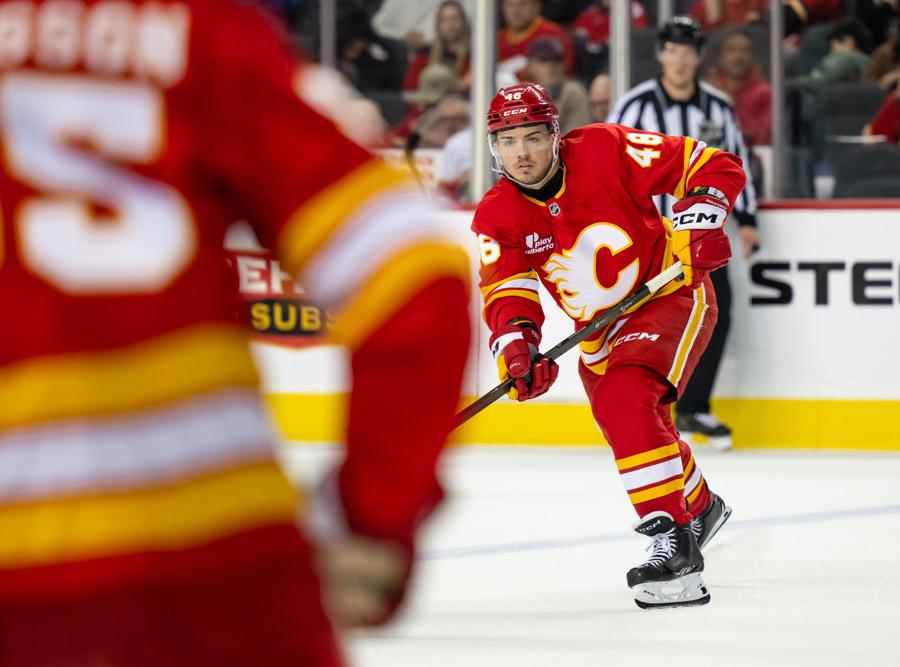

They started 5-13-2, the worst opening in franchise history. They recovered enough to tease wild-card relevance at the midpoint. Then they sold Kadri and Andersson and finished last in the Pacific. Huberdeau's contract remains. Dustin Wolf is real. The rebuild continues to resist completion.
By Pucky Editorial · May 2026 · 2025–26 Season Review Series
Phase 1 · Oct–Nov: Worst Start in History
5-13-2 after 20 games · last in NHL · Huberdeau injured
Phase 2 · Dec–Feb: Recovery
13-6-1 in 20 games · near wild card at midpoint · Wolf steadied
Phase 3 · Mar 6 on: Sell Mode
Kadri → COL · Andersson → VGK · Weegar dealt · rebuild acknowledged
The worst start in franchise history. That was the opening act of Calgary's 2025-26 season, 5-13-2 after 20 games, dead last in the National Hockey League, a performance so poor that the analytical community began debating whether the Flames would produce a top-three draft pick rather than whether they would make the playoffs. What followed was the season's most interesting internal contradiction: a recovery so strong, 13 wins in 20 games across December and January, that the team found itself three points from a wild-card spot at the midpoint. And then, gradually, inevitably, the same structural problems that had produced the worst start in franchise history reasserted themselves. The road record deteriorated. The offence, which had never truly solved its goal-scoring deficiency, sputtered again. And at the trade deadline, GM Craig Conroy accepted the reality that every decision-maker eventually must accept in a situation like this: the team is not close enough to contention to justify holding veterans whose contracts or futures don't align with the rebuild timeline.
Nazem Kadri went to Colorado. Rasmus Andersson went to Vegas, where he played through the postseason as the Golden Knights reached the Stanley Cup Final. MacKenzie Weegar was moved. The skeleton that remained was younger, cheaper, and honest about what it is: a team in transition that has now missed the playoffs in four consecutive seasons after reaching the second round as recently as 2021-22. Four years without a playoff appearance is not unusual for an organisation in full rebuild mode. It is unusual for one that keeps insisting, publicly, repeatedly, that it is not in full rebuild mode. That tension, between what the Flames say they are and what the standings say they are, is the defining narrative of this franchise's recent history and will remain so until the results change.
Home vs Road, The 2025-26 Calgary Paradox
They Were a Legitimately Good Home Team. They Were One of the Worst Road Teams in the League. The Gap Between Those Two Facts Is the Season.
Home Record at Scotiabank Saddledome 22-12-5
.603 points percentage · near-playoff quality at home
Road Record 11-26-3
.313 points percentage · among the league's worst
A .603 home points percentage is borderline playoff quality. Sustained over a full season on both home and road ice, that rate produces a playoff team. The Flames were not that team on the road, where their 11-26-3 record was one of the worst in the Western Conference. The gap, .290 percentage points between home and road performance, is the kind of discrepancy that reflects either a coaching system that is not translating between environments, a roster that relies on crowd energy and home comfort that disappears on the road, or both. Whatever its cause, it is the most important structural question the organisation must answer. You cannot be a playoff team at home and a bottom-three team on the road at the same time. The season record reflects the average of those two very different teams.
How 2025-26 Played Out
Phase 1, October to November 5-13-2 after 20 games · worst start in franchise history · last in the NHL
Jonathan Huberdeau missed the first five games with an injury, and what the team showed without him was exactly the structural problem that critics had been identifying for two seasons: they do not have a game-changer up front. Without a dominant first-line centre or a winger capable of single-handedly changing the contest, Calgary's offence was sterile. The power play ranked last in the league at 14.6% at points in the early season. The team allowed more than they scored almost every night. The crowd at Scotiabank Saddledome, which had supported this franchise through lean years before, began asking the question that always emerges when a rebuild drags: is the organisation being honest about what it is and what it will take to fix it?
The 5-13-2 start was not a run of bad luck. It was the clearest possible statement of where the roster stood. The saving grace was Dustin Wolf, who was keeping the deficit manageable on many nights when the defensive structure in front of him was insufficient. He was the reason some of those losses were close. Without him, the start could have been worse.
Phase 2, December to February 13-6-1 over 20 games · 3 points from wild card at midpoint · best stretch of the season
The recovery was real and somewhat remarkable. Calgary won 13 of 20 games across December and January, a stretch that moved them from the very bottom of the league to within three points of a wild-card spot. Kadri found his form and was producing at a rate that made him the clear team leader in every meaningful offensive category. Morgan Frost, who had a nightmare 2024-25, was much improved, sitting second on the team in scoring by the midpoint. Home ice was the difference: the 12-6 home record during this stretch was playoff-calibre hockey in the building that had always been the team's strength.
It was a December-January mirage of sorts, the team was never actually as good as the winning percentage suggested, but it gave the fanbase genuine hope and gave Conroy a difficult question heading into the trade deadline: do you sell Kadri and acknowledge the rebuild, or do you hold and push for a wild card that still felt within reach at the midpoint? The answer arrived in the standings, not from the front office. The results deteriorated before Conroy had to commit fully.
Phase 3, March 6 Trade Deadline and After Kadri, Andersson, Weegar all dealt · rebuild acknowledged · youth in charge
On March 6, Conroy moved Kadri to the Colorado Avalanche, the same day Colorado dealt Dickinson, Murphy, and other veterans. Rasmus Andersson, a reliable defensive defenceman who had been the team's most consistent blue-line presence for several years, was dealt to the Vegas Golden Knights, where he appeared in the Stanley Cup Final. MacKenzie Weegar was also moved. The three departures stripped the roster of its veteran core and confirmed what the standings had been suggesting since November: this was not a playoff team, and attempting to squeeze into the wild card with this roster would cost the organisation assets without improving the long-term trajectory.
What remained was a younger roster that played with more freedom and less pressure after the deadline. Matt Coronato emerged as the team's leading scorer. Morgan Frost produced consistently. The young defencemen were given extended opportunities. The final month of the season was played as development time, and it produced the kind of data about who the Flames actually are without the veterans that Conroy needed to make summer decisions with confidence.
The $84 Million Contract That Changed the Franchise's Direction - and Has Yet to Deliver What It Promised.
In 2022, Calgary signed Jonathan Huberdeau to an eight-year, $84 million contract extension - the most expensive contract in franchise history, signed the same summer they acquired Matthew Tkachuk and made one last push for contention. Tkachuk was gone before that push even began, traded to Florida in the deal that brought Huberdeau to Calgary. The rationale made sense at the time: Huberdeau was coming off a 115-point season with the Panthers, arguably the best season of his career. He was 29 years old. He was going to be the centrepiece of Calgary's next contention window.
It has not gone that way. Huberdeau's production in Calgary has been a fraction of what he delivered in Florida. His injury-interrupted 2025-26 season - he missed the first five games, then played inconsistently once he returned - was another year that did not match the contract's implied output. The eight-year deal runs through the 2029-30 season. The cap hit is significant. For a franchise attempting to rebuild around younger players, carrying a top-of-roster contract for a forward who is not producing at that level limits the flexibility that rebuilds require. Conroy has been careful in public about Huberdeau, always expressing faith in his eventual return to full production. That faith will be tested again in 2026-27, when Huberdeau will be 31 and entering the stretch of the contract where declining on-ice performance and rising cap hit become the most uncomfortable combination in modern hockey management.
None of this is a character indictment of Huberdeau, who is by every account a professional and a committed teammate. It is an honest accounting of where the franchise sits: committed to an expensive contract for a player who has not produced at contract level in three consecutive seasons, on a roster that ranked 32nd in goals scored at multiple points this season, with no obvious path to generating the first-line offensive output the team has been missing since Johnny Gaudreau left.
Who Stood Out, Who Struggled, Who Gives Hope
2025–26 Individual Season Grades
22 wins · .901 SV% at midpoint · best backstop this team has had in years
The clearest positive in a difficult season. Wolf is developing into a legitimate NHL starting goaltender, not just a capable backup, but a goalie who can make saves in close games and keep a below-average defensive team competitive on individual nights. His 22 wins led the team. His save percentage at the midpoint (.901) reflected the burden of playing behind a team that ranked among the league's worst defensively. He is 24. He is the most important piece of the rebuild that the organisation did not acquire through a trade. Keep him.
41 pts (12G–29A) in 61 GP before trade to Colorado · team's best forward until departure
He has been the best forward on this team for three seasons running, and the gap between him and the next contributor has been the most damning individual statistic of the Calgary rebuild. His 41 points in 61 games, delivered on a team that ranked 32nd in offence for stretches of the season, demonstrated his individual quality while highlighting the structural problem around him. He went to Colorado and played a meaningful role in their WCF run. Calgary got assets in return. Whether those assets are sufficient is the summer's first question for Conroy.
+12 (team leader) · 20 goals · consistent two-way contributor
The team's best plus-minus (+12 in a year when the team's overall differential was deeply negative) and one of only two forwards to score 20 goals. Coleman is the platonic ideal of what a middle-six forward should be: physical, reliable, defensively responsible, capable of producing opportunistic goals. He is the player who makes the team around him measurably better without carrying any single line's entire offensive burden. He has been this every season in Calgary. The question is whether that is enough for where this organisation needs to go.
45 pts (team-leading by season's end) · 18G · significant development leap
The young right-winger emerged as the team's scoring leader in the post-deadline stretch and finished with 45 points, the highest total on the roster by the season's end. He is the evidence that Calgary's forward pipeline is not completely empty. His development trajectory (from fringe NHL player to team leader) is the most encouraging individual forward story of the season, and he enters 2026-27 as the player around whom the front office most clearly needs to build the offensive identity.
21G–22A–43 pts · significant bounce-back after nightmare 2024-25
Frost had one of the worst individual seasons of any full-time forward in 2024-25, leading to questions about his NHL future. His 2025-26 was a meaningful rebound: 21 goals, 43 points, and consistently competitive two-way play. He is not a franchise centre, the gap between what this team needs up the middle and what he provides is still real, but his recovery from a terrible season demonstrates professional character that Huska and Conroy needed to see.
43 pts · 26A · 36 years old · captain for likely the final time
Backlund has been Calgary's captain for years and has represented the franchise with professionalism through a difficult stretch. His 43 points at age 36 are better than most veterans manage in decline. But the honest assessment is that this is his final season as captain and possibly his final season in a Flames uniform, depending on the offseason direction. He is not the player the next version of this team is built around. He is a person who deserved a better team around him during his prime.
Injured early, inconsistent after return · fourth disappointing season in Calgary
The grade is not C-minus because of his effort or his professionalism, it is C-minus because an $84 million contract comes with expectations that have not been approached in any season since his arrival. He is a good NHL forward. He is not the first-line driver that contract implied and that this team requires. At 31 next season, on the back half of a deal that runs to 2030, the question is no longer "will he return to his Florida form?" but "what version of Huberdeau is available at this stage of his career, and what does that mean for the roster built around him?"
Second full season · the home/road split is the most pressing tactical question
The home record under Huska (22-12-5) is evidence that his system and culture can work. The road record (11-26-3) is evidence that it currently does not work in hostile environments without home crowd energy. That is not an unusual problem for developing teams, younger rosters often lean on home support in ways that veterans compensate for on the road. But four seasons is long enough for a trend to become a pattern. The road performance is the most important tactical item Huska must address in 2026-27.
2025–26 Calgary Flames, Key Statistical Leaders
| Player | POS | GP | G | A | PTS | Note |
|---|---|---|---|---|---|---|
| Matt Coronato | RW | 82 | 18 | 27 | 45 | Team leader (post-deadline) · major development leap |
| Morgan Frost | C | 80 | 21 | 22 | 43 | Bounce-back season · 21G best in career |
| Mikael Backlund | C | 82 | 17 | 26 | 43 | Captain · 36 years old · still producing |
| Nazem Kadri | C | 61 | 12 | 29 | 41 | Traded to Colorado Mar 6 · best Flame until departure |
| Joel Farabee | LW | 80 | 20 | 18 | 38 | Solid depth forward · 20G |
| Blake Coleman | RW | 82 | 20 | , | +12 | Team-leading plus/minus · 20 goals · two-way reliability |
| Dustin Wolf | G | ~50 | , | , | 22W | .901 SV% at midpoint · franchise's best goalie since Markstrom |
| Adam Klapka | F | , | , | , | 110 PIM | Team PIM leader · physical presence |
What This Season Was and What Comes Next
Dustin Wolf Is a Real Starting Goaltender
The most important individual development of the season. Wolf's progression from promising prospect to legitimate NHL starter resolves the most persistent question about the rebuild's feasibility: they now have a goaltender they can commit to. Every rebuild that produces a playoff team eventually requires a goalie to grow into the position. Wolf appears to be that goalie.
Coronato's Emergence - The Forward Core Has a Legitimate Option
Coronato finishing as the team's leading scorer in the post-deadline stretch (and across the full season at 45 points) is the most encouraging individual forward development since the rebuild began. He is not a first-line driver yet, but he is the kind of secondary producer who makes a first-line driver's production more sustainable. He should enter 2026-27 as the team's most important offensive asset to build around.
208 Goals Scored - Third-Fewest in the League, Four Straight Years Without Playoffs
The Flames ranked third from last in goals scored (208) and last in shots on goal at various points during the season. They have not solved the offensive problem that has defined their post-Gaudreau era. Huberdeau has not replaced Gaudreau. No one else has either. The 2026 draft and the Kadri/Andersson/Weegar return need to produce the first-line generator that everything else is waiting for.
11-26-3 Away From Calgary - One of the Worst in the League
A .313 road points percentage is historically poor. Combined with a .603 home percentage, it suggests a team that is psychologically and structurally dependent on home support in ways that need to be addressed before the team can compete for a playoff spot. Road wins in April are what separate bubble teams from playoff teams. Calgary could not get them this year.
Huberdeau's Contract is the Rebuild's Biggest Obstacle
Eight years. $84 million. Runs to 2030. Huberdeau is 30 next season. His production has never approached what the contract implied and what the team needed. The cap space consumed by that contract is space not available for the high-end forward acquisition the team's offence requires. Until the Huberdeau situation resolves - either through a production return or a creative trade - the rebuild has a structural ceiling it cannot fully break through.
The Assets From Three Trades Must Produce Something Decisive
, ✦ ,
D+
Four straight missed playoffs. The worst start in franchise history. A home team that almost played .600 hockey, a road team that almost played .300 hockey. The rebuild continues to resist completion.
Wolf is real. Coronato is real. Frost bounced back. Coleman was reliable. The home record, for two months of the season, suggested something was working. Then the road record reminded everyone what wasn't.
Huberdeau is still in the lineup, still on the contract, still not producing at the level the franchise needed when it signed him. Backlund is 36. The captain era is ending. The first-line forward spot is still unfilled four years after Gaudreau left for Columbus and didn't come back.
The D+ reflects two things simultaneously: the genuine development of Wolf and Coronato (not D territory) and the fourth consecutive missed playoff on a roster that is no closer to contention than it was when the rebuild was declared. The summer must produce a first-line forward. Everything else in Calgary depends on whether it does.
© 2026 Pucky.com · NHL Hockey Analytics & Editorial · 2025–26 Season Reviews · #29 Calgary Flames · Next: #28
Season Review Verdict
Four straight missed playoffs. The worst start in franchise history. A home team that almost played .600 hockey, a road team that almost played .300 hockey. The rebuild continues to resist completion. Wolf is real. Coronato is real. Frost bounced back. Coleman was reliable. The home record, for two months of the season, suggested something was working. Then the road record reminded everyone what wasn't. Huberdeau is still in the lineup, still on the contract, still not producing at the level the franchise needed when it signed him. Backlund is 36. The captain era is ending. The first-line forward spot is still unfilled four years after Gaudreau left for Columbus and didn't come back. The D+ reflects two things simultaneously: the genuine development of Wolf and Coronato (not D territory) and the fourth consecutive missed playoff on a roster that is no closer to contention than it was when the rebuild was declared. The summer must produce a first-line forward. Everything else in Calgary depends on whether it does.