
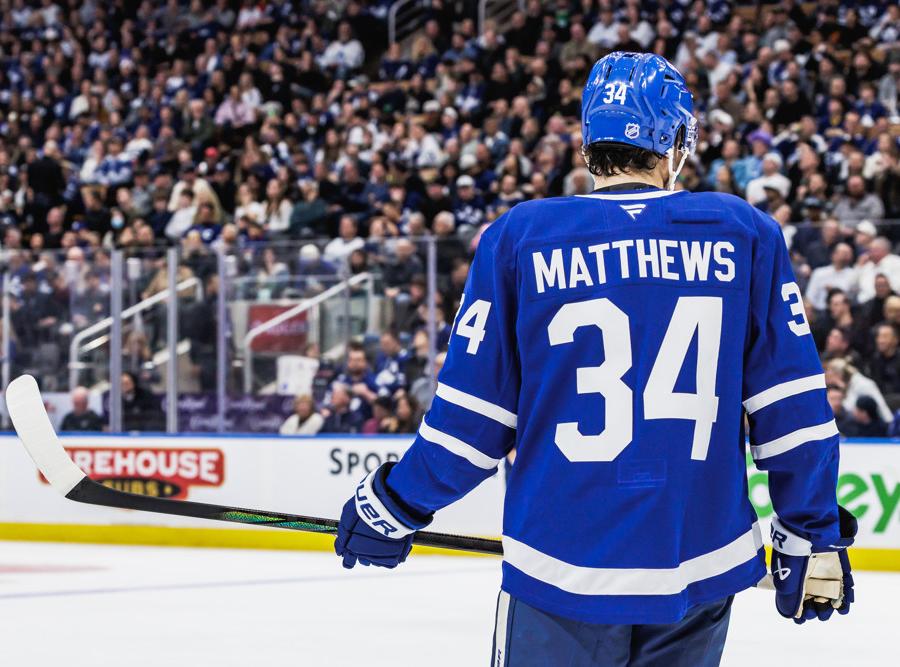

They fell 30 points from the prior season, the largest single-season decline in franchise history. The nine-year consecutive playoff streak, the longest active run in the NHL, is over. The goaltenders who were elite collapsed. The power play was dead last. The culture cracked. And Mitch Marner is now on the Stanley Cup Final stage for Vegas. It was that kind of year.
By Pucky Editorial · May 2026 · 2025–26 Season Review Series
Pre-Season: The Marner Departure
Sign-and-trade to Vegas July 1 · 102 pts replaced by 74 combined
Oct–Jan: Worse Than Expected
Defence collapsed · goaltending fell apart · PP dead last
Feb (Olympics): Matthews Injured
Gudas knee hit · Grade 3 MCL · season over early
Mar–Apr: Clean House
Treliving fired Mar 30 · Berube fired offseason · Chayka new GM
The 2025-26 Toronto Maple Leafs season ended a nine-year consecutive playoff appearance streak, the longest active run in the NHL, and produced the largest single-season point decline in franchise history. Thirty points. From 108 in 2024-25 to 78 in 2025-26. From first in the Atlantic Division to eighth. From a team that made the second round of the playoffs for the first time in the modern era to a team that was eliminated from postseason contention in late March. The same core players. The same coach. A different general manager who had made a decision in the summer that turned out to be the single most consequential transaction of the season, and it wasn't even close.
Mitch Marner, signed and traded to the Vegas Golden Knights on July 1, is playing in the Stanley Cup Final. He has 21 playoff points. He scored the fastest hat trick in Cup Final history. He holds the Vegas franchise record for single-postseason scoring. The $10.9 million in cap space his departure freed up went toward Matias Maccelli, Dakota Joshua, and Nicolas Roy, three forwards who combined for 74 points. The mathematics of that transaction are the mathematics of the season. It does not need elaboration.
30 Points in One Year. The Largest Single-Season Decline in Franchise History. The Trend Beneath It Is the More Uncomfortable Story.
The four seasons before 2025-26 averaged 109 points. The four seasons before those averaged the same. The Maple Leafs had been a consistently 100-plus-point team for eight straight years, a level of regular-season production that almost never produces this kind of collapse in a single offseason. The Marner departure is the first-order cause. The goaltending collapse, the defensive regression, and the Matthews injury are the second-order causes. Three of those four factors return to the ice next season. The one that doesn't, Marner, will be watching from Las Vegas when the Cup is raised.
What Actually Went Wrong
102 Points Were Replaced by 74 Combined. The Power Play Went from Functioning to Dead Last. Matthews Lost His Primary Setup Man.
Marner had 102 points in 2024-25. He was the team's power-play quarterback, their primary puck-mover in transition, and Auston Matthews's most important enabler. His 75 assists in 2024-25 fed Matthews and Nylander in ways that their individual production metrics only partially capture - the goals that Marner created for other players are now being created for Eichel and Dorofeyev in Las Vegas.
The replacement strategy - Maccelli, Joshua, and Roy - was not a failure of scouting. Those are legitimate NHL forwards. They combined for 74 points. The power play that Marner quarterbacked finished the season dead last in the NHL. No individual player on the roster had the combination of vision, skating, and puck-movement to replicate what Marner did from the right dot on the power play. The unit that was one of the best in the Eastern Conference became the worst in the league. Matthews, who scored 69 goals in 2023-24 with Marner feeding him, scored 27 goals before being injured in 2025-26. The connection between those two facts is direct and unmistakable.
The sign-and-trade was not necessarily wrong as a decision - Marner's contract demands and the franchise's desire to change the team's offensive identity were legitimate strategic considerations. The execution of the transition, and the failure to acquire an equivalent puck-mover in the process, is what made the departure catastrophic rather than merely difficult.
Woll and Stolarz Were Arguably the Best Tandem in the NHL in 2024-25. Both Fell Off a Cliff in 2025-26. At the Same Time.
In 2024-25, Stolarz posted a 2.14 GAA and was arguably the best goaltender in the Atlantic Division. Woll went 27-plus wins and provided elite relief. The pair was considered among the strongest tandems in the conference. Brad Treliving, reading the tea leaves correctly on their quality, signed Stolarz to a four-year, $15 million extension - a deal that now looks premature given the season that followed.
Both goaltenders regressed dramatically at the same time. Woll finished with a 3.22 GAA (-6.6 goals saved above expected in 39 games). Stolarz had a 3.29 GAA (-6.7 GSAA in 26 games amid another injury-interrupted season). The team allowed 299 goals - 31st in the NHL, ahead of only the Vancouver Canucks. The team that had allowed 231 goals and ranked among the best defensively in 2024-25 allowed 68 more goals in 2025-26. Simultaneous goaltending collapse and defensive regression of that magnitude, in a single season, with the same roster, is not a coincidence. It is a system failure - and that failure sits at the coaching staff's door as much as at the goaltenders' feet.
The Stolarz extension begins next season. His $3.75M cap hit for four more years is now an asset the franchise must either make work or find a creative way to resolve. Treliving paid for peak Stolarz at the precise moment Stolarz's form was about to collapse. That decision, more than any individual trade, defined his tenure's lasting impact on the roster.
Matthews's injury, a Grade 3 MCL tear suffered after a knee-on-knee hit from Anaheim captain Radko Gudas in March, removed any remaining theoretical playoff hope and ended a season that had already been disappointing on its own terms. He finished with 27 goals and 53 points, his lowest totals since his rookie year, in a season where his production had already flagged badly before the injury. The two consecutive seasons of below-Matthews-standard output, nowhere near the 69-goal form of 2023-24 in either 2024-25 or 2025-26, raise questions about whether that season was the peak of his individual output or whether the right environment can return him to it. The answer matters enormously, because the franchise's entire competitive window is organised around the final two years of his current contract.
The cultural dimension was not minor. When Gudas hit Matthews in March, the players' response was insufficient, there was no immediate team unity in the building or on the ice that the hit provoked. In a league where the captain is injured in a manner that draws a suspension, the locker room's reaction tells you something about what is happening inside it. The "heated topic" of culture that emerged publicly is the symptom of a deeper issue that three years of front-office and coaching changes had failed to resolve. It is also the issue that John Chayka, the new GM, inherits as his first priority ahead of any roster transaction.
Individual Assessment
2025–26 Individual Season Grades
79 pts (30G–49A) in 82 GP · point-per-game pace · team's only consistent offensive performer
The one bright spot of the season was consistent and genuine. Nylander's 79 points, on a team that allowed 299 goals, lost its best forward in March, and finished last in its division, is the individual season of a player who is better than the team around him and knows it. He leads the team in scoring and is well over a point-per-game pace. He has "professed a willingness to stay in Toronto if the team does not embark on a complete rebuild," per NHL.com, which is either reassuring or concerning depending on how you read the franchise's summer decisions. He is 29. He is in his prime. He deserves a team built to match his level.
31G (team leader) · 35 years old · remarkable consistency in a collapsing season
Tavares led the team in goals at 35 years old in a season where the team's supposed best player was injured and the franchise's most dynamic forward had been traded. His 31 goals were the product of professional consistency and the kind of net-front presence that does not diminish with age the way skating and speed do. He is not the Tavares of his peak years. He is a very good veteran forward who delivered above expectations in the circumstances he was given. The question for the summer is whether his contract and role align with what the new GM needs from the roster.
27G–26A–53 pts in limited games · Grade 3 MCL tear (March) · two consecutive below-standard seasons
The grade reflects two things simultaneously: the reality that a healthy Matthews at his peak produces 69-goal seasons, and the honest assessment that he was not near his peak in the games he played before the injury. His goals-per-game rate was substantially below his career average before Gudas's hit ended his season. Whether that is a product of the environment around him (no Marner, dead-last power play, team losing), a physical concern that has not been publicly disclosed, or simply a period of sub-peak form that will correct itself, is the most important individual question the franchise faces. His contract has two years remaining. Those two years need to produce playoff results.
15 wins · 3.22 GAA · -6.6 GSAA · collapsed from elite 2024-25 form
The previous season's numbers (27 wins, excellent GAA) created expectations that 2025-26 could not sustain. His -6.6 goals saved above expected in 39 games was among the worst in the NHL for starters. The defensive structure in front of him contributed, a team that allowed 299 goals is not generating elite goaltending performances from average goalies, but the magnitude of the drop from his 2024-25 form requires individual accountability. He is still the franchise's most viable starting goaltender entering next season, which is both a statement of his talent and a reflection of how thin the alternatives are.
Inconsistent deployment · too often scratched or on 4th line · late-season promise
The franchise's top prospect is 20, and the argument against judging his first season harshly is that the coaching staff mishandled him badly, too many healthy scratches, too many nights on the fourth line against bottom-six competition, not enough opportunity to develop in real game situations with real players around him. "Not until late in the season was he regularly slotted on a line with talented players," NHL.com noted. The late-season evidence was encouraging enough that the new regime will give him a proper opportunity in 2026-27. Whether that opportunity was unnecessarily delayed is the fair question about how this franchise developed its most important young player.
3 seasons · Marner sign-and-trade · Stolarz 4yr extension · fired three days before playoff elimination
The Marner sign-and-trade will define his legacy as a GM more than any other decision. The Stolarz extension will be the contractual footnote. The combination of losing 102 points of offensive production for 74 combined points of replacement, signing an expensive goaltender contract immediately before that goaltender collapsed, and overseeing a 30-point decline from a 108-point team are the three decisions that produced his dismissal. He was fired March 30, three days before the team's playoff elimination was confirmed. John Chayka replaced him.
Second season · defensive results did not materialise · fired after season ended
Berube was hired specifically because the franchise believed his defensive identity would transform a team that had been soft defensively. The 2024-25 season showed early signs that the transformation was working, 231 goals against, a legitimately good defensive team. In 2025-26, without Marner and with the goaltending collapsing, the defence allowed 299 goals. Whether the defensive regression was Berube's failure or the roster's failure is the honest question, and the answer is probably both. He was let go after the season ended. The franchise now rebuilds its coaching staff from scratch alongside a new general manager.
2025–26 Toronto Maple Leafs, Key Statistical Leaders
| Player | POS | GP | G | A | PTS | Note |
|---|---|---|---|---|---|---|
| William Nylander | RW | 82 | 30 | 49 | 79 | Only consistent star all season |
| John Tavares | C | 80 | 31 | , | , | Team goals leader at 35 years old |
| Auston Matthews | C | ~55 | 27 | 26 | 53 | Season ended by Gudas knee hit (MCL) |
| Chris Tanev | D | limited | , | , | +8 | Team best +/- but injury-limited (+31 in 2024-25) |
| Joseph Woll | G | 39 | , | , | 15W | 3.22 GAA · -6.6 GSAA · collapsed from prior year elite |
| Max Domi | F | , | , | , | 95 PIM | Team PIM leader |
| Matias Maccelli | F | , | , | , | 74 combined with Joshua + Roy |
What the New Regime Inherits, and What Must Change
Matthews + Nylander + a Healthy Season Is Still a Top-5 Combination in the East
When both are healthy and the roster around them functions, Matthews and Nylander are among the most gifted forward pairings in the conference. Nylander's 79-point season on a bad team confirms his individual quality. Matthews's 69-goal season in 2023-24 is evidence of what he can produce in the right environment. Two more years on his contract means two more windows to get this right.
Matthews Has Two Years Remaining - John Chayka Has to Win in Both of Them
The new GM's mandate is explicit: make this team a genuine Stanley Cup contender within two years, or watch the franchise's best-ever player reach free agency without a championship. Matthews is 29. He is reachable. But the team that walks into 2026-27 and 2027-28 must be substantially better than the team that produced 78 points and missed the playoffs. The organisational changes - new GM, new coach, new culture - must produce results immediately.
A Four-Year, $15M Extension for a Goaltender Who Collapsed Begins Next Season
Treliving locked in Stolarz before his performance fell off a cliff. The extension runs four years and begins in 2026-27. Stolarz's form must return to 2024-25 levels for the contract to work. If it doesn't, Chayka must either make it work or find a creative solution - and creative goaltending contract solutions are among the most difficult transactions in the salary cap era.
The Franchise's Top Prospect Was Mishandled in Year One - Year Two Cannot Repeat It
Cowan showed genuine promise in the games where he was given real opportunity. The coaching staff's decision to scratch him repeatedly and bury him on the fourth line was the most questioned individual management decision of the season. The new coaching staff must give him a legitimate top-six role from opening night. If he develops into what the prospect community believes he can become, he changes the franchise's ceiling materially.
The Gudas Incident Revealed Something - Chayka and the New Coach Must Address It
The players' insufficient response when their captain was hurt in a manner that drew a suspension is not a stat. It is a character data point. Three years of leadership changes (Shanahan out, Dubas out, Treliving in and out, Keefe out, Berube in and out) have produced a locker room whose culture is genuinely uncertain. The new coach's first and most important task is not X's and O's. It is establishing who this team is when things get hard.
Dead Last in the NHL Without a Marner-Equivalent - Chayka Must Solve the PP QB Problem
Marner quarterbacked a functioning power play. His departure revealed that nobody else on the roster could do it. The PP that finished dead last must be rebuilt around an acquisition or a development breakthrough. Brandt Clarke from LA was mentioned as a potential trade candidate - if Chayka can acquire a genuine PP quarterback, either through trade or free agency, the team's offensive identity immediately improves. Without one, the PP remains the biggest structural hole on the roster.
“Going into this season, the Maple Leafs had the longest active playoff streak in the NHL. But now, a new era is underway in Toronto. All of this turnover occurred within a three-year window." - The Hockey News, April 2026”
New era. New GM. New coach to be named. New culture mandate. Two years of Matthews's contract. A 79-point Nylander who says he wants to stay. A top prospect who was mishandled but remains the franchise's most promising young forward. A goaltending situation that is technically resolved on paper and structurally uncertain in practice. A 30-point decline that is the franchise record, meaning this has never happened before, meaning the recovery has no internal precedent to guide it.
Toronto is the most watched sports franchise in Canada and one of the five most scrutinised franchises in North American sports. What John Chayka does this summer, with Matthews's future, with the coaching hire, with the PP reconstruction, with the Stolarz contract, with Easton Cowan's deployment going into year two, will be analysed, debated, and adjudicated before training camp opens. The franchise deserves that scrutiny. It has had nine years of playoff appearances and no championship run. It had one year of playoff improvement (the 2024-25 second-round appearance) followed by one of the worst single-season collapses in its history. Something fundamental must change. The hope is that Chayka is the person who finally changes it.
Season Review Verdict
30 points. Nine years ended. Mitch Marner in the Stanley Cup Final. Auston Matthews on a knee. The franchise-record collapse deserved a franchise-record response. Whether Chayka can deliver it in two years is the only question that matters now. Nylander was excellent and deserved better. Tavares scored 31 goals at 35 and deserved better. Cowan showed late-season promise after being mishandled for months and deserved better. The foundation beneath the collapse is real. The collapse itself was comprehensive - defensive, offensive, goaltending, culture, management. The Marner gap was never filled. The goaltending that was elite became the second-worst in the league. The power play that Marner ran became the worst in the NHL. The culture that produced no meaningful show of team unity when the captain was kneed in March is the culture the new coach inherits. D-minus. The worst season of the Matthews era. The first missed playoff since the year he was drafted. The most important summer the franchise has faced in a decade begins now. Two years left. Everything riding on what Chayka builds next. The window is not closed. But it is definitely narrower than it has ever been.