
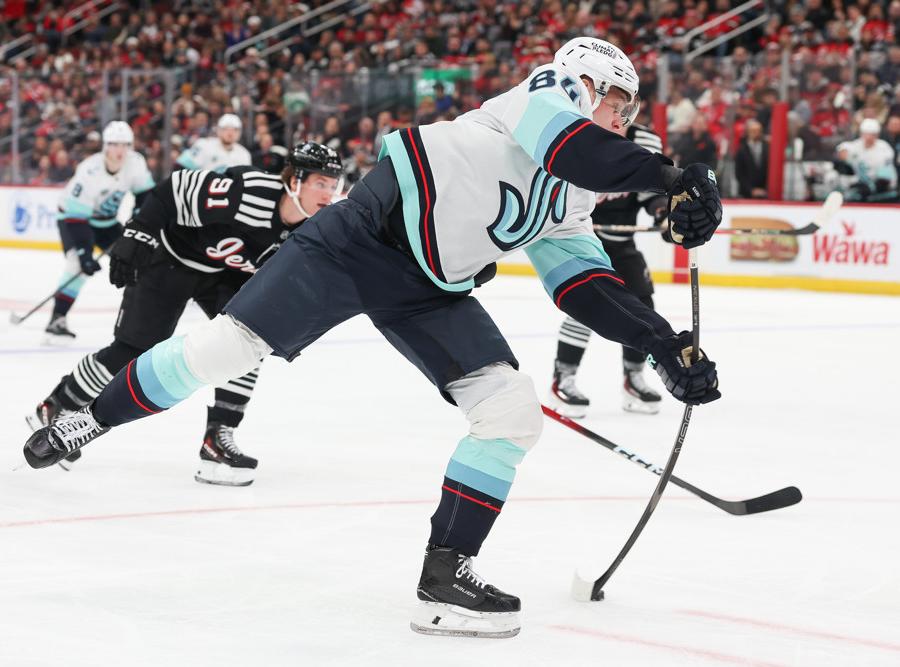

Jordan Eberle at 35 led the team in scoring. Matty Beniers has never eclipsed his Calder Trophy rookie totals. Shane Wright regressed from 44 points to 27. The penalty kill was 31st in the NHL. Ron Francis stepped down. The franchise that peaked in Year Two is still searching for a path back.
By Pucky Editorial · May 2026 · 2025–26 Season Review Series
Feb–Mar 11: Playoff Contention
Reached a playoff spot · needed Nashville to cooperate
Mar 12 – Apr: Worst Collapse in West
2nd-worst pts pct · fell from playoff spot to 28th overall
Offseason: Leadership Reset
Ron Francis steps down · Jason Botterill named GM
The Seattle Kraken were in a playoff spot on March 11. That fact exists. It is the most charitable framing of a 2025-26 season that produced the franchise's fourth missed playoff in five years of existence, and it does not survive honest examination for more than a sentence. Being in a playoff spot on March 11 and finishing the season with the second-worst points percentage in the entire league from February onward, better than only the last-place Vancouver Canucks, is not evidence of a team that came close. It is evidence of a team whose problems finally caught up with it in the stretch run, as they always do when those problems are structural rather than situational.
The problems are structural. The penalty kill finished 31st in the NHL. The team ranked 27th in goals scored. The leading scorer was a 35-year-old captain in the final stage of his career. The player the franchise built around, Matty Beniers, second overall in 2022, seven years and $50 million invested, has never once eclipsed the scoring totals from his Calder Trophy rookie season. Shane Wright, the fourth overall pick in the same draft class, regressed from 44 points to 27. Ron Francis, the general manager who built this franchise from the expansion draft, announced he was stepping down. The Seattle Kraken, in their fifth season, are no longer a young franchise with time on its side. They are a franchise with commitments to players who are not producing at commitment level, and the clock on those commitments is ticking.
One Playoff Appearance in Five Years. The Peak Was Year Two. Everything Since Has Been a Search for a Path Back.
The franchise's only playoff appearance, 2022-23, 100 points, a first-round loss to Colorado, remains the high-water mark. Everything since has been a regression from that year. The 2025-26 improvement of three points over the prior season (76 to 79) is the first positive movement since 2022-23, but three points of improvement on a team that finished 28th overall after being in a playoff spot in March is not meaningful progress. The arc of an expansion franchise that peaked in Year Two and spent three subsequent years unable to replicate it is a specific and uncomfortable type of franchise failure. Jason Botterill's first summer as GM is the first opportunity to address whether that arc can be reversed.
The Final Eight Weeks, What Actually Defines This Season
Playoff Spot on March 11. Second-Worst Points Percentage in the League from February Onward. The Numbers Tell You Everything About the Team's Character.
The collapse is the season's defining fact because it reveals something that a 79-point record does not: Seattle is not a bubble team that got unlucky in the final days. They are a team whose structural problems, the penalty kill, the goal-scoring, the Beniers/Wright production gap, were masked by a favourable schedule and a run of close wins in February that created a false playoff picture. When the schedule toughened and the opponents were teams competing for the same spot, Seattle fell apart. "The way they fell apart, late and thoroughly, has everyone smarting," the Spokesman-Review reported after elimination. That is the appropriate emotional response to a team that occupied a playoff spot one month before the season ended and finished the month with the second-worst record in the Western Conference.
Second Overall Pick. Seven Years, $50 Million. Four Seasons and He Has Never Scored More Points Than His Calder Trophy Rookie Year.
Matty Beniers won the Calder Trophy in 2022-23 - 24 goals, 57 points, 23 years old, genuine excitement about what he could become. In the three seasons since, he has scored 43, 48, and 45-50 points respectively. The trajectory has flatlined. He has improved marginally in 2025-26 from the low of 2024-25, but he has not broken out. He has not taken the leap from good young two-way centre to the scoring-first impact player that a $7.14 million AAV demands.
The Beniers problem is that the league has now seen enough of him to form a view. He is a very good defensive centre who will play meaningful minutes and contribute responsibly in the middle six. He is not the offensive driver that a 2nd overall pick is supposed to become. The two outcomes are not incompatible - a team can win the Cup with a defensive centre at $7M if the offensive production comes from elsewhere. The issue is that Shane Wright, expected to be Beniers's offensive complement, regressed from 44 points to 27 in 2025-26. Jordan Eberle at 35 is the team's leading scorer. The offensive structure that would make Beniers's defensive value usable simply does not exist around him at this roster level.
The honest reckoning for Botterill is whether Beniers is the centrepiece of a rebuild or an asset to be moved as part of it. His value - a 23-year-old defensive centre on a long-term deal - is not zero. There are teams who would pay significantly for exactly that profile. Whether Seattle decides he is what they're building toward or what they're building away from is the most consequential individual decision of the new GM's first summer.
72.9% Is Not a Bad Penalty Kill. It Is One of the Worst in the League in a Decade. It Directly Costs Games.
A penalty kill operating at 72.9% concedes a power-play goal at roughly a 27% rate. Over a full season, if a team takes 300 power plays against - a typical NHL number - that rate produces approximately 81 power-play goals allowed. The league average penalty kill allows about 17-18% of power plays to score. Seattle's rate was nearly ten percentage points worse than league average across the season. That gap, extrapolated over a full season, costs approximately 25-30 goals against - enough to flip eight to ten games from losses to wins or ties.
The penalty kill is the single structural problem that, if fixed, turns the Kraken from a 79-point also-ran into a playoff team. The differential between a league-average PK and Seattle's 2025-26 PK is roughly 10 points in the standings - the exact margin by which they missed the playoffs. Botterill must solve this as his first roster priority, ahead of offensive acquisition and ahead of the Beniers decision. PK problems are solvable through personnel (adding a dedicated kill forward or defensive defenceman) and through system (a coaching adjustment). Whether Lane Lambert retains his job may depend on whether the PK can be credibly attributed to personnel failures rather than system failures.
Individual Assessment
2025–26 Individual Season Grades
+16 (team leader) · developing into exactly what the trade for him promised
The best individual story of the Kraken's season was the player most casual observers overlook. Kakko, acquired from the Rangers, led the team in plus-minus by a wide margin (+16) on a team with a deeply negative overall goal differential. He has brought the speed, the NHL-calibre finishing, and the defensive responsibility that the Kraken's wing group has been missing. At 24, he is in the early prime of his career. He is the player Botterill builds the offence around in 2026-27.
30A (tied team lead) · 41 pts · most important defenceman on the roster
The offensive defenceman who makes everything else function in Seattle. His 30 assists, tied for the team lead with Chandler Stephenson, came despite the team ranking 27th in goals scored, which reflects how consistently he creates opportunities that others fail to convert. His power-play work is the most valuable individual contribution on Seattle's second-worst-in-the-league penalty-generating side of special teams. He is the blue-line piece the franchise must protect in any rebuild discussion.
52 pts (24G–28A) · 35 years old · team's leading scorer, the damning context
Eberle is a very good hockey player doing everything asked of him. The grade is not an assessment of his individual performance, it is an assessment of the structural reality it represents. A 35-year-old captain leading a team in scoring while playing in his final NHL years is a franchise that has not developed the internal scoring solutions it needs. He will retire soon. When he does, if no one beneath him has emerged, the Kraken's leading scorer problem becomes a crisis rather than a concern.
45-50 pts · 20G · Has never exceeded his Calder Trophy rookie-year totals · 7yr/$50M
The most important individual question mark on the roster. His two-way work is genuine, he earns his defensive minutes and wins faceoffs and backchecks conscientiously. His offensive output, at $7.14M, has not justified the contract. 20 goals and 48 points in 79 games is a legitimate NHL centre's season. It is not the season the second overall pick is supposed to deliver in year three of a $50M deal. At 23, he has time. The trajectory, however, has not moved in four seasons.
27 pts (12G–15A) in 74 games · down from 44 pts the prior year · alarming regression at 22
Wright was the fourth overall pick in 2022. He had 44 points in 2024-25, modest but directionally correct. In 2025-26, he regressed to 27 points in 74 games, a rate of 0.36 points per game that is bottom-six forward production. At 22, regression of this magnitude is not a veteran slump, it is a development alarm. He may still become the player Seattle drafted him to be. The 2025-26 season provided no evidence to support optimism. Botterill must determine whether Wright's regression is a correctible problem or a profile reveal.
19 wins · 3.00 GAA · .897 SV% · below expectations after breakout 2023-24
Daccord was one of the NHL's better stories in 2023-24, a late-developing goaltender who found his game in the NHL after a long development path. His 2025-26 numbers are below the bar he set for himself: 3.00 GAA, .897 SV%, in a season where Matt Murray actually posted better numbers in limited duty. He is still the team's best goaltending option. He is not currently a goaltender who can single-handedly carry a bubble team into the playoffs. That is the gap that needs to close.
Built the franchise from expansion · oversaw 4 of 5 missed playoffs · stepping down post-season
Francis deserves permanent credit for building the Kraken's 2022-23 season, 100 points, playoff appearance, Beniers's Calder Trophy, which remains the franchise's high-water mark. He also deserves the honest accounting of what followed: three consecutive missed playoffs, contracts to Beniers and others that haven't produced at the implied level, and a penalty kill that finished 31st in the league in his final season. He announced his departure with the class of a person who built something and recognised when the franchise needed a different direction. The franchise he built is more developed than it would have been without him. It is also stuck in a way that he was not able to unstick.
2025–26 Seattle Kraken, Key Statistical Leaders
| Player | POS | GP | G | A | PTS | Note |
|---|---|---|---|---|---|---|
| Jordan Eberle | RW | 82 | 24 | 28 | 52 | Team leading scorer at 35, the damning context |
| Chandler Stephenson | C | 77 | 15 | 30 | 45 | Tied team lead in assists · solid depth forward |
| Matty Beniers | C | 79 | 20 | 26 | ~48 | Has never exceeded Calder Trophy rookie totals |
| Vince Dunn | D | 80 | 11 | 30 | 41 | Most important defenceman · PP catalyst |
| Kaapo Kakko | RW | 78 | , | , | +16 | Team-leading +/- · bright spot of the season |
| Shane Wright | C | 74 | 12 | 15 | 27 | Alarming regression from 44 pts in 2024-25 |
| Joey Daccord | G | ~45 | , | , | 19W | 3.00 GAA · .897 SV% · below prior-year form |
| Ryan Lindgren | D | , | , | , | 60 PIM | Team PIM leader · 4yr/$18M deal signed Jul 1 |
Botterill's Mandate, The Summer's Key Questions
Kakko, Dunn, and a Deep Prospect Pool
Kaapo Kakko at +16 and Vince Dunn's offensive production from the blue line are the two most encouraging pieces on the current roster. Added to the three prospects cited in NHL.com's elimination analysis - Jake O'Brien (18, 8th overall pick), Nathan Villeneuve, Julius Miettinen - Seattle has legitimate development assets below the NHL level. The foundation for a competitive team exists. It is not yet the team.
31st - The Single Problem That Directly Cost Them the Playoffs
The gap between Seattle's PK (72.9%) and league average (~82%) costs approximately 25-30 additional goals against per season - enough to flip 8-10 games. That is the playoff margin. Botterill must identify whether this is a personnel failure (add a PK specialist forward or defenceman) or a system failure (a coaching decision). If it is the latter, Lane Lambert's future at the helm becomes the first conversation of the summer.
Build Around Him or Build Away From Him - There Is No Middle Option
Seven years and $50M commits the franchise to Beniers's trajectory for the medium term. If Botterill believes the offensive breakout is still coming, the summer is about adding around him. If he doesn't, Beniers's defensive value and long-term contract make him a genuine trade asset for a team seeking exactly that profile. This decision must be made. Not making it is the third option, and it is the worst one.
The 4th Overall Pick Dropped from 44 Points to 27 at Age 22
Wright had 44 points the prior season - modest but upward-trending. His regression to 27 in 2025-26 is not a fluke sample. It is 74 games of 0.36 points per game at age 22. Botterill needs to understand the cause - is this a confidence/deployment issue, a physical issue, or a skills ceiling reveal? The answer determines whether Wright is someone the franchise invests more in developing or someone whose remaining RFA status makes him tradeable for immediate help.
35 Years Old, Leading Scorer - The Next Generation Must Step Up
Eberle will retire within the next one or two seasons. When he does, the Kraken need an internal leading scorer to have emerged. Kakko is the most likely candidate. Beniers could be that player if his offensive development resurges. The urgency is not immediate - Eberle can still contribute at a useful level. But the franchise cannot enter Eberle's retirement with the same offensive production vacuum that 2025-26 revealed. The replacement plan starts now.
27th in Goals - 2.78 Per Game - Must Add a Primary Offensive Driver
Seattle has been among the lowest-scoring teams in the Western Conference for three consecutive seasons. The offensive identity of this franchise - Jared McCann's explosive 2022-23 form - has not been replicated. McCann is gone. Nobody has replaced his production. Botterill's most urgent acquisition priority, after fixing the PK, is identifying and acquiring the first-line offensive driver who makes the secondary pieces around him function. Without one, 79 points is approximately the ceiling.
“The way they fell apart, late and thoroughly, has everyone smarting. Many times it's been asked of the players: What is going wrong? They didn't have the time, desire or words to go into it." - Spokesman-Review, April 2026, after Seattle's elimination - a telling summary of what a lost season feels like from inside”
That quote is the season. A team that cannot explain its own collapse is a team that does not have a clear enough identity to understand when it is playing outside of it. The Kraken in March played like a team whose structural problems had been temporarily disguised by a favourable run and then were ruthlessly exposed when the schedule stopped cooperating. They had no language for what was going wrong because what was going wrong was not a tactical adjustment problem. It was a roster construction problem: not enough scoring, a disastrous penalty kill, young players who have not developed at the pace required, and a leading scorer who will be 36 next season.
Botterill inherits a franchise with a legitimate home building (Climate Pledge Arena), a decent defensive structure when the PK is not on the ice, Vince Dunn, Kaapo Kakko, and a prospect pool with genuine depth. He also inherits the Beniers contract, the Wright regression, the PK disaster, and the weight of three consecutive missed playoffs following a 100-point peak season. The 2022-23 formula, McCann's goal-scoring, Dunn's defensive creativity, Beniers's Calder-winning competitiveness, a penalty kill that worked, needs to be rebuilt in pieces. The expansion draft magic that produced that season is not available twice. What is available is a clear-eyed summer of decisions by a new GM who can approach the problems without attachment to how they were created.
Season Review Verdict
Four of five seasons missed. In a playoff spot in March, 28th by April. A 35-year-old leading the team in scoring. A penalty kill 31st in the NHL. Ron Francis stepping down after building what couldn't sustain. The C-minus reflects honest improvement over the prior year - three more points, a spell in playoff position, Kakko's emergence, Dunn's consistency - alongside the structural failures that made that improvement insufficient. The PK was historically bad. The scoring was near-league-worst. The late collapse was one of the worst in the Western Conference. Beniers is the central question. Wright's regression is the peripheral alarm. Eberle is 35. The penalty kill needs to be rebuilt from the ground up. Botterill has one summer to stabilise a franchise that has been drifting since its peak season and does not appear to have understood why. The Kraken are not a hopeless franchise. They have the building, the core defensive infrastructure, a genuine offensive defenceman, and a prospect pool that could produce meaningful contributors. They need a first-line scorer, a functional penalty kill, and an honest accounting of whether Beniers and Wright are the long-term answer or the current ceiling. Jason Botterill's first summer writes the next chapter. The current one ended badly.