
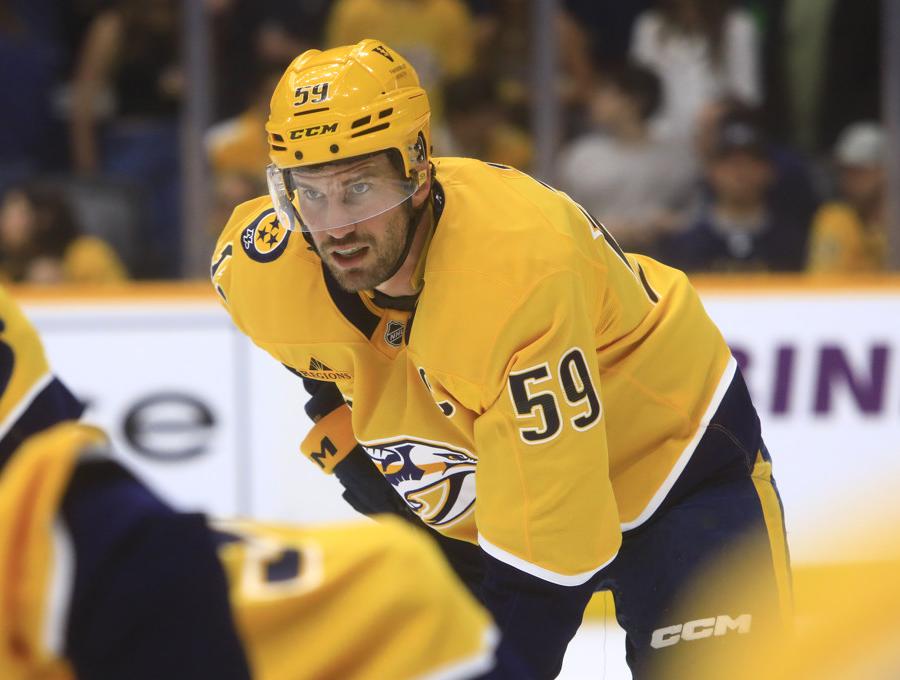

Stamkos at 36. Forsberg at 31 for the third time in five seasons. Josi at 35 still making the blue line work. Barry Trotz announcing in February he would step down. A team that improved 18 points but still missed the playoffs. Nashville is not broken - it is at an inflection point that every franchise eventually reaches, and the decision about which way to turn has never been more urgent.
By Pucky Editorial · May 2026 · 2025–26 Season Review Series
Oct–Nov: Miserable Start
4-6-2 October · 4-7-2 November · consistency a problem
Dec–Jan: Righting the Ship
Better results · Stamkos and Forsberg producing · too much ground to make up
Feb 2: Trotz Announces Exit
Retirement confirmed mid-season · uncertainty hits a struggling team
Post-Olympics: Stamkos Surge
12 of 40 goals after Olympic break · too late · eliminated Apr
Two players on the same non-playoff team each scored forty goals this season. One of them is thirty-six years old and scored twelve of those goals after the Olympic break in a second-half surge that was simultaneously remarkable and too late. The other is thirty-one and did it for the third time in five seasons, closing in quietly on the franchise's all-time goals record with 358 career goals while the team around him missed the playoffs for the second consecutive year. Nashville is not a bad team. It is a team at a crossroads - one of those specific inflection points that franchises reach when the core that produced sustained success is still productive but aging, the next generation has not yet fully arrived, and the decisions made in the next twelve months will determine whether the organisation enters a new competitive cycle or slides into a prolonged rebuild.
The bad start was the season's defining structural fact. Nashville went 4-6-2 in October and 4-7-2 in November - an 8-13-4 record in the first two months that left them too far behind in a competitive Central Division to recover. Consistency was described by NHL.com as the primary problem in the early going. The description is accurate and slightly incomplete: the Predators were also facing 29.5 shots against per game (26th in the league), their goaltenders were under more pressure than in prior seasons, and the absence of a true top-line centreman below Forsberg and Stamkos was visible in the team's inability to sustain offensive zone time when opponents took away their primary threats. They recovered in December and January. The recovery produced good hockey. It did not produce enough points.
The Core Four - Ages, Contracts, and the Window
Four Franchise Pillars. Three of Them Over 31. The Clock Is Not a Metaphor - It Is the Season's Most Important Fact.
| Age | Player | Role |
|---|---|---|
| 36 | Steven Stamkos | RW · 40G · 63 pts |
| 35 | Roman Josi | D · 55 pts in 68 GP |
| 33 | Ryan O'Reilly | C · 74 pts · +8 |
| 31 | Filip Forsberg | LW · 40G · 75 pts |
All four are performing. Stamkos at 36 just scored 40 goals - his best total since Tampa Bay in 2021-22. Josi at 35 had 55 points despite missing games with an injury and remains the most complete defenceman in the franchise's history. O'Reilly at 33 led the team in assists (49) and plus-minus (+8). Forsberg at 31 is the all-time franchise goals leader with 358 and is producing at a rate that has him in the conversation for another 40-goal season next year. The problem is not that any of these four is declining. The problem is that the team needs to plan for when they do decline - and they are all doing so simultaneously. The new GM inherits this core in 2026-27 and must decide: push for one more playoff run with veterans intact, or begin the transition to the next generation now, before the decline becomes irreversible. That is the most important strategic question in the franchise's immediate future.
Mid-Season, Mid-Playoff-Push, Barry Trotz Announces He Will Retire at Season's End. The Organisational Uncertainty That Followed Was the Season's Biggest Off-Ice Story.
Trotz announced on February 2 that he would retire as general manager after three seasons in the role, although he pledged to remain until a successor was named. The announcement came when Nashville was already in a difficult position - fighting to stay within striking distance of a wild-card spot while dealing with a second-half schedule in the competitive Central Division. The timing was not ideal. "The uncertainty had to hit hard for a team that was fighting through another disappointing season," NHL.com noted. That is diplomatically honest.
Trotz's tenure as GM is a complicated legacy to assess. He inherited a franchise that was aging and needed transition, made the Stamkos signing that has produced 40-plus goals in consecutive seasons, and oversaw both the 2024-25 disaster (30-44-8, 68 points) and the 2025-26 improvement (38-32-10, 86 points). The core strategic question he never definitively answered - whether Nashville should push for one more playoff run with the aging veterans or commit to youth - is the question the next GM inherits. His retirement opens the door for a fresh perspective on that decision. Whether the new GM chooses push or transition will determine the franchise's trajectory for the next five years.
The successor announcement was still pending at season's end. The longer that vacancy persists, the more the uncertainty compresses the decision-making window before training camp. A new GM who arrives in July with a clear directive - push or transition - can act decisively. A new GM who arrives in July still learning the roster is a more dangerous outcome for a franchise that needs to move quickly in one direction or the other.
The Predators are, in 2025-26, a team that has two genuine star forwards both producing at 40-goal levels, a franchise-defining defenceman still performing at 35, a reliable two-way centreman who led the team in assists and plus-minus, and a goaltender in Juuse Saros who has been elite in prior seasons and was below his standard this year. That roster profile - stars producing, goaltender underperforming, depth insufficient - is the most common profile of teams that finish just outside the playoff line. It is also the most correctable roster profile for a new GM who can make targeted acquisitions rather than wholesale changes.
The goaltending is the clearest problem. Saros went 28-something with a 3.16 GAA and .894 SV% - below the .920 level that made him a Vezina Trophy-calibre goaltender in his best seasons. The backup Justus Annunen, who posted a 2.77 GAA in limited action, was the team's best goaltender by that metric. Saros facing 29.5 shots per game (26th in the league) reflects the defensive structure's failure to limit shot volume as much as his own individual performance. The system placed him under more pressure than his elite stopping ability could absorb. A defensive adjustment - either through roster additions or a coaching system change - is the most direct route to improving the goaltending numbers without replacing the goaltender.
“Nashville qualified for the playoffs for eight straight seasons from 2014-22. They advanced to the only Stanley Cup Final in their history in 2016. The core that built those years is still here. The window to use it is closing." - NHL.com, April 2026 - the central tension of Nashville's current moment”
Stamkos's post-Olympic surge is the encouraging counterpoint to the age argument. Twelve goals from late February through the end of the season - at 36 - is not an old player running out of road. It is an elite goal-scorer who was given better linemates and better opportunities in the second half and converted them at exactly the rate his career suggests he should. The argument for pushing one more time with this group is Stamkos in February and March - still elite, still capable of carrying the offensive load when the moment demands it. The argument against is that February and March came after an 8-13-4 start that eliminated any real playoff hope before December was over.
2025–26 Individual Season Grades
40G · 63 pts · 12 goals post-Olympics · best goal total since 2021-22 Tampa
At 36, he scored 40 goals. That sentence deserves to stand alone. He is still one of the most effective goal-scorers in the league from the right circle - the one-timer that has defined his game since his first shift at Tampa Bay has not deteriorated. Twelve of those goals came in the second half after the Olympic break, which is either evidence that he is best with rest built into the schedule or evidence that the team's system finally got him into better shooting positions. Either way, the production at this age is remarkable. He will be 37 next season. Whether he can do it again is the most important individual question for the push-or-transition debate.
40G · 75 pts · 358 career goals (franchise all-time leader) · 3rd time in 5 seasons hitting 40
The all-time franchise goals leader continues to score at a rate that most 25-year-olds cannot match. His 40-goal season - third in five years - on a team that missed the playoffs for the second straight year is the individual bright spot that the franchise most needs to acknowledge honestly. He is 31. His peak production window has at least three or four seasons remaining. If the new GM is going to make a push, Forsberg's prime years are the reason to do it now rather than after a rebuild cycle that would waste exactly those years.
74 pts (25G–49A) · +8 (team leader) · led team in assists · most complete performer
The most quietly excellent season on the roster. O'Reilly led the team in plus-minus, led in assists, and produced 74 points at age 33 as the team's primary two-way centreman. He is exactly the kind of player a franchise needs when it is trying to compete with an aging core - a reliable, professional, system-compatible performer who makes the players around him measurably better. His 49 assists were also second in the league among centres, a number that has not received the attention it deserves.
55 pts in 68 GP · missed games with undisclosed injury · 779 career pts (franchise all-time pts leader)
Josi at 35 is the all-time franchise points leader and still one of the better offensive defencemen in the Central Division. Missing a handful of games with an upper-body injury (and the season finale) introduced the injury concern that had not previously been a significant part of the Josi conversation. His 55 points in 68 games is a pace of 66 over a full season - competitive, productive, and contextually strong for his age. The question entering 2026-27 is not whether he is still good but how many more seasons he can sustain this level.
28W · 3.16 GAA · .894 SV% · below Vezina-calibre form · faces 29.5 shots/gm (26th)
Saros has been one of the best goaltenders in the league in his best seasons. In 2025-26, he was not that version. The 3.16 GAA and .894 SV% are not elite numbers - they are the numbers of a competent starting goaltender on a team that allows too many shots. The shot volume context is genuine: 29.5 shots against per game is a burden that very few goaltenders can absorb at .920+. The new GM must determine whether the Saros solution is a defensive system change, a roster addition that reduces shots against, or whether his form has declined in a more permanent way. The first two are correctable. The third is a different conversation.
44 assists (2nd on team) · emerging young forward · the most important development story
The franchise's most encouraging young forward is the one who is not yet the centre of the conversation. Evangelista's 44 assists - second on the team - represent genuine development from a player who spent the first two years of his career earning his NHL role. He is the answer to the question "what comes after the veterans?" that the franchise needs to be able to give convincingly. He is not yet Forsberg or Stamkos. He is developing in the right direction at the right time.
4-6-2 October · 4-7-2 November · recovered mid-season but early hole too deep
The early-season inconsistency is the coaching staff's clearest individual failure of 2025-26. A team with Stamkos, Forsberg, Josi, and O'Reilly should not be 8-13-4 through November. Whether the problem was system, preparation, lineup deployment, or the genuine roster limitations of depth scoring is the honest question Brunette and the new GM must answer. The second-half improvement suggests the system can work. The first-half collapse suggests it takes too long to implement. In a competitive Central Division, that timeline is not acceptable.
2025–26 Nashville Predators - Key Statistical Leaders
| Player | POS | GP | G | A | PTS | Note |
|---|---|---|---|---|---|---|
| Filip Forsberg | LW | 82 | 40 | 35 | 75 | Tied team pts lead · 358 career G (franchise record) |
| Ryan O'Reilly | C | 82 | 25 | 49 | 74 | Tied team pts lead · +8 team leader · 49A (2nd among centres) |
| Steven Stamkos | RW | 82 | 40 | 23 | 63 | 40G at 36 · 12G post-Olympics · best since Tampa 2021-22 |
| Roman Josi | D | 68 | 13 | 42 | 55 | 779 career pts (franchise record) · missed games injury |
| Luke Evangelista | F | - | - | 44 | - | 2nd on team in assists · most important young forward |
| Juuse Saros | G | 59 | - | - | 28W | 3.16 GAA · .894 SV% · faces 29.5 shots/gm (26th in NHL) |
| Justus Annunen | G | ~25 | - | - | 2.77 GAA | Team's best GAA · backup who outperformed Saros on the stat |
What the New GM Must Decide
Forsberg Is 31, O'Reilly Is 33, Josi Is 35, Stamkos Is 36 - Push Now or Waste Their Prime
Forsberg in his prime (ages 28-34) is a 40-goal scorer who won't wait for a rebuild. The window with all four veterans healthy and productive is probably two seasons - 2026-27 and 2027-28. A new GM who acquires a top-four defenceman, fixes the shot-against volume, and resolves the early-season consistency problem could put a legitimately competitive team on the ice next October. Missing the playoffs with Stamkos scoring 40 and Forsberg scoring 40 is the evidence that one or two targeted moves make the difference.
Nashville Made the Playoffs Once in the Last Four Seasons - Is This Core a Contender or a Bubble Team?
The honest version of the push-or-transition case: Nashville qualified for the playoffs once in four seasons (2023-24, lost in round one). The same veterans who are producing now produced in prior years and did not result in playoff runs. Stamkos at 37 scoring 35 goals might still not get them to the second round. Transitioning around Evangelista, the young prospects, and the draft assets from moving veterans gives the franchise a better long-term ceiling than squeezing two more seasons from a core that has not produced postseason results.
Saros Needs Fewer Shots Against - The Fix Is Defensive, Not a Goaltender Trade
29.5 shots against per game is not fixed by trading the goaltender. It is fixed by adding a defensive defenceman who reduces shot volume and by adjusting the system to limit perimeter shots. The new GM's first move should address the defensive structure before evaluating Saros's form in a more protected environment. Saros in 2023-24 was a Vezina candidate on the same roster. The roster is worse defensively now, not the goaltender.
8-13-4 Through November Killed the Season Before December - That Cannot Happen Again
An 8-13-4 start in a division where the top three teams all finished above 95 points is a season-ender by December. The cause - described as "consistency" by NHL.com - is the most important tactical problem Brunette and the new GM must identify and solve. Whether it is a system issue, a conditioning issue, or a lineup configuration issue, arriving at training camp 2026-27 without a concrete answer to why November happened is not acceptable for a franchise that wants to compete.
44 Assists at 22 - The Bridge Generation Is Emerging Alongside the Veterans
Evangelista's 44 assists is the most important long-term data point in the roster. Joakim Kemell developing. Justin Barron as a defensive prospect. The youth is arriving alongside the veterans - which means a push-now strategy does not necessarily sacrifice the future. If the new GM can make targeted acquisitions that help the veterans compete while giving Evangelista and Kemell meaningful roles, the two strategies are not mutually exclusive.
Whoever Trotz's Successor Is, They Arrive With an Urgent Clock and a Clear Choice
The new GM has approximately two seasons of Forsberg, Stamkos, Josi, and O'Reilly at useful production levels. The decision must be made quickly - a delayed summer with no clear direction entering training camp is how a two-season window becomes one. The clarity of the choice is the opportunity: Nashville knows what it has and knows what it needs. A new GM who acts decisively on that knowledge in July and August gives this roster its best chance of breaking the two-year playoff drought before the veterans' decline makes the question moot.
Nashville's 2025-26 season is the compressed version of a franchise identity crisis that has been building for several years. Eight consecutive playoff appearances from 2014 to 2022 created the expectation that this franchise competes. Two consecutive misses with essentially the same core - plus Stamkos, plus O'Reilly - have disrupted that expectation without fully replacing it with something new. The franchise is neither rebuilding nor contending. It is hovering, and hovering franchises eventually fall in one direction or the other. The new GM, whoever they are, must push it.
Season Review Verdict
Two players each scored 40 goals. Both missed the playoffs. The GM announced his retirement mid-season. A franchise hovering between its past and its future, with a clock that is running out of patience for indecision. The C reflects a team that improved 18 points, had genuine individual excellence from its veterans, and still could not make the playoffs for the second consecutive year. The early-season collapse (8-13-4 through November) is the C earner - a team with Stamkos, Forsberg, Josi, and O'Reilly should not be that bad in the first two months. The positives are real. Stamkos at 36 scoring 40 goals after an Olympic break surge is the kind of production that cannot be dismissed. Forsberg's third 40-goal season in five years is a franchise-defining individual achievement. O'Reilly's 74 points led the team in everything that mattered most. The question now is the only question that matters: push or transition? Forsberg is 31 and in his prime. Stamkos is 36 and still elite in spurts. Josi is 35 and the franchise's all-time points leader. The window is open. Whether the new GM has the decisiveness to use it before it closes is what 2026-27 will answer.