
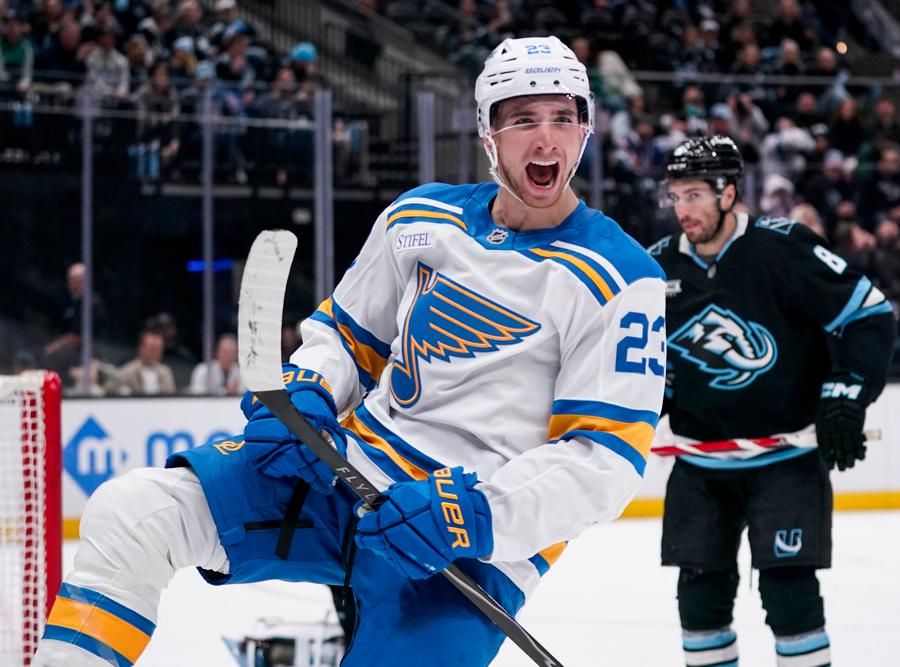

They missed the playoffs by four points and won their last four games. The captain was traded in March. The GM who built the 2019 Cup team announced his departure. The backup goaltender outperformed the starter all season. And a 2025 first-round pick scored 80 points in 60 junior games. The standings are one story. The franchise's direction is another.
By Pucky Editorial · May 2026 · 2025–26 Season Review Series
Oct–Nov: Strong Start, Then 0-5-2
3W in first 4 · then 7-game winless run · early hole dug
Dec–Feb: Competitive but Inconsistent
Binnington poor · Hofer better · Kyrou injured and struggling
Mar 6: Schenn and Faulk Traded
Captain gone · 3 first-round picks accumulated · Armstrong departure confirmed
Mar–Apr: Too Little, Too Late
Won last 4 games · Binnington 5-2-1 run · 4 points short
Four points. That is the margin between the 2025-26 St. Louis Blues and a Stanley Cup Playoff appearance. They won their last four games of the season - had they won two more across the prior two months, or converted one of the overtime losses in December into a regulation win, or not been decimated by a seven-game winless run in October that buried them before November was over, they are a playoff team. The mathematics of the miss is narrow enough that it is genuinely difficult to classify this season as a failure and genuinely dishonest to call it a success. Four points is the gap. The season was one bad stretch and one Kyrou knee away from something different.
What makes the 2025-26 Blues more interesting than the standings suggest is the simultaneous leadership reset happening around the on-ice results. Brayden Schenn - the captain who hoisted the Stanley Cup in 2019 as one of the team's most important players - was traded in March. Doug Armstrong, the general manager who built that 2019 team and has been the most important decision-maker in the franchise for fifteen years, announced his departure. Jordan Binnington enters the final year of his contract in an uncertain position. Jordan Kyrou had a minor knee procedure mid-season that cut his output to 18 goals and 46 points - far below the 30-plus-goal seasons he had strung together for three consecutive years. The team that was 44-30-8 last season and made the playoffs in 2024-25 is now navigating a transition that the standings show as a one-season blip and the front office moves suggest is something more structural.
The Captain Is Gone. The GM Who Built the Cup Team Is Leaving. The Starting Goaltender Is in His Final Contract Year.
The three departures or transitions happening simultaneously - captain traded, GM stepping down, starting goaltender in his final year - create the most significant leadership reset the franchise has experienced since the 2019 Cup team aged out. Three first-round picks in the 2026 draft (accumulated partly through the Schenn and Faulk trades) give the new GM an unusual amount of capital to shape the roster's next version. The direction that capital takes the franchise is the most important question of the offseason.
A Seven-Game Winless Run in October, and Jordan Kyrou's Knee. Fix Both and They Make the Playoffs Comfortably.
The early-season collapse was the more damaging of the two. Three wins in the first four games suggested a team ready to contend. Then a 0-5-2 run buried them. By the time November ended, they were too far behind in the Central Division's standings to recover at a comfortable pace - the rest of the season became a mathematics problem rather than a genuine playoff push. They solved the mathematics problem almost perfectly, winning 17 of their final stretch of games and four in a row to close the season. Almost. Four points short.
Kyrou's knee procedure - a minor surgery that nonetheless limited his effectiveness across a season where he finished with 18 goals and 46 points in 72 games - removed the team's most consistent goal-scorer from his previous three seasons. Kyrou had scored 30-plus goals and 65-plus points in each of the three prior seasons. His absence from that production level cost the team approximately 15 goals and 20 points compared to his established rate. That is more than the four-point margin by which they missed the playoffs. The arithmetic is uncomfortable: a healthy Kyrou, at even 75% of his prior-season rate, almost certainly makes this a playoff team. He is expected to be healthy for training camp. The new GM inherits a healthy Kyrou as a meaningful asset.
Binnington was also a factor. His numbers declined from his 2024-25 form, and the ClutchPoints article on why the Blues missed the playoffs cited him as one of three central reasons. Joel Hofer, his backup, posted a better GAA (2.59 vs Binnington's higher number) in fewer games. The goaltending question that the new GM faces is not whether Hofer is ready - he has demonstrated he is - but whether the franchise benefits more from trading Binnington for assets or from letting him play out his final year and walking away.
St. Louis Blues - Incoming Prospect Pipeline
#1 Round · 2025 Justin Carbonneau 80 pts · 51G in 60 GP QMJHL Blainville-Boisbriand. Shared first in the league in goals (51). 80 points in 60 games. Through two rounds of the QMJHL playoffs: 15 points and sharing second in the league. This is elite junior production from a 2025 first-round pick arriving in St. Louis's system. His goal-scoring ability at the junior level (51 in 60 games) projects to NHL impact scoring potential on the right timeline.
#1 Round · 2024 Adam Jiricek 59 pts · 19G–40A (D) OHL Brantford Bulldogs. Fourth among all OHL defensemen with 59 points. Third in goals (19), sixth in assists (40). Elite offensive defenceman production from a blue-liner - 59 points from the blue line at the OHL level projects to top-pair offensive defenceman at the NHL level. He gives the Blues the future defensive presence they've needed since the prime years of Parayko faded.
Goaltender Vadim Romanov 1.42 GAA · .954 SV% (AHL Playoffs) AHL Springfield Thunderbirds. Shut out Providence in Game 4 (37 saves). Has not allowed more than 2 goals in any AHL playoff game. 5-1 record, 1.42 GAA, .954 SV% in the AHL postseason. If Binnington is traded, the Blues have both Hofer (established NHL backup-to-starter) and Romanov (elite AHL performance) as the goaltending future.
Forward Jimmy Snuggerud Developing · NHL-ready timeline The Bleacher Report article specifically cited Snuggerud as a reason for optimism about the franchise's future. His development timeline and the role he plays in 2026-27 is one of the key variables for whether the Blues can compete while transitioning away from the veteran core.
Defender Theo Lindstein B+ grade · developing NHL defender Logan Mailloux and Theo Lindstein both graded B+ or equivalent from the Blues roster analysis. Young defensive prospects developing alongside Jiricek. The blue line pipeline, combined with Jiricek's elite OHL production, gives the franchise genuine optimism about the next defensive generation.
2025–26 Individual Season Grades
58 pts (22G–36A) · +18 (team leader by huge margin) · led team in all offensive categories
The team's best player in every meaningful metric. His +18 led the team by a wide margin and was one of the better defensive-forward numbers in the Central Division for a player who produces offensively. His 58 points led the team with Kyrou limited by injury. He is the player the new regime builds around - a genuine two-way centre at 25 who gives the franchise the kind of reliable first-line performance that doesn't require everything else to go right. His plus-minus on a team that missed the playoffs by four points is the most encouraging individual number in this review.
22 wins · 2.59 GAA (team best) · outperformed Binnington · the goaltending future
The most consequential individual development of the Blues' season was the backup goaltender posting better numbers than the starter. Hofer's 2.59 GAA leads the team - better than both Binnington's regular-season number and the context in which he played. He has now established himself clearly as the better goaltender on the roster. The decision about what to do with Binnington in the final year of his contract becomes straightforward if Hofer's numbers hold: trade Binnington for assets and make Hofer the starter. Hofer's emergence is the most positive goaltending development the franchise has had since Binnington's own ascent.
B+ grade from external analysis · consistent contribution from the acquired forward
Acquired from Edmonton, Holloway proved to be one of the Blues' better offseason additions - a young forward who provided the physical energy and offensive contribution the team needed in its middle-six. His grade reflects consistent, reliable production across a season where inconsistency was the team's most significant problem. He enters 2026-27 as one of the team's better young forwards.
Consistent secondary contribution · energy and competitiveness throughout
One of the more reliably consistent performances on the roster. Neighbours provides the physical, competitive energy that makes the team harder to play against - not a primary scorer, but a forward whose contribution to the team's identity is measurable and consistent. He is the kind of player who helps a team win games 3-2 rather than 5-4, which is exactly the profile the Blues need more of.
18G–28A–46 pts in 72 GP · down from 30G–65pts in each of prior 3 seasons · knee procedure
The injury excuse is legitimate and the grade acknowledges it. A healthy Kyrou is a 30-goal, 65-point forward at his established rate - one of the better offensive producers in the Central Division and the player most responsible for the Blues' competitive playoff run last season. His 2025-26 was limited by the knee, and he is expected to be fully healthy for 2026-27. The C-minus reflects what happened this year; the more important assessment is that a fully healthy Kyrou next season changes the team's offensive ceiling significantly.
Below prior-year form · Hofer outperformed him · final contract year incoming · cited as reason for miss
The grade is the honest assessment of a season where the backup outperformed the starter and outside analysis (ClutchPoints: "3 reasons why Blues missed playoffs") identified him as one of the reasons the team couldn't cross the playoff line. His late-season resurgence (5-2-1 in his final 8 starts, 2.26 GAA in that stretch) adds a complicating footnote - but a goaltender who performs that well in his final eight games of the season and not in the prior 50 is a goaltender whose consistency cannot be relied upon for a playoff push.
15 years as GM · 1 Stanley Cup · 3 first-round picks accumulated this season · exiting on his own terms
The A is for the body of work and the manner of the exit. Armstrong built a franchise from perennial playoff contender to Stanley Cup champion, maintained competitiveness across multiple roster cycles, and made the decision to step down at the right moment rather than overstaying into a decline. The three first-round picks the franchise heads into the 2026 draft with - partly his accumulation, partly the Schenn and Faulk trades he executed - are the parting gift he leaves the new regime. Fifteen years. One Cup. A pipeline in place. Stepping down on his own terms. That is an A-grade executive tenure.
2025–26 St. Louis Blues - Key Statistical Leaders
| Player | POS | GP | G | A | PTS | Note |
|---|---|---|---|---|---|---|
| Robert Thomas | C | 82 | 22 | 36 | 58 | +18 (team leader by wide margin) · led all categories |
| Jordan Kyrou | C | 72 | 18 | 28 | 46 | Knee procedure · far below 30G-65pt prior 3-season rate |
| Dylan Holloway | LW | - | - | - | - | B+ season · best acquisition from offseason |
| Pavel Buchnevich | RW | - | - | - | - | C grade · inconsistent secondary contributor |
| Joel Hofer | G | ~35 | - | - | 22W | 2.59 GAA (team best) · outperformed Binnington |
| Jordan Binnington | G | ~48 | - | - | - | Below prior form · final contract yr · 5-2-1 late surge |
| Brayden Schenn | C | ~55 | - | - | - | Traded Mar 6 to NY Islanders · captain Oct-Mar |
The 2026 Draft Currency to Build the Next Version of This Team
The Schenn and Faulk trades, combined with prior draft asset management, gave the Blues three first-round picks entering the 2026 NHL Draft. The new GM's first major decision is what to do with that capital: use all three picks to draft the best available talent and build through the pipeline, or bundle them for an established player who accelerates the competitive timeline. The caution the Bleacher Report article urged - "must resist the temptation to bundle their 3 1st-round picks" - reflects the real tension.
A 30-Goal Scorer Coming Back at Full Health Changes the Team's Ceiling
A healthy Kyrou at his established 30-goal, 65-point rate is the single most important on-ice variable for 2026-27. Thomas at 58 points plus Kyrou at 65-plus points gives the Blues two legitimate first-line contributors - a pairing that, with Hofer in goal and Holloway healthy, makes a playoff push genuinely plausible. The gap between this season and the playoff line was four points. Kyrou healthy is worth more than four points.
Trade Him for Assets or Let Him Play Out His Final Year - Neither Option Is Obvious
Hofer outperformed Binnington this season. The case for trading Binnington: acquire assets (a useful return for a Stanley Cup-winning goaltender with name recognition) and install Hofer as the clear starter now. The case for keeping him: his late-season form (5-2-1, 2.26 GAA in final 8 starts) suggests he can still be competitive, and an established veteran in the locker room during a transition year has intangible value. The new GM must decide quickly - the longer Binnington's status is unresolved, the harder both options become.
Both Graded F - The Defensive Core Has Significant Problems
Colton Parayko and Cam Fowler both received F grades from external Blues analysis. Parayko's decline from his peak years has been one of the franchise's most discussed topics for two seasons. Fowler underperformed after his acquisition. The defensive core beneath Jiricek's future arrival and Lindstein's development has a gap problem that the new GM must address - either through acquisition or coaching system adjustment - before 2026-27.
80 QMJHL Points and Top OHL Defensive Production - The Pipeline Has Arrived
Carbonneau's 80 points in 60 QMJHL games (51 goals) is one of the best junior performances by any Blues draft pick in the franchise's history. Jiricek's 59 points as an OHL defenceman ranks among the best defensive production in the league. Both are on NHL timelines of one or two years. The new GM inherits two of the organisation's most exciting prospects arriving on an accelerated schedule.
+18 on a Non-Playoff Team - The Franchise Centre Is Already Here
Robert Thomas at 25 with a +18 plus-minus on a team that missed the playoffs by four points is the clearest individual evidence that the next version of the Blues has a legitimate franchise centre. He does not need to be developed. He does not need to be acquired. He is already here, already elite, and the new GM's job is to build a team around him rather than hoping he carries it alone.
“The Blues finished the season strong, winning their last four games and going 17-something in their final stretch. If they had another two weeks, they very likely would be a playoff team." - ClutchPoints, April 2026 - the most accurate summary of a season that felt like it ended two weeks too early”
Four points. The Blues are the closest non-playoff team to the playoff line of any franchise reviewed in this series. They were also the team most visibly in transition - captain traded, GM stepping down, starting goaltender in his final year, a 0-5-2 run that defined the season before it truly started. The simultaneity of the on-ice frustration and the leadership reset is the Blues' 2025-26 in full.
The new GM is the most important hire the franchise makes since Armstrong himself was appointed in 2010. They need someone who can navigate the Binnington decision, deploy the three first-round picks correctly, integrate Carbonneau and Jiricek on the right timeline, and build around Robert Thomas as the franchise cornerstone. The inputs are better than the 37-33-12 record suggests. The pipeline is genuinely exciting. The four-point miss, with Kyrou healthy next year, becomes a playoff appearance in 2026-27 if the transition is managed correctly. Whether it is managed correctly is the one question this review series cannot answer - it arrives in October.
Season Review Verdict
Four points. Won the last four games. The captain traded, the GM stepping down, the backup better than the starter, and a prospect who scored 80 points in junior hockey. The standings are one story. The future is another. The C+ reflects a narrow miss with explainable causes (Kyrou's knee, the 0-5-2 October run) alongside a genuinely exciting prospect pipeline and the most thorough leadership reset in a decade. A team that missed by four points with the second-most exciting junior forward in their draft class scoring 80 points is not a franchise in crisis. Thomas at +18 on a non-playoff team. Hofer at 2.59 GAA outperforming the established starter. Carbonneau and Jiricek arriving on accelerated NHL timelines. Three first-round picks in 2026. A healthy Kyrou returning. The new GM inherits tools that most non-playoff franchises would exchange several years of comfort to obtain. Whether they use them correctly - deploying the draft capital, installing Hofer, building around Thomas, and making the right call on Binnington - determines whether 2026-27 is the year the four-point gap closes for good. Everything points to yes. October will confirm it or not.