
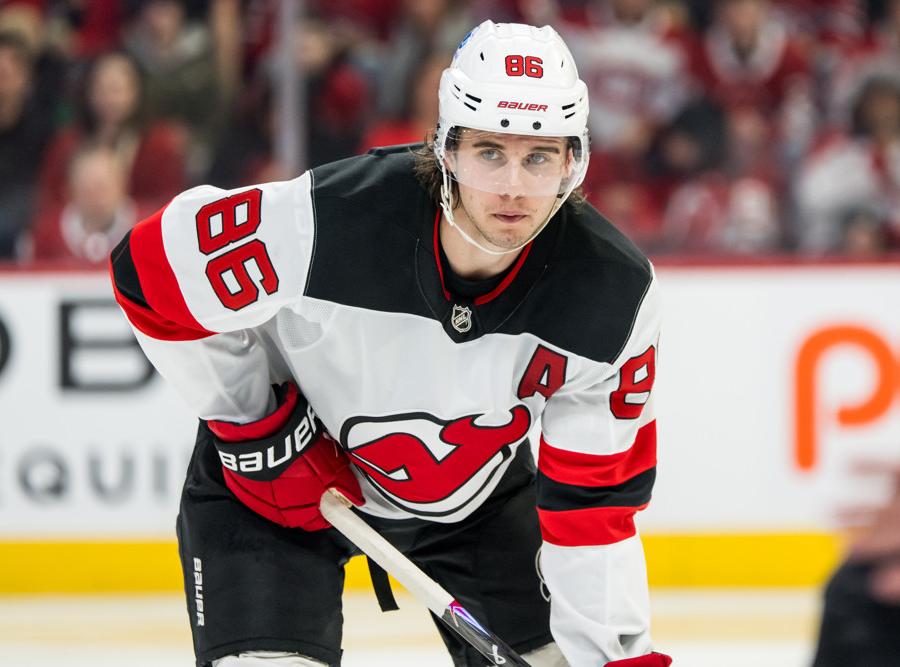

Jack Hughes became a national hero in Milan-Cortina. Then the New Jersey Devils went 4-13-1 at Prudential Center from November to February - dead last in the NHL during that stretch. They started 9-0-1 at home and ended it in last place domestically. Five players scored 20 goals. The depth they needed to sustain it never materialised.
By Mike Holloway · May 2026 · 2025-26 Season Review Series · #20 of 32
Phase 1 · Oct-Nov: Hot Start
An eight-game win streak. 9-0-1 at home, tied for a franchise record. Four goals per game on average. Hughes healthy and producing at a point-per-game pace.
Nov 15 - Dec 19: Hughes Hand Injury
Eighteen consecutive games missed. The team went 8-13-0 without him. The trigger for the home collapse and the moment the season's mathematics began to deteriorate.
Nov 29 - Feb 25: Home Collapse
4-13-1 at Prudential Center, the worst home points percentage in the NHL during that stretch. Playoff contention was lost domestically before the calendar turned to March.
February (Milan-Cortina): Hughes Gold Medal
The overtime winner against Canada at 1:41 of the extra period. The first U.S. men's Olympic gold since 1980. Hughes returned to a different season than the one he had left.
Mar - Apr 6: Fitzgerald Fired
The general manager was dismissed three days before the regular season ended, the position vacant for the final week. The clearest organisational signal that ownership had moved on.
At 1:41 of overtime in the gold medal game of the 2026 Winter Olympics in Milan-Cortina, Jack Hughes scored to give Team USA a 2-1 win over Canada. He became, in that moment, a national sports hero - the face of American hockey's return to Olympic supremacy, a 24-year-old from Orlando who was the third overall pick in 2021 and had been building toward exactly this kind of moment since the first time he touched a hockey stick. The goal was beautiful. The celebration was electric. The United States won their first Olympic men's hockey gold medal since 1980. Jack Hughes scored it.
Then he came home to Newark, rejoined a team that had gone 4-13-1 at Prudential Center from November 29 through February 25 - the worst home points percentage (.250) in the entire NHL during that stretch - and the New Jersey Devils tried to salvage a season that had been drained of whatever energy it had built in October. It was not enough. They missed the playoffs by ten points, finishing with 87 points and seventh in the Metropolitan Division. Tom Fitzgerald was fired as general manager three days before the season ended. The organisation that entered 2025-26 with high expectations - five players who would finish with 20-plus goals, a genuine Stanley Cup contender profile on paper - ended it in the familiar frustration of a team that could not be consistent when it mattered.
They Tied the Franchise Record for Season-Opening Home Win Streaks. Then Had the Worst Home Points Percentage in the NHL for Three Months.
The contrast between those two records is the entire New Jersey Devils season in two numbers. A team that averaged four goals per game in October and tied a franchise record for home dominance went on to post the worst home points percentage in the NHL for a three-month window that covered exactly the period when playoff contention is most decided. The home collapse eliminated them from genuine playoff contention before February was over. Hughes's hand injury - missed November 15 through December 19, eighteen consecutive games, 8-13-0 without him - was the trigger. The deeper cause, depth scoring that could not sustain the team when the top players had lulls, was the same problem the organisation has been unable to solve for multiple seasons. Nine losses in January and February included multiple shutouts and several games where the team could not score more than one goal. Against Metropolitan Division rivals specifically, they were unable to compete.
He Scored the Most Famous Goal in American Olympic Hockey in 46 Years. His Team Was Last in the NHL at Home When He Returned. Both Things Are True About Jack Hughes's 2025-26.
Hughes's Olympic gold medal overtime winner - scored at 1:41 of the extra period against Canada in the gold medal game - was the most significant goal scored by any American hockey player since the 1980 Miracle on Ice. The context is not hyperbole: Team USA had not won an Olympic men's hockey gold medal since Lake Placid. Hughes's goal ended that 46-year drought. He was 24 years old. He became a national sports hero in the 48 hours that followed.
His regular-season numbers - 77 points (approximately 25 goals, 50-plus assists) in 61 games - are point-per-game production on a non-playoff team. Pace those out and Hughes without his 21-game absence is a 100-point player on a team with 87 points. The Hughes injury (hand, November 15 to December 19) was the season's most consequential individual event. The team went 8-13-0 without him. The home collapse accelerated during his absence. By the time he returned - and then left again for the Olympics - the playoff mathematics had deteriorated past recovery.
At 24, Hughes remains one of the most gifted offensive centres in the Eastern Conference. His point-per-game rate in the games he played was elite. His impact on the team's identity - their offence runs through his vision and distribution in ways no other player's can replicate - is the most important individual variable for what New Jersey becomes in 2026-27. The gold medal is the best thing that happened to this franchise's star player in 2025-26. The injury is the most consequential.
The Devils finished 2025-26 with five players scoring 20-plus goals: Nico Hischier (28), Jack Hughes (approximately 25-27), Jesper Bratt, Timo Meier, and Dawson Mercer. Only two or three teams in the NHL had as many 20-goal scorers as New Jersey. The depth of offensive talent in the top six is genuine and measurable. The fact that a team with five 20-goal scorers missed the playoffs by ten points is the most telling individual data point about the franchise's structural problem: they are scoring enough goals at the top and still not winning enough games.
The mechanism is straightforward. Only two line combinations produced more than ten five-on-five goals - Mercer-Hischier-Meier and Bratt-Hughes-Brown. Those same two lines combined to give up 31 goals against while only producing 27 for at five-on-five. The top six was not only failing to carry the depth - it was producing a negative differential when the stakes were highest. The depth scoring that should have padded the advantage those five 20-goal scorers created was absent. When the core had lulls, nobody else stepped up. Nine losses in January and February featured either shutouts or single-goal outputs from the entire team.
"The expectations have been high for us for a few years, which is good. That's what you want. And obviously, when you're not getting there, it sucks. And we didn't deserve it. Like I said, we didn't play consistent enough the whole year."
, Nico Hischier, captain, on locker cleanout day
Hischier's own production declined from his 2024-25 form: 28 goals compared to 35 the prior year, lower point totals across the board. The regression is significant - he had been one of the most reliable 30-goal scorers in the Metropolitan Division for three consecutive seasons. Whether the decline reflects a physical issue, a system issue, or the natural variance of playing fewer games than in prior years, the franchise's captain underperforming his own established standard contributed meaningfully to the 10-point playoff gap.
77 pts in 61 GP · Olympic gold medal OT winner vs Canada · point-per-game pace when healthy
The grade reflects the individual performance across the games he played - point-per-game production, the most important player on a non-playoff team, and the most celebrated goal any American hockey player has scored since 1980. The ceiling on his grade is the 21 missed games and the impact of that absence: 8-13-0 without him is the most damning team record in this review. He is not responsible for those losses. He is responsible for the games he played, and in those games he was elite. The gold medal belongs in this grade. It is the one thing about the 2025-26 Devils that was completely, unambiguously excellent.
50 A (team leader) · 70+ pts · one of only five players to suit up for all 82 games · added alternate captaincy Jan 27
The team's most consistent performer across the full season - one of only five Devils to play all 82 games, and one of two to finish with 70-plus points. His 50 assists tied for the team lead. He is the model professional in an organisation that badly needed one during the January-February stretch where everything fell apart. His 50 assists compared to 67 the prior year represents a production decline, but leading the team in assists on a roster that missed playoffs by ten is not the same as declining as a player. He was in the right places. The team around him wasn't.
28 G (team leader) · 6 game-winning goals · played all 82 · production below prior year
Leading the team in goals (28) and game-winning goals (6) while playing all 82 games is not a bad individual season by any conventional measure. The context that limits the grade: his 35-goal, higher-point form from 2024-25 was a realistic expectation he didn't meet. The captain of a team that missed the playoffs by ten points with five 20-goal scorers owns part of that result. He scored 28 goals. He needed to score 35. The gap between those two numbers is approximately the gap between 87 points and a playoff spot.
20+ goals · played all 82 games · one of the five · consistent depth forward emergence
Mercer's 20-plus-goal season on a team that could have used this kind of production from him two years ago is the development breakthrough the franchise needed to see. He played all 82 games, contributed on both lines that produced positive five-on-five totals, and provided the kind of reliable two-way centre play that makes the top six function. His development from "promising prospect" to "consistent NHL contributor" is the franchise's most encouraging internal story from 2025-26.
23 wins · backup Nico Daws had better GAA (2.62) · below 2024-25 form
The prior year's Markstrom (26 wins, much-improved GAA) was one of the reasons the Devils' defensive numbers improved significantly. In 2025-26, his backup outperformed him by GAA - Daws at 2.62 against Markstrom's higher number. That's not the profile of a goaltending tandem pulling the franchise forward. Markstrom is a capable veteran. He was not the reason the Devils missed the playoffs. But he was also not the goaltending upgrade that makes a team competitive in the Metropolitan Division's toughest moments.
Career-high 18-19 goals in 66 games · team-best +3 plus/minus · best season of his career
The team-leading plus/minus (+3) belongs to the player most casually observed, which is both a reflection of Glass's improvement and a damning comment on the team's overall goal differential. His career-high goal total in 66 games is a genuine individual development story - acquired from Pittsburgh, he found his best production level in New Jersey's system. He is exactly the kind of player who makes the difference between "just missed" and "made the playoffs" if two or three more depth forwards perform at his level. They didn't.
Fired April 6 - three days before the season ended · GM vacant for the final week of the season
The timing of the firing - with three days remaining in the regular season, making the position vacant for the final week of the campaign - is the organisational signal that ownership had lost patience before the year was officially over. The depth problem that produced nine losses in January and February is a roster construction failure as much as a performance failure. Fitzgerald assembled five 20-goal scorers and could not find the sixth, seventh, and eighth contributors who convert that top-six talent into a playoff team. The grade reflects outcomes, not effort.
Second season · inherited the depth problem · home collapse is the system's most urgent question
The home collapse (4-13-1, last in NHL, November-February) raises specific questions about how the team's system plays at home versus on the road. The prior-season Devils had a reasonable home record; the 2025-26 version was historically bad in the specific window that decided the season. Whether the collapse reflects lineup decisions, system adaptation, motivational issues, or the compounding effect of Hughes's injury is the question Keefe and the new GM must answer together. His overall record - 42-37-3 - is not a coaching disaster. The specific home stretch is the most challenging specific result to explain.
Jack Hughes Is the Foundation
A point-per-game centre at 24 is the franchise cornerstone. Hughes at 24, point-per-game pace when healthy, Olympic gold medal, elite vision and distribution - he is the franchise player New Jersey has been waiting for since the 1990s dynasty. Everything the new GM builds must begin with keeping him healthy and building sufficient depth around him that 21 missing games doesn't eliminate a team's playoff chances.
The Depth Problem Is the Franchise Problem
Five 20-goal scorers still missed the playoffs - the sixth through tenth forwards are the issue. Only two line combinations produced positive five-on-five differential. Nine shutouts or one-goal games in January-February. Acquire depth forwards who produce at five-on-five, win faceoffs, and compete physically in March when the Metropolitan Division decides itself.
The Home Ice Problem Needs an Answer
9-0-1 then 4-13-1 is one of the most extreme intra-season home splits in the modern NHL. Whether the cause was Hughes's injury, the system's adjustment period, motivational factors, or scheduling is the most important question Keefe and the new GM must answer before camp. A team that goes 13-0-1 at home through any reasonable stretch is a playoff team.
Hischier Must Return to 30+ Goal Form
The captain scored 35 goals in 2024-25 and 28 in 2025-26. The decline needs to reverse. He plays all 82, he is consistent, he wins faceoffs (56.1%), he represents the franchise well. But 28 goals from a captain on a team with five 20-goal scorers that still misses the playoffs is not the output the franchise needs from its centre.
Luke Hughes's Ice Time
23-plus minutes per game from the youngest Hughes brother is the blue line's most important development. He gives the team the offensive defenceman activation that power plays and transitional offence require. His continued development alongside Simon Nemec gives the new GM a functional blue-line core to build the rest of the defence around.
One Clear Mandate for the New GM
Depth scoring, depth scoring, depth scoring. The top six is fine. Five players with 20 goals. Jack Hughes at point-per-game when healthy. Luke Hughes developing. The goaltending is adequate. The problem identified clearly and consistently across multiple seasons is the depth below the top six. The summer's most important decisions are about the sixth, seventh, eighth, and ninth forwards.
The expectations will be the same next year. Hischier said so explicitly. Higher, even, because nobody on this roster wants to feel what April 15, 2026 felt like. The talent to be competitive is real and present. The depth that converts talent into wins in February and March has not been found in multiple successive offseasons. The new GM's credibility will be established specifically by whether this summer produces what multiple previous summers have not: depth forwards who win games when the stars aren't scoring.
Season Review Verdict
Olympic gold. Five 20-goal scorers. A franchise-record home start. And then the worst home record in the NHL for three months, a GM fired three days before it ended, and ten points short of the playoffs.
The C-minus reflects the gap between the talent and the result. A team with Jack Hughes at point-per-game pace, five 20-goal scorers, and the depth to win an eight-game streak does not miss the playoffs by ten points without something fundamentally failing. The home collapse is what failed. The depth that should have absorbed it didn't exist.
Hughes scored the most famous goal in American Olympic hockey in 46 years. He returned to a team that had wasted the best stretch of home hockey in franchise history and was now last in the NHL at Prudential Center. Both things are the season. Both are real. Neither cancels the other.
Fitzgerald is gone. A new GM arrives with the same roster and a cleaner directive than any of the previous summers: depth scoring, first, second, and third priority. The top six is not the problem. It has never been the problem. The new GM who solves what Fitzgerald could not makes this team a playoff team. The question is whether this summer is finally the one where the solution actually arrives.