
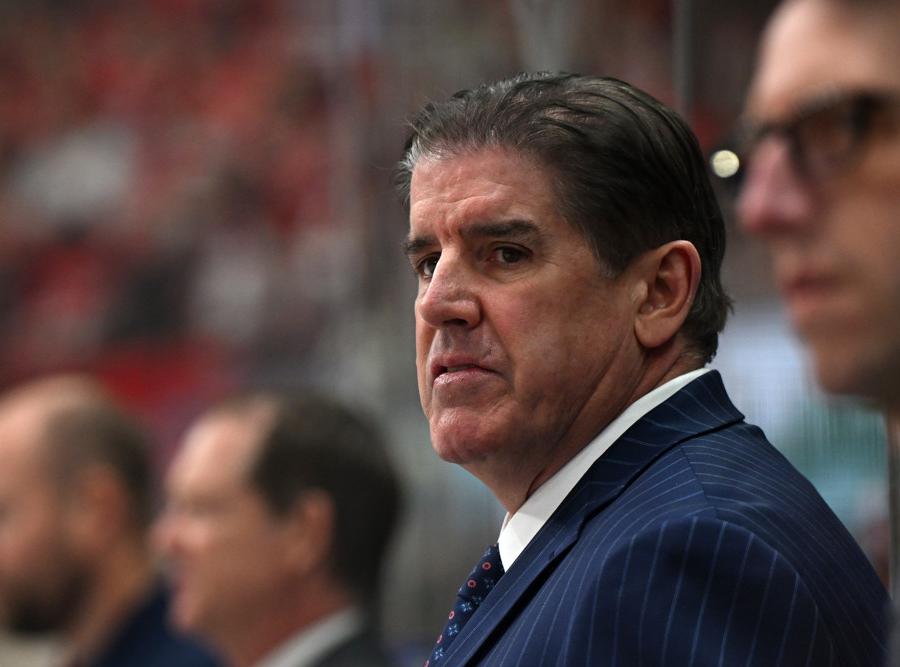

Five straight first-round exits. Five goals in four playoff games against Colorado. Anze Kopitar's retirement ending the longest single-player captain tenure in the franchise's modern era. And a GM who publicly questioned whether his team was too defensive-minded after being swept by the Presidents' Trophy winner. When Ken Holland sat down to solve the coaching question, he needed someone who could answer all of it at once. He found the answer in a 61-year-old who has been to the Cup Final three times as a coach, won it once, and has a documented pattern of making his new teams dangerous in his first season. Whether that pattern holds in Los Angeles is the most important question the Kings ask going into 2026-27.
The Los Angeles Kings have not won a playoff round since raising the Stanley Cup in 2014. That is twelve years. In those twelve years they have made the playoffs in seven different seasons, been swept four times, and fired three head coaches and two general managers. The franchise has excellent defensive structure - Holland's own words - and has never quite been able to produce the sustained offensive output that translates defensive dominance into playoff advancement. Five goals in four games against Colorado this spring was the distilled version of the problem. The Kings control games, prevent chances, and then cannot score enough to win when the defensive structure encounters opposition with comparable quality at the other end.
Peter Laviolette is not a defensive-first coach. He is the furthest thing from it available at the coach level. His Philadelphia Flyers reached the Cup Final in his first season. His Nashville Predators reached the Cup Final in his fourth season. His New York Rangers won the Presidents' Trophy in his first season, with Artemi Panarin - now a Los Angeles King - having the best offensive season of his career. The most consistent thread across his six-team, 23-year head coaching career is that his teams score goals. They play fast. They play aggressive. They play the kind of transitional, attacking hockey that the Kings have been missing since Anze Kopitar was in his prime and Dustin Brown was providing the net-front presence that the current roster lacks.
This Is Both a Safe Pick and the Right Pick - Which Is Not Always the Case When Hiring a Coach
Laviolette's teams score goals. The Kings have not scored enough goals for twelve years of playoff hockey. That alignment between what the team needs and what the coach provides is the most direct justification for the hire. His system - aggressive forecheck, transitional offence, activating defencemen - is the specific antidote to the defensive passivity that Holland identified after the Colorado sweep. He also knows Artemi Panarin intimately, having coached him to the best offensive season of his career (120 points in 2023-24). Reuniting a coach and a star who have demonstrated elite chemistry together is a genuine accelerant.
He has been fired by six teams. The pattern of strong early performance followed by gradual decline is not coincidence - it is the consistent output of a coaching style that motivates and unlocks new rosters quickly but loses effectiveness as opposing coaches adapt to his system over two or three seasons. The Rangers' collapse from Presidents' Trophy to 39-36-7 in Year 2 under him is the most recent example. A three-year deal is appropriate precisely because it captures the window of his historically best performance. If the Kings haven't won a playoff round by year two, the final year becomes a lame-duck situation that no one benefits from.
The most immediate visible change will be the forecheck. Jim Hiller's Kings played a structured, contained game that suppressed offensive zone time for opponents but also suppressed it for themselves. His teams were among the most disciplined defensively in the league and among the most passive in transition. D.J. Smith's interim record - 11-6-6, with goals per game improving from 2.60 under Hiller to 3.10 under Smith - hinted at what a different approach might produce. Laviolette's approach is the full version of what Smith's sample suggested.
His forecheck pressures opposition puck-carriers before they can organise breakouts. His wingers are expected to hunt loose pucks behind the opposition net rather than retreat to defensive positions. His defencemen are encouraged to activate - to jump into the attack when the opportunity presents, knowing that the system has backside coverage built into its structure. The result, when it works, is a team that generates sustained offensive zone time through north-south pressure rather than east-west cycle possession. It is the opposite of what the Kings have been doing. It is the reason Panarin flourished under him.
“Under Laviolette in 2023-24, Artemi Panarin scored 120 points - the best season of his career. He is now an LA King for two more seasons. The coach-player reunion that produced those 120 points is the most compelling specific evidence that this hire works.”
— Pucky Editorial
The power play will also change. Hiller's Kings had a functional power play that relied on point shots and second-chance opportunities. Laviolette's power plays are built around movement and multiple shooting threats - the Philly configuration of his 2009-10 team, the Nashville one-timer system that Shea Weber anchored, the New York set-up that put Panarin on the right side as the trigger. With Kevin Fiala, Panarin, and Adrian Kempe available as shooting threats from multiple positions, the Kings have the personnel for an elite power play under Laviolette's system. Whether Brandt Clarke - 22 years old, a developing offensive defenceman - is ready to be the point quarterback that system requires is the most important individual development question of training camp.
Kopitar Is Gone. Byfield Is 23. The Kings Need to Know Quickly Whether He Can Be a No. 1 Centre in This System - Or Acquire One.
Anze Kopitar retired after 20 seasons - all with the Kings - as one of the most complete centres of his generation. He was +17 in his final season at 38 years old. He won two-way faceoffs, drove possession, led the penalty kill, and was the single player around whom every Kings system of the last 15 years was organised. There is no replacement for that in the current roster. There is a succession candidate: Quinton Byfield.
Byfield is 23 and has been one of the most anticipated young centres in the Western Conference since being drafted second overall in 2020. His physical tools - 6-foot-4, fast, two-way capable - are exactly the profile that Laviolette's system needs at the top of the lineup. The crucial question is whether Byfield takes the leap from very good young centre to legitimate No. 1 centre in his first season as the designated heir. Some players do it immediately when the environment demands it. Others require a year of adjustment when the spotlight narrows. Laviolette's system is specifically good at identifying which type of player Byfield is - his forecheck is demanding enough that the centre's role is unavoidable. If Byfield is ready, the Kings are genuinely competitive. If he needs a year, Holland may need to acquire a stop-gap solution.
The alternative is a centre acquisition this summer. The Kings have the cap space, the assets, and the need. Whether Holland decides Byfield is the answer or pursues a veteran centre to bridge the gap - and whether that bridge centre is someone like Dylan Larkin, whose trade request from Detroit has been public - will define the team's ceiling more than any other offseason decision. Laviolette has worked with elite centres his entire career (Eric Staal at Carolina, Mike Richards and Claude Giroux in Philly, Ryan Johansen in Nashville, Nicklas Backstrom in Washington, Mika Zibanejad in New York). He knows what a No. 1 centre looks like. He will know within weeks of training camp whether Byfield is ready to be one.
The thing that has not been adequately discussed about the Laviolette hire is the specific chemistry it resurrects. Panarin chose Los Angeles for family reasons - his desire for the LA market was genuine and primary in the trade request. But Laviolette's arrival makes an already appealing situation significantly more appealing for the Russian winger. He was 120 points good under this coach. He is 34 now. His ceiling on a forward line with Kempe and Fiala, in a system built around his vision and creation at the half-wall, is the highest it has been since he left New York.
“Players of Panarin's skill, hockey sense, resume... hard to find those players. He's an elite offensive producing machine. Does it year in and year out. Talking to him, he's really excited to come to LA. I think this was his No. 1 destination.”
— Ken Holland, LA Kings General Manager, after the Panarin trade
That was before Laviolette was hired. After the hire, Panarin is in Los Angeles with his preferred city, his preferred coach, and two more years on a contract that is manageable for the franchise. The argument that this version of the LA Kings - Laviolette coaching, Panarin playing, Kempe and Fiala on the wings, Byfield at centre, Doughty and Clarke on the back end - is meaningfully more dangerous than any version the franchise has deployed since 2014 is not a leap of faith. It is the straightforward arithmetic of putting the right coach with the right players and the right system.
Whether it produces a playoff round win - the first since 2014 - depends on Holland closing the goaltending gap and resolving the centre question before September. Those are not small asks. But the foundation is more promising than it has been in years. Laviolette's first season in Los Angeles will be the most interesting Kings season since the second Cup run. It starts in October. The preparation for it starts now.
Peter Laviolette
2026 - Year One
The most attacking coach available. The right winger already on the roster. The first-line centre question still to be answered. Five years of first-round exits waiting to be ended.