
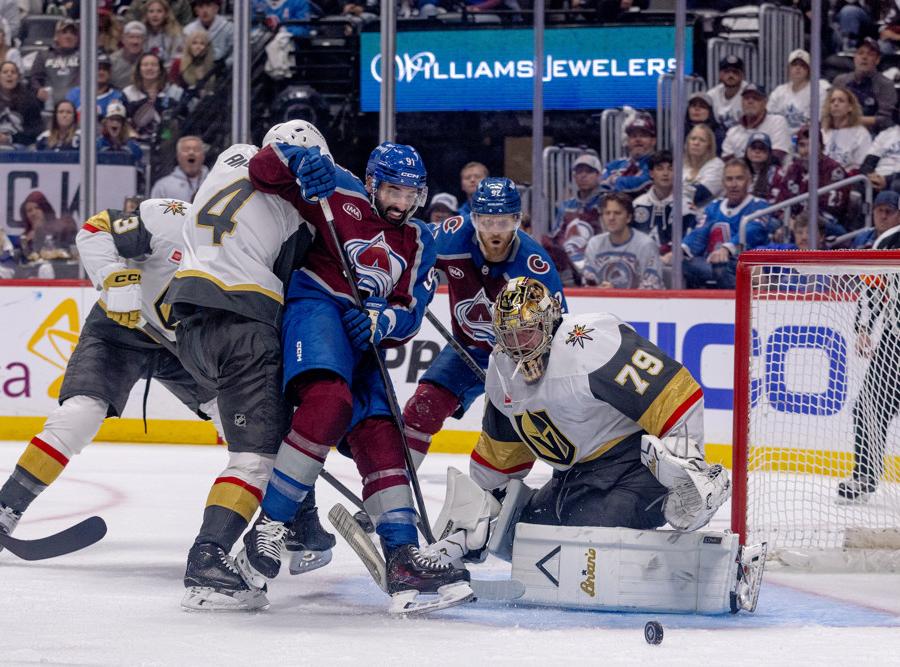


The Vegas Golden Knights were 0-19 in playoff history when trailing by three goals. They had a 6% implied win probability after the first period of Game 3, according to Vegas' own analytics team tracking betting markets. Mark Stone had just returned from a five-game absence with a lower-body injury. Colorado Avalanche forward Nathan MacKinnon was healthy. Cale Makar was back in the lineup after missing two games. The Presidents' Trophy winners led 3-0 at T-Mobile Arena after twenty minutes, having quieted a building that doesn't quieted easily.
Nineteen seconds into the second period, Stone tipped a Mitch Marner feed past Scott Wedgewood on the power play. The sequence took one shift. The comeback took forty minutes. The series, in every meaningful sense, ended in that moment.
Vegas scored five unanswered goals to win 5-3, their first three-goal playoff comeback in franchise history. They lead the series 3-0. No team has ever recovered from that deficit in a conference final. The Avalanche, who posted 121 points in the regular season (55-16-11), now face elimination Tuesday in the same building where they watched their season turn on a single shift they couldn't kill.
The specific mechanics matter. Colorado entered the second period with momentum and a three-goal cushion. Vegas had barely survived the first twenty minutes - Colton Sissons hit a post on a breakaway that Wedgewood stopped, Pavel Dorofeyev had a goal correctly waved off for a high stick, and thirty-two seconds later Jack Drury scored shorthanded to make it 3-0 instead of 2-1. T-Mobile Arena was quiet in a way it almost never is during playoff hockey.
Stone's first shift back changed the temperature. Marner walked the puck into a clean passing lane off the opening draw. Colorado's penalty kill sagged into a passive box. Stone arrived in the soft ice between the forwards and defense, unimpeded, and redirected the feed past Wedgewood's glove. Three-to-one, 19 seconds gone, and the crowd found its voice.
"This was a game where we showed some (guts)," Vegas head coach John Tortorella said afterward, according to NHL.com's game recap. That undersells what happened. What Vegas showed was the identity that has defined their playoff run: an absolute refusal to believe a game is over until the final horn.
The goal was the third-fastest from the start of a playoff period in Golden Knights history, per NHL media relations. More importantly, it was the psychological reset that allowed everything else to follow. William Karlsson scored at 4:05 of the second, his first goal of these playoffs, cutting it to 3-2. Keegan Kolesar tied it later in the period with his first of the postseason. Tomas Hertl gave Vegas the lead at 8:21 of the third with a backhand that beat Wedgewood blocker side. Brett Howden added an empty-netter, his tenth goal of the playoffs, to seal it.
The throughline was Stone's 19-second strike. "When Karlsson scored, it put doubt in their heads, and Vegas started playing smarter and more aggressive," Hertl said in NHL.com's feature on Stone's return. The doubt he described was visible in Colorado's posture on the ice for the final forty minutes. The first period's urgency gave way to something more fragile - the way urgency always becomes fragile when it encounters a setback it didn't prepare for.
The Avalanche didn't lose this game in nineteen seconds. They lost it across every decision point that followed, and the pattern was identical each time: Vegas applied pressure, Colorado failed to respond structurally, and Wedgewood couldn't compensate.
After Stone's goal made it 3-1, Colorado had 39 minutes to protect a two-goal lead or extend it. They did neither. Karlsson's goal at 4:05 came on a rebound after Wedgewood stopped Marner's initial shot - a play Colorado's defense should have cleared but didn't. Kolesar's tying goal was a batted-down shot from Dylan Coghlan that Colorado's forwards let through unchallenged. Both goals came within five minutes of each other, the third consecutive game Vegas scored a pair that quickly.
Hertl's go-ahead goal in the third was the most damning. Stone bumped him the puck through the neutral zone. Hertl danced around Sam Malinski at the blue line and released a backhand that beat Wedgewood clean. It was both the best individual play of the night and a referendum on Colorado's defensive structure: Malinski was the only defender between Hertl and the net because the Avalanche's forwards were too deep in the offensive zone to recover.
Wedgewood's numbers across three games tell the complete story. He has allowed 12 goals on 63 shots, a .810 save percentage. In Game 3 specifically, he was excellent in the first period - the Sissons breakaway stop alone kept the 3-0 lead intact - and then allowed four goals on 11 shots across the final forty minutes. The pattern is identical in all three games: Wedgewood holds until the pressure intensifies, then the dam breaks.
The question facing Jared Bednar is whether to start Mackenzie Blackwood in Game 4, the single game Colorado must win or the season ends. Blackwood was excellent in Game 4 against Minnesota, Colorado's last must-win situation, then didn't play again. The case for switching is as strong now as it was then. The case against is equally real: Blackwood hasn't played in nineteen days and would be starting an elimination game in a hostile building on two days' notice.
Makar played 27:14 in his first game back from injury. He generated 11 shot attempts. He recorded zero points. "We gave them a couple too many opportunities," he said after the game, per multiple reports. The understatement was significant. Colorado gave Vegas far more than "a couple" - they gave them an entire second period of momentum and a third period where Vegas controlled the pace.
The larger problem is that Makar was visibly compromised. He wasn't finding the right gear in transition, the trademark acceleration that turns even-strength play into odd-man rushes. His 27 minutes were necessary because Colorado has no one else who can quarterback the power play or absorb that much ice time against Vegas' top lines, but they were 27 minutes of a diminished version of the league's best defenseman.
MacKinnon's situation is worse. He blocked a shot with his knee in the second period and needed help getting to the bench. He didn't start the third. He returned briefly, took a few shifts, and was clearly not functional. Bednar had no update after the game. The quieted was its own statement.
Colorado's two best players are both managing injuries in a series they need to win four consecutive games to survive. The mathematical probability of that outcome is not favorable. The practical reality is even worse: this is a team built to overwhelm opponents with speed and skill, and both elements are now compromised against an opponent specifically designed to grind teams down.
How A Waved-Off Goal Became 3-0 Instead Of 2-1
At 7:26 of the first period, Dorofeyev appeared to score a power-play goal to make it 2-1 Colorado. The officials waved it off immediately and video review upheld the call: the puck was batted in from from above the crossbar. Thirty-two seconds later, Drury scored shorthanded to make it 3-0.
Had Dorofeyev's goal counted, the second period starts at 2-1 rather than 3-0. Stone's 19-second goal makes it 2-2 instead of 3-1. The entire psychological architecture of the game shifts. Colorado never plays from ahead by three, which means they never play the version of the game where they're trying to protect something rather than extend it. Whether they win that version is unknowable. But the waved-off goal is the invisible context for everything that followed - and for why Stone's goal felt so immediately fatal.
The difference between these teams is not talent. Colorado won the Presidents' Trophy with 121 points. They have two of the five best players in hockey when healthy. Their depth chart, on paper, should overwhelm a Vegas roster that finished 26 points behind them.
The difference is identity under pressure. Vegas has now completed three consecutive comebacks in this series where they've erased deficits of multiple goals. They did it in Game 1 when down 2-0. They did it in Game 2 when trailing late. They did it in Game 3 when facing a 3-0 hole. The common thread is not any single player - Stone in Game 3, Howden in Games 1 and 2, Ivan Barbashev in Game 2 - but the fact that someone different steps forward each time.
"They're not afraid," Tortorella said after Game 3, per NHL.com. "Something we've tried to stress is don't be afraid to make a mistake. They're not afraid of any of that. I think they just have an uncanny ability to stay together."
That fearlessness is what Colorado cannot match in their current condition. The Avalanche came back from 3-0 against Minnesota in Game 5 because MacKinnon tied it with 1:23 left in regulation and they had Makar at full speed and a home crowd pushing them forward. Vegas came back from 3-0 on Sunday because this is simply who they are, regardless of circumstance, regardless of building, regardless of opponent.
Tortorella's system has tightened Vegas' structure since he replaced John Tortorella with only a handful of games left in the regular season. The emphasis on shot blocking, defensive accountability, and fearlessness in one-mistake games meshes perfectly with a veteran core that already won a Cup. The result is a team that treats early deficits as solvable problems rather than death sentences.
Colorado, by contrast, has spent three games demonstrating that they don't know how to protect leads against opponents who refuse to quit. The first-period dominance in Game 3 was everything Bednar could have drawn up. Vegas erased it in twelve minutes of the second. That is what this series has been. That is what it is.
Brock Nelson hit a post in Game 3, the closest he has come to scoring in the entire postseason. Martin Necas made a beautiful pass on the Nazem Kadri goal in the first period and then recorded zero shots at even strength for the remainder of the game. Ross Colton played eight minutes in Game 2.
The depth scoring that makes Colorado dangerous when MacKinnon and Makar are fully operational has been absent in every game except the first period of Game 3. When those two are compromised, there is nothing below them that can sustain offensive production against Vegas' defensive structure. Gabriel Landeskog scored first on Sunday, crashing the net to put the crowd on its heels, but the bottom six generated almost nothing after the first period.
This is the structural problem that no amount of tactical adjustment can solve: Colorado's identity requires their top two players to be dominant. When they're not - when Makar is playing his second game back from injury and MacKinnon is blocking shots with his knee - the team doesn't have a fallback plan that works against opponents this good.
Four teams in NHL history have won a best-of-seven series after going down 0-3. The 1942 Maple Leafs in the Stanley Cup Final. The 1975 Islanders against Pittsburgh. The 2010 Flyers against Boston. The 2014 Kings against the Sharks. Three of them did it before 2014. The most recent, the Kings over the Sharks, was a first-round series.
No team has ever done it in a conference final. That reflects the compounding nature of a three-game deficit at this level: the team ahead has too many tactical and psychological advantages for the trailing team to consistently overturn. The general quality of the Avalanche is high. The specific situation they are in has no precedent for successful escape.
Game 4 is Tuesday at T-Mobile Arena. Colorado must win or their season ends. The choices Bednar makes before that game - Wedgewood or Blackwood in net, how to manage Makar's minutes, whether MacKinnon can even play - are the most consequential he will make in these playoffs. The honest answer is that the choices probably don't matter.
“As low as it can get. It's a big hill to climb. The next 24-to-36 hours is for, you've got to find a way to get over it, regroup and go again.”
— Jared Bednar, Colorado Head Coach
Not because Colorado is bad - they are the Presidents' Trophy winner with two of the best players in the world - but because the series has already been decided in all the ways that series get decided before they are formally over. Vegas' identity has been demonstrated three consecutive times against a team that has every reason to believe in itself. Colorado's best period of hockey in this series, the first twenty minutes on Sunday, was erased in the time it took Stone to tip one puck past Wedgewood.
Makar said after the game that the mentality was there but that Colorado gave Vegas opportunities and Vegas capitalized. Both parts of his sentence are true. Both have been true in all three games. A mentality that is right but produces losses three times in a row is not the issue. The issue is that the team on the other side of the ice refuses to believe games are over when they're down three goals, and that refusal has proven more valuable than anything Colorado can generate when their two best players are compromised.
The curse framing around the Presidents' Trophy - no team has won it and the Cup in the same season since Chicago in 2013 - is a narrative convenience that reduces structural explanations to supernatural ones. The structural explanation is simpler: winning 121 points requires engagement and risk-taking across 82 games that creates wear. By May, in a conference final against a team built for these moments, slightly more worn is sometimes the entire margin.
Colorado also had bad luck. Makar's injury was bad luck. MacKinnon's knee was bad luck. But the team ready to absorb bad luck and still win was Vegas, not Colorado. Nineteen seconds into the second period, Stone scored the goal that proved it. Everything that followed was just confirmation.