
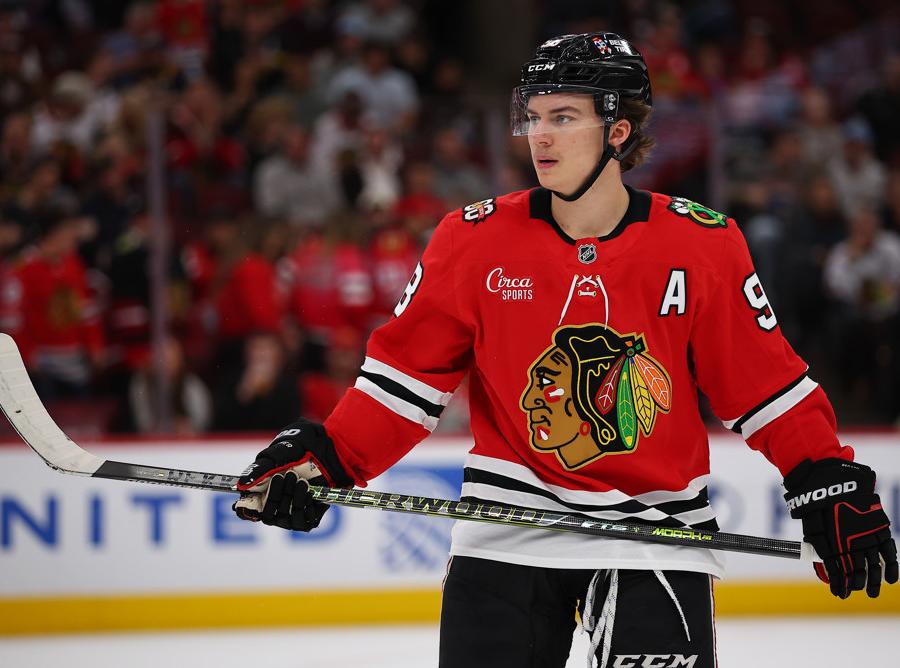

The Chicago Blackhawks finished 29-39-14, 72 points, 31st in the NHL. They allowed 270 goals. They were never in a playoff race. And the rebuild is exactly where it should be.
That verdict sounds like a contradiction until you understand what GM Kyle Davidson actually built this season. The number that matters is not the 29 wins or the minus-57 goal differential. It is December 12, the night Connor Bedard's shoulder gave way and took Chicago's offensive structure with it. Before that injury, the Blackhawks were not a bottom-three team. They were a team playing competitive hockey at 2.53 goals per 60 minutes, 13th in the NHL through early December, with a 20-year-old centre putting together the most complete stretch of his young career.
Then the shoulder happened. Bedard missed 13 games. The team reverted to what the roster actually was: young talent in development, veteran bodies providing structure, and nowhere near enough quality to survive without their franchise player. When Bedard returned, the momentum was gone. The final record - 72 points, 11 more than last season - tells the story of a rebuild climbing faster than anyone expected, interrupted by injury, and still moving in the right direction.
On March 6, Davidson traded Nick Foligno, Connor Murphy, Jason Dickinson, Colton Dach, and Ilya Mikheyev. Five veterans out. Nine picks in the first two rounds of the next two drafts in. Bedard was named alternate captain at 20 years old, the youngest player given that responsibility since Jonathan Toews received the captaincy at 21. Head coach Jeff Blashill called it his season's most meaningful moment.
Phase 1: October to December 11 - The Promising Start
Nobody predicted the Blackhawks would open the season playing offensive hockey competitive enough to rank 13th in the league at 2.53 goals per 60 minutes before December. The roster construction heading in was transparent: young talent being developed around Bedard, veteran bodies providing structure. What arrived instead was a Bedard operating with genuine top-ten-in-the-league urgency, faster, more defensively engaged, more willing to absorb hits to make plays.
Bedard had worked on his skating all summer rather than attending the World Championships. The difference showed from week one. He was drawing defensive attention in ways that created space for Tyler Bertuzzi to have the best season of his career. Frank Nazar was asserting himself as a legitimate NHL player. Ryan Greene, a 2022 second-round pick who cracked the roster out of training camp, played 81 of 82 games and led all Blackhawks rookies in scoring - a development precisely nobody forecast in September.
Phase 2: December 12 to February - The Injury Window
Bedard's shoulder injury sent him to the sidelines for 13 games. The effect was immediate. Without him, Chicago became the roster it actually was: capable veteran structure, genuine young talent in development, and not enough quality to compete with the Western Conference middle class.
Artyom Levshunov, the 2024 second overall pick, had his own struggles in this period. He was demoted to Rockford in December, a development decision reflecting the difficulty of asking a 19-year-old Belarusian defenceman to carry top-four minutes on a team desperately needing structure from its back end. Sam Rinzel similarly bounced between the AHL and NHL. The Bedard absence revealed exactly how much infrastructure still needed to be built around him.
Phase 3: March 6 to Season End - The Full Youth Movement
The trade deadline was the day the Blackhawks formally transitioned from "veteran-young blend" to "this is a young team now, full stop." Foligno, traded to Minnesota to reunite with brother Marcus, had been the emotional anchor of the room, the presence who mentored Bedard through his first two NHL seasons. The Blackhawks sent a heartfelt tribute when he left. It deserved one.
What remained: Bedard as alternate captain. Bertuzzi as alternate captain. A lineup of young players being asked to do for themselves what professionals had been modeling for them. Seven forwards drafted by Davidson appeared in NHL games this season. The prospect pipeline was not theoretical - it was producing bodies capable of meaningful NHL minutes.
First 30-Goal Season. First Point-Per-Game Season. Top-20 NHL Centre at 20.
Year one was promise. Year two was a sophomore slump that generated national conversation about whether the "generational talent" label had been premature. Year three was the answer: 30 goals, 45 assists, 75 points in 69 games, an 89-point full-season pace, and defensive engagement that scouts had flagged as the missing piece.
His best stretch came before the December 12 shoulder injury, a window in which his production sat alongside Macklin Celebrini at the top of the 2023-2024 draft class. He returned and still finished at 75. He is already the unquestioned franchise leader, and based on his trajectory, the most likely next 100-point centre in the league when the team around him develops sufficiently to generate sustained zone time and power-play opportunities.
“He's earned it with his commitment to winning hockey. He's very, very competitive. He works hard every day. He has to continue, the team's going to follow him.”
— Jeff Blashill, on naming Connor Bedard alternate captain at 20 years old, March 6, 2026
The late-season wall was real - his production dipped in the final 10 games as the physical toll of carrying a rebuilding team's entire offensive structure at 20 caught up to him. That wall gets shorter when the roster around him improves. The trajectory is right.
Connor Bedard, C - A. 30G-45A-75 points in 69 games. First 30-goal and point-per-game season. Improved skating, better defensive engagement, missed 13 games to shoulder injury and still delivered an 89-point pace. The late-season fatigue in the final 10 games reflected the physical cost of being a 20-year-old carrying an entire offensive structure. That changes as the supporting cast develops.
Tyler Bertuzzi, LW - A. Led the team in goals with 32, the most of his NHL career at 30. Blashill's system unlocked a version of Bertuzzi's power-forward game that previous coaching staffs hadn't accessed consistently. Power play, even strength, physical net-front presence. The only forward who didn't need Bedard on the ice to be dangerous. His UFA status is the summer's key decision.
Ryan Greene, C/LW - B. The season's biggest surprise. The 2022 second-round pick cracked the NHL roster in training camp and never returned to Rockford, playing 81 of 82 games and leading all Blackhawks rookies in scoring - a development precisely nobody forecast in September.
Frank Nazar, C - B. After proving he belonged in 53 games last season, Nazar's full 2025-26 campaign provided evidence that the 2022 13th overall pick is tracking toward the second-line centre role Chicago drafted him to fill. Skillful, creative, still developing his defensive game but no longer a project.
Spencer Knight, G - B-. Competent and reliable when healthy. His 18 wins led all Blackhawks goalies, which in a rebuilding context is exactly what a starter needs to provide. Not spectacular, not a liability. Drew Commesso posted the better GAA (2.31) across his starts, raising the long-term question of which goalie Blashill should lean toward in 2026-27.
Artyom Levshunov, D - C+. The most scrutinized individual season on the team outside of Bedard. First-half struggles led to his AHL demotion in December. His return was more stable but not consistently dominant. He is a 19-year-old Belarusian defenceman who was asked to be a top-four NHL blueliner in a rebuilding team's third full season. The ceiling, every scout who has watched him agrees, remains enormous. C+ from a 19-year-old second overall pick in his first NHL season is a development point, not a verdict.
Oliver Moore, C/W - C. Moore's season was defined by injury rather than development. The Blackhawks' speediest forward, who produced four assists in nine NHL games last season with elite two-way energy, was derailed. His 2026-27 health and return are among the most important non-draft questions the organization will navigate this summer.
Murphy to Edmonton - Chicago Win
Connor Murphy was the longest-tenured Blackhawk and the most respected veteran in the locker room. His penalty-killing intelligence and defensive positioning were genuinely valuable to Edmonton's playoff push, which is why the Oilers paid a 2028 second-round pick where most observers thought a third or fourth was the ceiling. At 50% salary retained, Chicago extracted maximum value.
Dickinson + Colton Dach to Edmonton - Davidson's Best Deadline Deal
The package surprised the league. Multiple analysts called it an overpay by Edmonton, which means Chicago got full value: Andrew Mangiapane (a forward who gets a clean slate in Chicago and provides depth) and a top-12 protected 2027 first-round pick that becomes an extremely valuable asset if Edmonton misses the playoffs next spring.
Foligno to Minnesota - Mutual Win
Foligno was reunited with brother Marcus in Minnesota, a storyline that overshadowed the hockey transaction. The Wild got veteran leadership and physical presence for their playoff run. Chicago got future assets and the formal beginning of the post-Foligno era. His two seasons as captain did exactly what Davidson signed him to do: provide the stable environment in which Bedard, Nazar, and the wave of young talent could learn what NHL professionalism looks like.
Scott Wheeler at The Athletic released his league-wide prospect rankings on April 8, 2026, and placed the Blackhawks first in the NHL. Not top-three. First. The chief reason was depth: another organization could possess the best individual forward, defenceman, and goaltender between any two teams while still trailing Chicago in overall pool quality, simply because Chicago has more legitimate prospects at more positions than any other team. That is the specific outcome Kyle Davidson has been engineering through four drafts.
The headliners:
- Anton Frondell (2025, #3 overall, F): 6 points in 8 NHL games to close the season after dominating the SHL and winning gold at the World Juniors. Tier 1.
- Sam Rinzel (2022, #25, D): Close to graduating after a strong Rockford year. Tier 2.
- Roman Kantserov (2023, #44, RW): Developing abroad. Tier 2.
- Nick Lardis (2023, #67, RW): 117 OHL points, 4th in OHL scoring. Tier 3.
- Sacha Boisvert (2024, #18, C): Strong first college season at North Dakota. Tier 3.
- Marek Vanacker (2024, #27, LW): 42 AHL points in 45 games despite injury. Tier 3.
- Kevin Korchinski (2022, #7, D): Approximately 100 NHL games, graduating soon. Tier 3.
- Drew Commesso (2020, #46, G): 2.31 GAA in NHL starts, ready now. Tier 4.
Connor Bedard, Frank Nazar, Artyom Levshunov, Ryan Greene, and Wyatt Kaiser have all graduated from prospect status. Despite that, this is still the #1 ranked pipeline in the NHL.
Eleven First-Round Picks in Four Years. Nine R1-R2 Picks in the Next Two Drafts.
Kyle Davidson has used the rebuild years to accumulate first-round picks at a rate that only Pittsburgh, when they had Crosby and were drafting consecutively, has matched in recent NHL history. Chicago drafted 11 players in the first round alone over the previous four years. Following the March 6 trades, they hold nine picks in the first two rounds across the 2026 and 2027 drafts.
The headline piece is the conditional Edmonton 2027 first-round pick acquired in the Dickinson-Dach trade. If Edmonton misses the playoffs next year, that pick lands in the lottery. Davidson earned a contract extension at the end of 2025-26. The organization believes in his vision. The evidence supports that belief.
The Blackhawks' summer has three critical items.
First, Bertuzzi's UFA status. A career year at 30 raises the question of whether Chicago can retain him on a team-friendly deal, or whether a contender outbids them for the player who led their team in goals. Keeping Bertuzzi gives Bedard his most effective linemate and provides continuity in the one area of the roster - top-six forward play - that actually worked. Losing him creates a production void that Frondell and Lardis are likely two years away from filling.
Second, Levshunov. Year two must be better. The organization still believes - all internal messaging indicates the demotion was a development decision, not a judgment. But the external clock is ticking on a second-overall pick who hasn't yet imposed himself on NHL games the way his draft position suggested he would. A significant leap from Levshunov, even a partial one, changes the entire defensive picture of the team heading into 2027-28.
Third, the 2026 draft. The Blackhawks hold their own first-round pick. They are open to trading it if the right opportunity emerges. Whether Davidson finds a trade that accelerates the timeline or uses the pick to add another high-ceiling body to the best prospect pool in the league will indicate whether the rebuild is in "stabilize" mode or "accelerate" mode for the coming year.
The Germany Global Series games this fall will give the league a chance to see what Bedard looks like in year four and what Frondell looks like in his first full season. The answer is not yet "playoff contender." But the answer is also no longer "team going nowhere." The answer is something rarer and more specific: a rebuild that, if it continues on this trajectory, produces a legitimately dangerous team by 2028.
Bedard Is Real
First 30-goal and point-per-game season at 20. Defensive engagement and skating both visibly better. Named alternate captain after the deadline. The franchise centre piece is no longer in question.
Best Prospect Pool in Hockey
#1 per The Athletic even after graduating five players. Frondell, Rinzel, Lardis, Boisvert, Vanacker, Kantserov, Commesso. The wave is still coming.
Goal Differential of -57
213 GF, 270 GA. You cannot make the playoffs with a -57. Levshunov's development is the most important individual variable in whether that changes by 2027-28.
Bertuzzi's UFA Decision
The career year at 30 was the perfect combination of Blashill's system and Bedard's gravity. Re-sign on a team-friendly deal and the top six holds. Lose him and Frondell or Lardis is asked to fill the void two years too early.
Eleven more points than last season. Seven Davidson-drafted forwards in NHL games. Bedard's first 30-goal and point-per-game year. A trade deadline haul that added nine first-and-second-round picks over two drafts. The best prospect pool in the NHL per The Athletic. That is the optimistic read.
The honest read: the goal differential is -57. They allowed 270 goals. Levshunov was demoted in December. Oliver Moore was injured. The playoffs were never a theoretical possibility. The distance between this team and a wild card spot is measured in years, not points.
The grade is B- because the gap between the rebuild's trajectory and the finished product remains enormous, but the trajectory itself is correct, and Bedard at 20 with 30 goals and the best prospect pool in hockey waiting behind him is the most encouraging foundation for a franchise rebuild the United Center has seen since the early Toews-Kane years. The franchise was built around a generational centre once before. The last time it went well.