

 Colorado Avalanche
Two games in Denver. Two Vegas wins. Two losses for the team that finished the regular season with 121 points, the Presidents' Trophy, and what looked on paper like the deepest playoff roster in hockey.
This is not a slow start. This is the sound of a formula failing when it matters most.
The Golden Knights lead the Western Conference Final 2-0 after taking home ice from the Avalanche without needing overtime, without trailing in the third period of either game, and without their power play doing the heavy lifting. Game 3 is Monday night at T-Mobile Arena, where Vegas is 8-1 this postseason. Colorado does not have a margin-for-error problem. It has a margin-for-error-that-no-longer-exists problem.
The Third-Period Problem Is Real, and It's Structural
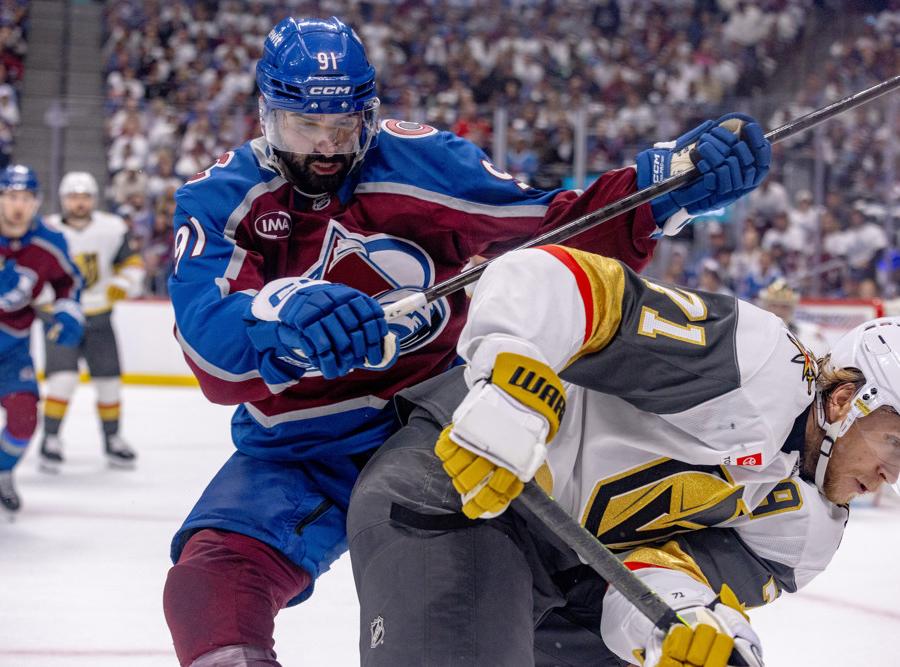
Saturday night looked, for forty minutes, like the response everyone expected. Ross Colton opened the scoring at 16:59 of the first on feeds from Brent Burns and Nazem Kadri, Ball Arena was loud, and Carter Hart had looked beatable. Colorado led after two periods and owned a 45-0-0 record this season in that situation - regular season and playoffs combined. (John Matisz, TheScore)
That streak ended in seven minutes.
Jack Eichel tied it at 9:15 of the third on a backdoor feed from Pavel Dorofeyev. Ivan Barbashev buried an Eichel setup two minutes and seven seconds later for the lead. Then the empty-netter. The final score was 3-1 Vegas. The Eichel-Barbashev-Dorofeyev line finished the night a combined plus-seven and was on the ice for two of Vegas's three even-strength goals.
Vegas outshot Colorado 14-4 in the final frame and turned a hostile building silent. More importantly, they did it with territorial control, not opportunism. "We felt if we stayed patient, eventually we'd get looks," Golden Knights head coach John Tortorella said postgame. "They like to stretch the zone, and if you can turn pucks over in the neutral zone, you can make them defend tired." (Jesse Granger, The Athletic)
Across both games, Vegas has outscored Colorado 4-0 in third periods at five-on-five. That is not variance. That is Vegas playing their best hockey in the ten minutes that decide playoff games, and Colorado shrinking into a defensive shell that invites exactly the kind of pressure they cannot sustain.
MacKinnon Has Been Erased
Nathan MacKinnon has played 116 minutes and 41 seconds in this series and has zero points. That is not a shooting-percentage correction waiting to happen. That is a coaching victory.
Tortorella has glued the Eichel line and the Shea Theodore-Alex Pietrangelo pair to MacKinnon at every opportunity, and Colorado head coach Jared Bednar has not found a counter. When the best player in the world - the Hart Trophy favorite, the engine of a 121-point season - cannot generate a dangerous look for two straight games, the problem is not individual. It is systemic.
"We stopped playing our game. We sat back," Bednar said after Game 2. "You can't do that against a team like Vegas." (Emily Kaplan, ESPN)
MacKinnon was more direct. "There's no excuses," he said. "We had the game. We've got to find a way to close that out. That's on us, especially the top guys." (Emily Sadler, Sportsnet)
Peter Baugh of The Athletic noted that MacKinnon and Mikko Rantanen combined for zero five-on-five shots on goal in the final ten minutes of Game 2 despite heavy ice time in a trailing situation. (Peter Baugh, The Athletic) That is not bad luck. That is two elite forwards being taken out of a game by a structured opponent.
Why the Presidents' Trophy Never Mattered
Colorado entered this series with elite regular-season numbers across the board: 57.2 percent shot share at five-on-five, 56.4 percent expected-goals share, and a 62.8 percent goal share that led the league. (Natural Stat Trick data via search results)
Vegas? A 54.4 percent shot share, 54.0 percent expected-goals share, and a 48.8 percent goal share.
But there is one number that tells the real story: Vegas held a 56.1 percent share of high-danger chances at five-on-five this season, compared to Colorado's 55.4 percent. The Golden Knights were not just surviving elite competition. They were generating more of the chances that actually decide playoff games.
"This is not a curse; it's scoreboard-driven hockey," TSN's Travis Yost wrote after Game 2. "Vegas is playing their best hockey when the game is most likely to be decided." (Travis Yost, TSN)
Sean McIndoe of The Athletic was blunt in his assessment of Colorado's broader pattern. "That's a great team over there, but once the playoffs start, everybody's 0-0," he wrote, adding that Colorado's roster has been "aggressively tilted toward skate-you-to-death hockey" while Vegas has "four lines of playoff-tested adults and two goalies who don't care how many points you had in December." (Sean McIndoe, The Athletic)
Hart Is Playing Like the Best Goalie Left
Carter Hart has stopped 29 of 30 shots in this game, a .967 save percentage that undersells how clean his work has been. The one goal he has allowed came on broken coverage at even strength - not a single soft one, not a single rebound that should have been controlled differently.
His 2023 Conn Smythe Trophy was not a fluke. This is what he looks like when the structure in front of him is airtight and he is seeing pucks cleanly. "We're clogging the middle and making them go through five guys," Vegas forward Mark Stone said. "When they have to dump pucks, it takes away a lot of what makes them dangerous." (Sportsnet panel recap)
Scott Wedgewood has been fine for Colorado - he is not the problem. He made 22 saves on 24 shots for a .917 save percentage. But Hart is the goalie who looks like he belongs on the team that is winning, and that gap matters when games are decided by one or two plays.
Game 1 Set the Template
Thursday's 4-2 Vegas win was not a road heist. It was a blueprint.
Elliotte Friedman described Vegas on Sportsnet's panel as "a team that just doesn't panic anymore," contrasting them with Colorado, who "play like they're aware of how much they have to lose." (Elliotte Friedman, Sportsnet)
Jesse Granger of The Athletic noted that Vegas used "the exact same script" in both games: stay patient, clog the neutral zone, then flip the game with sustained pressure in the final ten minutes. "Colorado had no counterpunch," he wrote. (Jesse Granger, The Athletic)
What Colorado Can Still Fix
Last change in Vegas should help, but only if Bednar is willing to trust the Casey Mittelstadt line to take heavy minutes against Eichel. So far, he has leaned on MacKinnon in that matchup, and it has not worked.
Colorado also needs to stop dump-and-chasing into the Theodore-Pietrangelo pair. Vegas's defensive-zone exits have been clean because Colorado keeps feeding them retrievals instead of carrying the puck or simply not entering the zone.
The power play went 0-for-4 in Game 2 with a chance to put the game away, generating just 0.37 expected goals across those four opportunities according to Sportsnet's tracking. (Emily Sadler, Sportsnet) For a unit with MacKinnon, Cale Makar, Rantanen, and Nazem Kadri, that is a failure of execution and creativity.
And Colorado needs to put a shooter next to Kadri. Colton scored in Game 2, but the line has been a non-factor at five-on-five. Moving Artturi Lehkonen up is the obvious fix.
The Stakes
Down 3-0 to Vegas would be terminal. No team has come back from that deficit against a goaltender of Hart's caliber since the 2014 Kings, and that group had Jonathan Quick, Drew Doughty, and Anze Kopitar in their primes.
This Colorado roster has the talent - MacKinnon, Makar, Kadri, Rantanen - but talent is what got them 121 points and the Presidents' Trophy. The playoffs have always been about identity under pressure, and right now Vegas has more of it.
Monday in Vegas is no longer a chance to take control. It is a chance to avoid the early summer that has become this franchise's defining playoff outcome.