
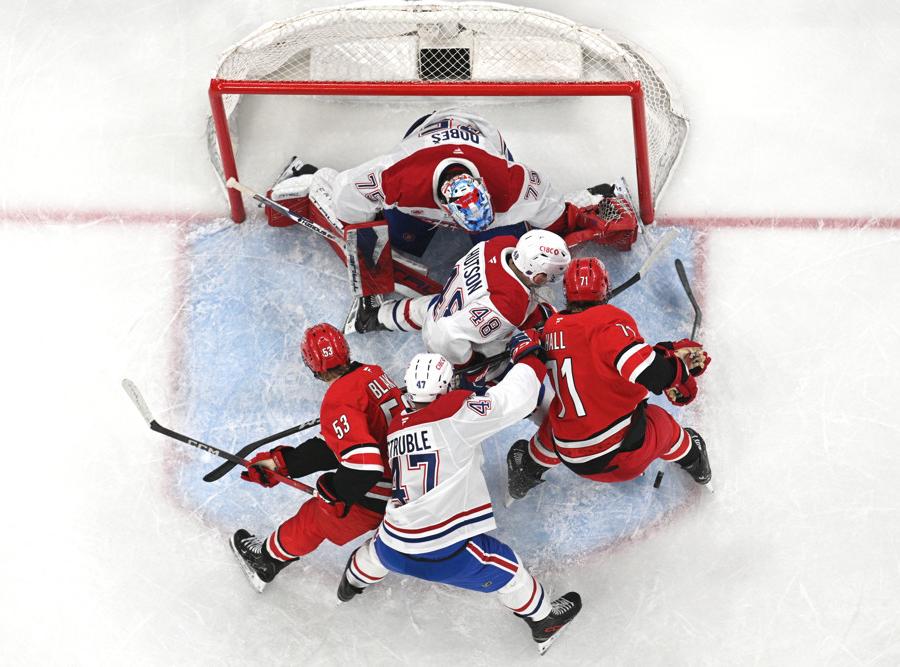
 Carolina Hurricanes
The Carolina Hurricanes have not trailed for a single second through eight playoff games. They swept Ottawa. They swept Philadelphia. They've allowed 10 goals in two full rounds - a 1.25 goals-against-per-game rate that puts Frederik Andersen in conversation with Jacques Plante and Terry Sawchuk. They've had twelve days to watch the rest of the Eastern bracket resolve itself, to heal whatever bumps accumulated through two series, and to prepare for whichever team survived.
The Montreal Canadiens have played fourteen games to get here. They are three days removed from Alex Newhook's second Game 7 overtime winner of the postseason in Buffalo. They are 25.8 years old on average - the youngest conference finalist in 33 years. They are also the only Eastern Conference team that beat Carolina this calendar year, and they did it three times out of three.
This is the tension that defines the Eastern Conference Final: the most dominant team in the 2026 playoffs by every public metric against the one opponent that has their number. Game 1 is Thursday in Raleigh.
What the Models Say - And Where Montreal Broke Them
Carolina's underlying numbers through two rounds are borderline historic. According to Natural Stat Trick's five-on-five data, they've controlled 58.2 percent of expected goals - second-best among all playoff teams - while generating 3.01 expected goals per 60 minutes and allowing just 2.16. Their 56.7 percent share of high-danger chances is elite. Their actual goal share at five-on-five is 67.9 percent.
Montreal's numbers tell a different story. They've been out-chanced at five-on-five, posting a 47.7 percent expected goals share across fourteen games. They've allowed 2.73 expected goals per 60 - worse than league median - and controlled just 46.8 percent of high-danger chances.
Yet Montreal has won more actual goals than expected by 6.3 across the postseason, per MoneyPuck's tracking. Their five-on-five shooting percentage is 9.4 percent - well above Carolina's 7.5 percent. Their high-danger conversion rate is 21.5 percent; the playoff average is around 17 percent.
"This is the classic rested wagon vs. exhausted underdog series," Sean McIndoe wrote for The Athletic in his Eastern Conference Final preview. He describes Carolina's 8-0 start and plus-18 goal differential as "a continuation of a five-year trend where they win the territorial battle almost every night," while Montreal has "survived more than they've dominated."
But the counter-evidence sits in Carolina's own regular-season file: 7-5 loss in Raleigh on January 1, 5-2 loss at Bell Centre on March 24, 3-1 loss in Raleigh on March 29. Aggregate: 15-8 Montreal. The Canadiens were the only team in the Eastern Conference to sweep the season series against the Hurricanes.
One caveat: Brandon Bussi started the New Year's Day game for Carolina, not Andersen. The other two were Andersen losses - both in the second half of the season, both with Montreal dictating pace for long stretches. Whether the version of Andersen that has posted a .955 save percentage across eight playoff starts is meaningfully different from the version that allowed five and three goals in March is the question every Montreal coach has been asking for seventy-two hours.
The Gap That Could Decide Games 1 and 2
Carolina finished its second-round sweep of Philadelphia on May 9. Game 1 of the Eastern Conference Final is Thursday, May 21. That is twelve days of rest - the longest playoff gap for any NHL team since the 1919 Canadiens waited through the Spanish flu epidemic. Every bump, every bruise, every ailment Carolina was managing through the first two rounds has had twelve days of treatment.
Montreal finished a seven-game war on May 18. Their fourteenth playoff game in thirty days. They have three days of rest, and they will fly into Raleigh on Wednesday already behind the curve in terms of recovery. Martin St. Louis has been deliberate about distributing minutes through the postseason - Mike Matheson at 25:40, Kaiden Guhle at 23:11, depth forwards in the 13-15 minute range - precisely because he knew this fatigue moment was coming.
The rust question is real. Carolina has never been forced to play from behind in these playoffs. The first time they face genuine adversity - their first deficit, their first overtime road game - will be the most informative moment of the series. But in the opening two games in Raleigh, the rest advantage is structurally enormous.
"We've been here, we know how hard this is… we've had enough of learning lessons. It's about finishing now," Rod Brind'Amour said this week. (Tom Gulitti / NHL.com)
Montreal's Nick Suzuki offered a different framing: "We're not trying to trade chances every night anymore. We know we can win 2-1 just as much as 5-4." (Eric Engels / Sportsnet)
Where This Series Will Be Won
Carolina's 56.8 percent Corsi share and 58.2 percent expected goals share through two rounds are the foundation of everything else. "They don't give you much. You have to work for every inch inside," Cole Caufield said. (Eric Engels / Sportsnet) Montreal's 47.3 percent Corsi share and 47.7 percent expected goals share mean they've been playing uphill all postseason. The gap is significant. Carolina will own the puck and the high-danger real estate unless Montreal can disrupt their breakout or force turnovers in the neutral zone.
Carolina's power play is operating at 29.6 percent - nearly nine points above the playoff average of 20.8 percent. Their penalty kill has allowed two goals on 23 opportunities for a 91.4 percent success rate - by far the best of any team remaining. Montreal's power play sits at 23.1 percent, respectable but not elite. Their penalty kill is 76.3 percent - the weakest unit of the final four.
Andersen's 1.12 goals-against average, .955 save percentage, and two shutouts through eight games put him in rare company. Montreal's Samuel Montembeault has posted a .928 save percentage and is plus-3.7 goals saved above expected, per MoneyPuck. Emily Kaplan wrote for ESPN that goaltending is "the one area where the gap is smaller than the public perception," noting that Montreal's starter has held his own by goals-saved-above-expected metrics. The relevant benchmark Montreal will lean on: Montembeault's .962 save percentage in two March games against Carolina.
Montreal's 21.5 percent high-danger shooting percentage is about 4.3 points above the playoff average. Mitch Marner has five high-danger goals - tied for the playoff lead - on 4.1 individual expected goals. That's plus-2.7 goals above expected. Carolina's high-danger shooting percentage is 16.0 percent, slightly below average. If Montreal can sustain their finishing edge in tight, they have a path.
Carolina's bottom six has been a quiet weapon. The Jordan Staal-Jordan Martinook line has posted a 64.9 percent expected goals share in their minutes together, per Natural Stat Trick. Sara Civian noted for ESPN that Carolina has gotten "meaningful minutes and goals from their bottom six," which allows Brind'Amour to roll four lines and "keep the tempo high into the third period." Montreal's drop-off after the top nine is more pronounced, and fatigue will only sharpen that gap.
Carolina has not trailed for a single second in eight games. Montreal is 5-0 after losses this postseason. The first Carolina deficit will be the most important stretch of the series, because it will reveal whether the dominance is structural or whether the absence of adversity has hidden something.
The Names That Matter Most
Frederik Andersen (CAR) - 36 years old, the franchise all-time wins leader, fourth goaltender in NHL history to allow two or fewer goals in each of his first eight postseason starts. Brind'Amour managed him at 35 regular-season starts specifically to produce this version. He is the single biggest reason Carolina is the favorite. He is also the goaltender Montreal beat 5-2 and 3-1 in March.
Mitch Marner (MTL) - Five high-danger goals in fourteen games, tied for the playoff lead. Natural Stat Trick credits him with a 52.7 percent expected goals share at five-on-five - the best mark among Montreal's top forwards - and a 14.2 high-danger chances-per-60 rate. His 16.7 percent five-on-five shooting percentage is elevated but not wildly unsustainable. "We've been in the fire for two straight series. We're comfortable there," St. Louis said when asked about his top players. (Arpon Basu / The Athletic)
Sebastian Aho (CAR) - Six goals on 4.2 expected goals (MoneyPuck), plus-1.8 above expected. His 60.2 percent expected goals share at five-on-five leads all Carolina forwards. Evolving-Hockey's regression-adjusted plus-minus model gives him a plus-0.52 net impact - elite top-line center production. "We take pride in not giving up much," Aho said. "If it's a boring game for people to watch, that usually means we're doing it right." (Luke DeCock / Raleigh News & Observer)
Jaccob Slavin (CAR) - Natural Stat Trick credits him with allowing just 0.93 goals-against per 60 minutes at five-on-five and a 59.4 percent expected goals share in his minutes. Evolving-Hockey's model gives him a minus-0.51 defensive impact - one of the best marks among all playoff defensemen. DeCock described Carolina's blue line as "the best top-four left in the tournament," arguing that Montreal's young forwards "haven't seen a defense that closes space this fast."
Alex Newhook (MTL) - Eight playoff goals, both Game 7 overtime series-clinchers, second player in NHL history to score multiple Game 7 series-winning goals in a single postseason. His speed has been crucial for Montreal's rush game. Kristen Shilton wrote for ESPN that Carolina's structured gaps "will be the toughest test yet" for his ability to carry the puck through the neutral zone.
Samuel Montembeault (MTL) - Plus-3.7 goals saved above expected across fourteen games, per MoneyPuck. His .962 save percentage in the two March games against Carolina is the data point Montreal will lean on hardest. He has won two Game 7s this postseason and has been the emotional anchor of the entire run.

 #15 · C · 9 GP
The Names Beyond the Marquee
Cole Caufield (MTL) - Six goals on 3.7 individual expected goals. Plus-2.1 above expected, per MoneyPuck. His 17.1 percent shooting percentage across all situations is elevated, and his five-on-five expected goals share is 48.0 percent - he's not driving play, but he's converting when he gets looks. In the regular season vs. Carolina, he was part of the 7-5 and 5-2 wins.
Andrei Svechnikov (CAR) - Five goals on 5.0 individual expected goals - exactly in line with his chances. His 61.7 percent expected goals share at five-on-five is excellent, and his 14.3 high-danger chances per 60 minutes lead all Carolina forwards. If he gets hot at the same time Aho maintains his form, Montreal's defense will be stretched beyond capacity.
Lane Hutson (MTL) - 22 years old, averaging 26:01 per night, nine power-play points to lead all playoff performers. Arpon Basu wrote for The Athletic that "the series might hinge on whether Suzuki can at least break even in those minutes" against Staal and Slavin, but Hutson's ability to quarterback the power play is equally critical. If his power-play production sustains, Montreal has a path. If it gets shut down in Raleigh, this ends quickly.
Jordan Staal's Line (CAR) - The Staal-Martinook-Jesper Fast trio has posted a 64.9 percent expected goals share in roughly 110 minutes together, with a 6-1 actual goal margin. They're a pure territorially dominant matchup unit. If they can neutralize Montreal's top six in even-strength minutes, the Hurricanes' top line will get easier looks.
Two Teams Beat This Carolina Core Recently. Both Had Hot Goaltending and Clutch Forwards.
The Rangers eliminated Carolina in the second round in both 2022 and 2024. Both Rangers teams were built around elite forward talent (Panarin, Kreider, Fox), a goaltender outperforming expectations under playoff pressure (Igor Shesterkin), and the ability to capitalize on the few high-danger chances Carolina's structure allows.
The parallels to this Montreal team are real. Newhook, Caufield, Marner, and Suzuki give the Canadiens a comparable offensive ceiling. Montembeault's .962 against Carolina in March was not a fluke, and his two Game 7 wins make him a legitimate playoff goaltender. The structural template - hot goaltending plus enough high-end forwards to find the seams Brind'Amour's system normally closes - is the same template that beat Carolina twice in the last four years.
The counter: Carolina's 2026 roster is better than either of those vintages. Andersen at .955 is significantly better than whoever Carolina ran out in those losses. Eighteen players in the current room have Eastern Conference Final experience from last year's loss to Florida. The institutional knowledge of what it takes to advance from this round is present in a way it was not three or four years ago. But the template Montreal needs to follow is established, recent, and on tape.
Why Games 1-2 Could Decide Everything
The rest differential is maximum in Raleigh. Carolina has had twelve days; Montreal has had three. If Carolina wins both opening games cleanly, Montreal will face a 0-2 deficit against a team that has not trailed all postseason. The Canadiens would need to win four of the next five games - two of them in Raleigh - to advance.
But Montreal is 5-0 after losses this postseason. Every time they've been beaten, they've answered. If they can steal Game 1 - capitalizing on any rust from Carolina's long layoff - the series flips. Bell Centre for Games 3 and 4 becomes a potential equalizer, especially with last change allowing St. Louis to shelter his weaker defensive pairs.
"It's a big test. They don't cheat the game," St. Louis said of Carolina this week. "We've grown a lot in how we manage risk, and we're going to need all of that against them." (NHL.com)
The Hurricanes' structural advantages are real, but the 3-0 regular-season sweep gives Montreal belief.
The modal outcome is Carolina winning both games in Raleigh behind Andersen's goaltending, Aho's line, and a rested, structured defense that Montreal hasn't seen anything like yet. Montreal wins at least one in Bell Centre - probably Game 3, where the building and last change give them their best leverage. If it's 2-1 or 2-2 heading into Game 5, Carolina's depth and rest advantage should assert itself over the final two or three games.
The scenario where Montreal wins: Montembeault replicates his March form for four games, Newhook scores three or more in Bell Centre, and Hutson converts at 30 percent on the power play. Probability: 25 to 30 percent. Not impossible. Not the bet.
Carolina in six. The question is not whether the Hurricanes can dominate territorially - they've done that for two straight rounds. The question is whether they can maintain that dominance when Montreal drags them into the kind of one-goal chaos that has defined the Canadiens' entire run. The first deficit Carolina faces will tell us everything we need to know about whether this is finally the year they finish the job.
| Player | Team | G | A | PTS | GP |
|---|---|---|---|---|---|
| Lane Hutson | MTL | 1 | 12 | 13 | 14 |
| Mitch Marner | MTL | 10 | 5 | 15 | 14 |
| Alex Newhook | MTL | 8 | 3 | 11 | 14 |
| Nick Suzuki | MTL | 3 | 8 | 11 | 14 |
| Sebastian Aho | CAR | 6 | 6 | 12 | 8 |
| Andrei Svechnikov | CAR | 5 | 4 | 9 | 8 |
| Cole Caufield | MTL | 6 | 3 | 9 | 14 |
| Category | Carolina | Montreal |
|---|---|---|
| Record | 8-0 | 7-7 |
| 5v5 xGF% | 58.2% | 47.7% |
| 5v5 GF% | 67.9% | 55.4% |
| HDCF% | 56.7% | 46.8% |
| Power Play % | 29.6% | 23.1% |
| Penalty Kill % | 91.4% | 76.3% |
| 5v5 Shooting% | 7.5% | 9.4% |
| 5v5 Save% | .944 | .923 |
| Rest Heading Into G1 | 12 days | 3 days |
| Regular Season H2H | 0-3 | 3-0 |