
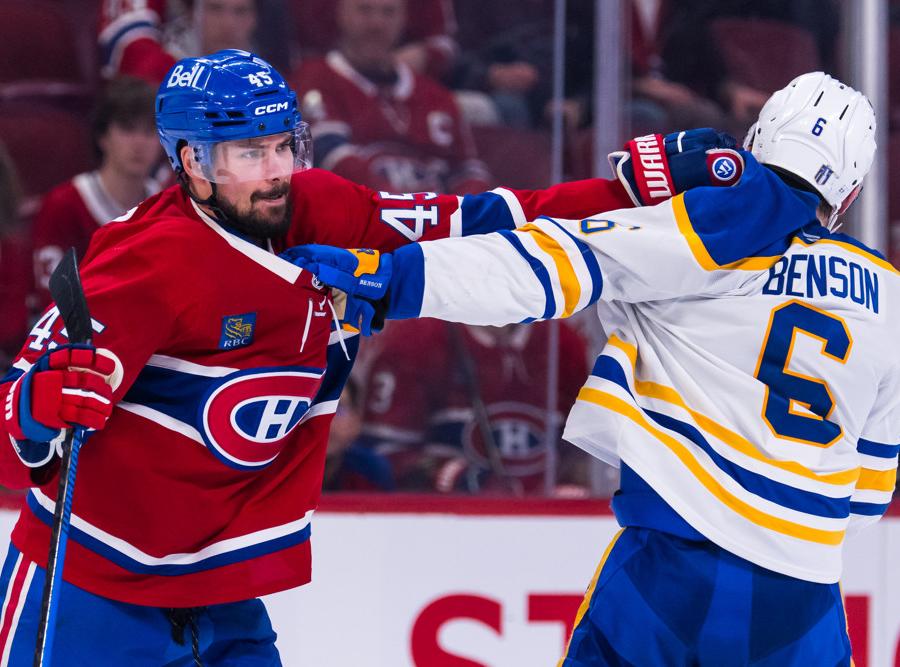


Alex Newhook scored both of the Montreal Canadiens' series-clinching Game 7 overtime goals in the 2026 playoffs. He scored the one that eliminated Tampa Bay in the first round. And now, at 11:22 of overtime in KeyBank Center, with 18,000 Buffalo fans holding their breath and a building that had been the loudest in the Eastern Conference two years running silenced by the weight of the moment, he did it again. A cross-ice pass from Alexandre Carrier. Newhook arriving at the top of the left circle. A low wrist shot that found the glove side of Ukko-Pekka Luukkonen before the goaltender could react. The horn. The silence. The Canadiens piling onto the ice in a building that had never quite seen a moment like this in its new playoff life.
He is the second player in NHL history to score multiple Game 7 series-clinching goals in a single postseason. The first was Nathan Horton, with the Boston Bruins in 2011. The company is rarefied. The circumstance is more remarkable than the statistic: Newhook arrived in Montreal this past summer as a forward expected to provide reliable secondary scoring. He has instead defined the Canadiens' entire 2026 playoff run, leading the team in goals across both series and delivering both of the decisive moments when the stakes were highest.
Montreal advances to the Eastern Conference Final to face the Carolina Hurricanes, who are 8-0, rested for nearly two weeks, and waiting. The Canadiens will arrive as the youngest conference finalist in 33 years, with an average age of 25.8 years. The last team to get to the conference final at that age was the 1993 Montreal Canadiens. Those Canadiens won the Stanley Cup. The narrative is inevitable and the Canadiens are probably already tired of hearing it. They will hear it for as long as they are alive in these playoffs, which may be longer than anyone outside Bell Centre predicted in October.
Buffalo goes home. Their season - which broke a 14-year playoff drought, won their first series since 2007, and produced hockey this city had not seen in the spring since the Drury-Briere era - ends here. It ends with Rasmus Dahlin making playoff history in Game 6, with Luukkonen holding his own in Game 7 against everything Montreal threw at him, and with Lindy Ruff saying: "That pain will go away. But I won't let this one game define the season we had."
Seven Games. Every One Different.
BUFMontreal arrived in Buffalo three days after a Game 7 against Tampa Bay - worn down, emotionally and physically depleted, the kind of tired that only playoff hockey in May produces. It showed immediately. Buffalo's power play converted twice in the first period through Ryan McLeod and Bowen Byram - Byram's goal tying the franchise playoff record for a defenceman with four goals. Jakub Dobes allowed four and finished with 12 saves. Alex Lyon made 26 in a controlled performance. Cole Caufield extended her point drought to five games.
Josh Doan was the most energetic player in the building. Byram moved as if he was playing the most important game of his career. From the outside it looked like the series Buffalo had prepared for: physical, structured, the Sabres' depth advantage over a tired opponent producing the expected result. Both teams knew the next five games would tell the real story.|key:Dobes's first look at KeyBank Center - unfamiliar building, hostile crowd, tired legs. He surrendered four goals. The question heading into Game 2 was whether that performance reflected Montreal's exhaustion or Dobes's limitations. The next six games answered it comprehensively.
MTLNinety-six seconds. That was how long it took Newhook to change the series. A Peyton Krebs turnover in the Buffalo zone. Newhook reading the loose puck before anyone else moved. A snap shot that slipped under Lyon's blocker arm at 1:36. Then Mike Matheson floated a point shot from the left side over Lyon's right shoulder at 4:27. Two goals in under three minutes in the opponent's building. Newhook scored again in the second period. The series was level. The crowd that had roared for Game 1 was bewildered.
Dobes made 27 saves in a game where Buffalo generated volume without quality. Tage Thompson's line - which had been expected to be the series' dominant line - was invisible. Dahlin afterwards was explicitly direct: "Awful game. Not acceptable." Thompson went further into self-criticism: "Everything I touched turned into disaster tonight." Montreal had solved Buffalo's speed in 48 hours. The rest of the series would be about whether Buffalo could find a counter.|key:Newhook's goal at 1:36 - the fastest the tone of a playoff game has been set in this series. The Krebs turnover, the Newhook read, the instant answer to a building that had been confident after Game 1. It was the first clear signal that Newhook was going to be the series' defining individual performance.
MTLBell Centre hosted its first second-round home game since 2015. The noise before puck drop was unlike anything that had happened in that building in years. Thompson scored in the first minute to quiet it - a Dahlin point shot that came off the end boards onto Thompson's stick - but Newhook's rebound goal at 15:31 of the first period restored it. Then Caufield ended her six-game point drought on a power play in the second, and the building came fully apart. Zachary Bolduc, Juraj Slafkovsky, and Kirby Dach each scored. Dobes denied Zach Benson twice in moments that defined the game's emotional architecture. Lyon allowed five goals on 20 shots.
The "Do-by! Do-by!" chants started early in the third period when the score was already beyond reach. Dobes made 26 saves and was calm throughout - grinning from the crease when the crowd found its rhythm, composed when Buffalo pressed late. "I'm just a goofy goalie who tries to stop pucks," he said afterwards. The simplicity of the description - and the accuracy of it, in the context of a 22-year-old performing like a veteran in the most electric building in the Eastern Conference - said everything about what Montreal had found in goal.|key:Dobes's two saves on Benson in the third period when Montreal led 4-2. Both were doorstep chances. Both would have tightened the game to a state where Buffalo could have generated a comeback. Both went into Dobes's pads or gloves. In terms of momentum, they had won the game.
BUFRuff made three changes: Luukkonen replaced Lyon, Konsta Helenius made his playoff debut, Luke Schenn returned. Mattias Samuelsson scored first at 6:32. Jack Quinn's goal was reviewed, confirmed, then overturned on a Montreal challenge for Helenius' goaltender interference on Dobes. Newhook tied it - his fifth of the series. Caufield scored with 13 seconds left in the first on the power play. Thompson tied it in the second when a dump-in deflected off the glass and bounced off Dobes' leg. Benson, on his 21st birthday, took a Doan slot pass and backhanded the winner past Dobes at 4:41 of the third.
Luukkonen made 28 saves. Buffalo blocked 27 shots - second most of any team in the 2026 postseason. Series tied 2-2 heading back to Buffalo with the goaltending question on both benches now front and centre.|key:Benson's birthday goal. The youngest player on the ice in Bell Centre, in the most important game of his career to that point, converting on his 21st birthday off a Doan slot pass with a calm backhand. The Sabres bench erupted as if the series was won. It wasn't. But the belief that propelled them through Game 4 and Game 6 started with that backhander.
MTLFive goals in 8:15 of the first period - the 11th-fastest combined scoring burst between two teams in playoff history. Jason Zucker's deflection opened it at 2:00. Caufield tied it 1-1 at 6:31 (Nick Suzuki found her crashing the net from a Conor Timmins giveaway). Doan's one-timer made it 2-1 at 7:45. Alex Texier's shot deflected off his own skate nine seconds later for 2-2. Helenius gave Buffalo the lead 3-2 with a five-hole wrist shot at 10:15 - his first career playoff goal in his second career playoff game. Buffalo led after twenty.
Then Dobes stopped Thompson on a partial breakaway early in the second - the game's turning point, identified as such by Martin St. Louis in his post-game press conference. Josh Anderson's backdoor pass from Lane Hutson tied it 3-3 at 8:01. Jake Evans batted in Ivan Demidov's squirt-through for 4-3 at 16:15. Suzuki's PPG made it 5-3 entering the third. Demidov's power-play goal - his first career playoff goal - sealed the 6-3 final. Luukkonen was pulled after two periods.|key:Dobes's partial-breakaway save on Thompson early in the second at 3-3. Identified by St. Louis as the turning point. Had Thompson scored, Buffalo leads 4-3 with fifteen minutes of second-period hockey to protect. Instead Dobes covered with his left pad and three Montreal goals arrived in the next nine minutes. One save. An entire series within it.
BUFThe most extraordinary individual performance of the series - and one of the most extraordinary performances by a defenceman in any elimination game in NHL history. Dahlin, Buffalo's captain, walked into Bell Centre for a game his team needed to win to survive and produced 1 goal and 4 assists for 5 points. He is the first defenceman in NHL history to record five points in an elimination game. The record stood alone from the moment it happened.
Montreal scored first - three goals in ten minutes to take a 3-1 lead and send the Bell Centre crowd into the kind of delirium that precedes a series-clinching celebration. Arber Xhekaj tied it 1-1 at 1:40, snapping a one-timer after Evans drew the puck from the faceoff. Demidov's power-play slap shot made it 2-1 at 8:12. Evans' short-handed goal - he stripped the puck and broke in alone on Lyon - put Montreal up 3-1 at 10:14. Lyon was pulled immediately, replaced by Luukkonen. Then seven straight Buffalo goals. Thompson scored four points across the rally. Quinn had two power-play goals. Zach Metsa scored Buffalo's fourth power-play goal of the night at 17:49. Eight to three, final.|key:Buffalo scoring seven consecutive goals after trailing 3-1 in an elimination game, in Bell Centre, with the building at full roar. The sequence began with Luukkonen replacing Lyon at 10:14 and ended with Metsa's goal at 17:49 of the third. Six minutes and nineteen seconds of playoff hockey that produced a 7-0 run. The sheer implausibility of the scoreline - 8-3 for a team that needed a win to stay alive - is what makes Game 6 one of the most memorable individual games of the Sabres' 2026 postseason.
MTLThe city of Buffalo, which had spent three years preparing for this - the return from the playoff drought, the first series win, the belief that this roster had more in it - filled KeyBank Center to capacity. The noise was different from any other game of the series. It was the noise of a fanbase that had waited fourteen years for games that mattered and was unwilling to let this one slip away without everything they had. Dahlin scored on a backhand through the back door in the third period to tie it 2-2. Jordan Greenway had given Buffalo the lead earlier. The Sabres were twelve minutes from the Eastern Conference Final.
At 11:22 of overtime, Carrier found Newhook with a cross-ice pass at the offensive zone entry. Newhook carried to the top of the left circle. He shot low to the glove side. Luukkonen's glove moved but not fast enough. "It was a war all series long," Newhook said. "And for it to end up being Game 7 in overtime, sometimes it just takes one shot." Dobes left KeyBank Center having won two Game 7s in a single postseason - only the third Canadiens goaltender in history to do it, and the sixth rookie in NHL history. The three Canadiens goalies before him were Ken Dryden, Patrick Roy, and Jose Theodore. All of them won the Stanley Cup in those same postseasons.|key:Newhook's winning goal at 11:22 of OT. Carrier's pass. The top of the left circle. The wrist shot low to the glove side. The glove that moved too slowly. The second series-winning overtime goal in a single postseason by the same player - the only time in NHL history it has happened twice. The first Horton comparisons arrived before the horn had fully sounded.
What This Series Did to the History Books
Rasmus Dahlin: The First Defenceman in NHL History With Five Points in an Elimination Game
One goal, four assists. Eight-to-three final score. The previous record for a defenceman in any playoff game was four points - Derek Roy (two goals, three assists in 2006) and John Tucker (two goals, three assists in 1988) co-held the Sabres record. Dahlin tied both and surpassed every defenceman in NHL playoff history.
When the record was pointed out to him in the postgame media scrum, his answer was exactly right: "Five points is pretty good, I don't think there's much else for you to say about that." This is the performance that will be referenced when people explain what kind of player Dahlin is in his prime. He did it in a game his team had to win. He did it in the building of the team closest to eliminating them. He tied it with one goal at 32 seconds of the first period - a backhand over Dobes' right shoulder - then spent the rest of the night making plays that produced the goals that followed.
The record is his. No defenceman has ever matched it. Nobody may for years.
Alex Newhook: Second Player in NHL History to Score Multiple Game 7 Series-Clinching Goals in One Postseason
Tampa Bay. Game 7. First round. 2-1 win. Newhook with the winner. Then Buffalo. Game 7. Second round. 3-2 overtime win. Newhook with the winner again.
The first player to accomplish this in a single postseason was Nathan Horton, with the 2011 Boston Bruins, who scored series-clinching Game 7 overtime goals against both Montreal and Tampa Bay before going on to win the Stanley Cup. The historical resonance is not accidental. Newhook is being mentioned in the same sentence as Horton precisely because the circumstance requires it.
Jakub Dobes: Third Canadiens Goalie and Sixth Rookie in NHL History to Win Two Game 7s in a Single Postseason
The five who preceded him: Ken Dryden (1971, won the Cup), Patrick Roy (1986, won the Cup), Patrick Roy again (1993, won the Cup), Mike Vernon (1995, made Cup Final), Jose Theodore (2002, Canadiens). The first three Canadiens goalies on the list won the Stanley Cup in those same postseasons.
The history is what it is. Dobes is 22 years old. He watches Game of Thrones between starts. He lets the crowd chant "Do-by!" from his crease and he smiles. He has now won more Game 7s in a single postseason than goalies three times his age have managed in entire careers. The conversation about what he is and what he can become is going to be one of the defining storylines of the next decade of NHL hockey.
Average Age: 25.8 - The Youngest Conference Finalist in 33 Years - The Same Team That Won It Last Time
1993 Montreal Canadiens - Roy in net. Damphousse, Bellows, LeClair up front. Chelios, Ramage on defence. The Canadiens of 1993 won 10 consecutive overtime games in the playoffs and swept the Los Angeles Kings in the Final. The youngest conference finalist of their era. Their average age was 25.8 years. They won the last Stanley Cup in franchise history.
2026 Montreal Canadiens - Dobes in net. Newhook, Caufield, Suzuki up front. Hutson, Kaiden Guhle on defence. Slafkovsky, Demidov, Bolduc in development. The youngest conference finalist since their 1993 counterparts - with the same average age, the same franchise, and the same city.
The players who bring the average down: Demidov (20), Hutson (22), Slafkovsky (22), Jacob Fowler (21), Bolduc (23). Their four players over 30 are Phillip Danault (33), Anderson (32), Matheson (32), and Brendan Gallagher (34). Six current Canadiens were on the 2021 Stanley Cup Final team - Suzuki, Caufield, Evans, Gallagher, Danault, and Anderson - giving this young roster more postseason experience than their ages suggest. The 1993 Canadiens also had veteran experience alongside their youth. The comparison is not purely aesthetic. It is structurally meaningful.
How Dobes, Lyon, and Luukkonen Shaped Seven Games
The goaltending decisions on both benches defined the series more than any line combination or tactical adjustment either coach made. Buffalo went through three goaltending phases - Lyon starting, Luukkonen taking Game 4, and the confused Game 6 where Lyon allowed three goals on four shots before being pulled at 10:14 of the first period. The rotation that had given Ruff flexibility all regular season became, in a seven-game series, a structural liability.
| Goalie | Team | Record | SV% | Defining Moment |
|---|---|---|---|---|
| Jakub Dobes | MTL | 4-3 | .921 | G5 Thompson breakaway stop |
| Ukko-Pekka Luukkonen | BUF | 1-2 | .962 (G4) | 22 saves in G7 loss |
| Alex Lyon | BUF | 1-3 | 3 GA on 4 SOG (G6) | Pulled at 10:14 of G6 |
Dobes's .921 save percentage across seven games against the Atlantic Division's top seed is the complete rebuttal to every reservation anyone had about him entering the postseason. His Game 6 - where he allowed three goals in 10:14 of the first period before being replaced - is the anomaly in an otherwise historically consistent performance. It is the same anomaly that Luukkonen's disastrous Game 5 represents for Buffalo. Both goalies had one terrible performance and several excellent ones. The difference is that Dobes's excellence included the two moments - the Thompson breakaway in Game 5 and the full Game 7 - that decided the series, while Luukkonen's excellence (his Game 4 masterpiece) was unable to hold beyond one game.
 #15 · C · 9 GP
What Both Teams Revealed
Newhook Was the Entire Series
8 total goals across both rounds. Both series-clinching Game 7 overtime winners. In a series that could have been defined by Caufield or Suzuki, Newhook was the only consistently dangerous forward across all seven games. His production when Montreal needed it most - and his composure in both OT Game 7 situations - is the story of Montreal's 2026 playoff run.
5-0 After Losses - The Most Resilient Team in the East
Montreal followed every single loss in these playoffs with a win. The pattern held across all seven games of this series: they lost Game 1 and won Game 2, lost Game 4 and won Game 5, lost Game 6 and won Game 7 in overtime. The resilience is not accidental - it reflects a team that identifies what went wrong, adjusts, and produces the answer immediately.
Thompson: Zero Genuine Goals in Seven Games
The 53-goal regular-season scorer had no genuine goals in this series. One deflection that went off Dobes' leg counted on the scoresheet. His partial breakaway in Game 5 - the game's turning point - was denied by Dobes and the series tilted. A fully functioning Thompson changes this series result. He wasn't there, and it was the reason the Sabres needed seven games instead of winning in five or six.
The Goaltending Rotation Was the Series-Long Problem
Lyon, then Luukkonen, then the Game 6 confusion where Lyon was pulled at 10:14 of the first. Neither goaltender could sustain performance across consecutive games. The series required a starter who could be trusted in Games 5, 6, and 7 without reservation. That goaltender did not emerge. Dobes, on the other side, started and finished all seven games. The stability was itself an advantage.
Game 6 Was the Greatest Individual Performance in Sabres Playoff History
Dahlin's five-point elimination game - the first by a defenceman in NHL history - is the moment that will define this run in the collective memory. An 8-3 win in Bell Centre facing elimination, with the captain producing at a level no defenceman has achieved before, is not a consolation. It is a statement of what this franchise has built.
Can Caufield Produce Consistently Against Carolina's Structure?
Caufield scored in Games 3, 4, and 5 - important contributions after her six-game drought. But Carolina's penalty kill neutralised Philadelphia's power play (1-for-19). Caufield's best route to production is on the power play, where Hutson sets her up. Carolina's kill has been historically good. Whether Montreal's power play can convert against Brind'Amour's structure is the first tactical question of the Eastern Conference Final.
| Player | Team | G | A | PTS | GP |
|---|---|---|---|---|---|
| Alex Newhook | MTL | 6 | 3 | 9 | 7 |
| Rasmus Dahlin | BUF | 3 | 6 | 9 | 7 |
| Nick Suzuki | MTL | 2 | 6 | 8 | 7 |
| Lane Hutson | MTL | 1 | 7 | 8 | 7 |
| Tage Thompson | BUF | 1 | 6 | 7 | 7 |
| Josh Doan | BUF | 2 | 5 | 7 | 7 |
| Juraj Slafkovsky | MTL | 1 | 5 | 6 | 7 |
| Ivan Demidov | MTL | 2 | 3 | 5 | 7 |
| Cole Caufield | MTL | 3 | 2 | 5 | 7 |
| Bowen Byram | BUF | 2 | 3 | 5 | 7 |
| Jack Quinn | BUF | 3 | 1 | 4 | 7 |
| Zach Benson | BUF | 2 | 2 | 4 | 7 |
| Category | Montreal | Buffalo |
|---|---|---|
| Goals For | 27 | 23 |
| Games Won | 4 | 3 |
| Record After a Loss | 3-0 (5-0 postseason) | 2-3 |
| Road Record | 3-1 | 3-0 |
| Home Record | 1-3 | 0-3 |
| Avg Age | 25.8 | 28.9 |
The Sabres' Future After Their Best Season in Fifteen Years
Buffalo ended a 14-year playoff drought this season. They ended a 19-year series drought against Boston. They won games in Bell Centre when the series was on the line. They pushed the No. 3 Atlantic seed - a team that had beaten Tampa Bay in seven games - to the seventh game in overtime before losing on a Newhook wrist shot from the left circle. This is a franchise in the right direction. The goaltending question and Thompson's production are the two things that separate this group from competing in the ECF next spring rather than being eliminated in the second round. Both are fixable. The window is open and getting wider.
Thompson (C, 27) - Zero genuine goals against MTL is the number nobody in Buffalo will let him forget, and he won't forget it either. He led all playoff scorers in primary assists this postseason when he was functioning. The series failure was real and requires honest accounting this summer.
Dahlin (D, 25) - Five points in an elimination game. A franchise record. An NHL record. The best individual performance in the Sabres' 2026 playoff run and one of the best by a defenceman in any playoff game in the sport's history. He is the captain, the cornerstone, and the reason this team has a ceiling.
Benson (LW, 21) - Birthday PPG in Game 4. First career playoff moments that will be referenced in Sabres history. His personality - irritating, fearless, clutch - is the spirit of what Buffalo is becoming. His development is the franchise's most exciting individual storyline.
Byram (D, 22) - Three goals and five points in the series. His franchise playoff record (four goals) tied in Game 1 alongside Dahlin's historic Game 6. At 22, he is already producing at a level that suggests the blue line pairing of Dahlin and Byram will be one of the best in the league within two years.
Doan (F, 21) - Seven points across both rounds. The longest point streak by a Sabres player since Tim Connolly in 2006. His energy, his backcheck, his willingness to go to the difficult corners - all of it defines what the third line is supposed to be in a deep playoff team. He is already that.
Goaltending - Summer Priority #1 - The Lyon/Luukkonen rotation that won the Boston series and collapsed against Montreal is the summer's most urgent structural question. Neither delivered the sustained excellence a playoff run requires across seven games. The organisation must decide: commit fully to one, acquire an upgrade, or maintain the split.
25.8 Years Old, the 1993 Parallels, and Now the Carolina Hurricanes
Montreal enters the Eastern Conference Final as the youngest conference finalist in 33 years - with exactly the same average age (25.8) as the 1993 Canadiens who won the Stanley Cup. They face the Carolina Hurricanes, who are 8-0, rested since May 9, and have allowed ten goals in eight playoff games. The series begins Thursday.
The head-to-head context: Montreal swept the regular-season series 3-0 against Carolina, with Dobes posting a .962 save percentage across the games he started. Carolina's penalty kill has been 21-for-21 across two rounds. Montreal's power play - led by Hutson, who has nine power-play points to lead all 2026 playoff performers - will be tested immediately.
The tactical challenge is enormous. Carolina has not trailed in eight playoff games. Frederik Andersen has a .955 save percentage. The Hall-Stankoven-Blake line is the most consistently dangerous line in the Eastern Conference. Rod Brind'Amour's penalty kill will be the most difficult system Dobes has faced. But Montreal's youth means they arrived in this ECF without the accumulated psychological weight that older teams carry. The 1993 Canadiens - the last team with this same average age to reach the conference final - surprised everyone who had written them off.
Newhook has now scored in two consecutive Game 7 overtime situations, in two consecutive series, eliminating two consecutive opponents. Carolina has never lost a game in these playoffs. One of those facts will change by the end of this series. The Eastern Conference Final begins Thursday at Lenovo Center, Raleigh.
“Newhook. Left circle. Low to the glove. The second Game 7 series-clinching overtime goal of his postseason. 1993 all over again - same franchise, same age, same city. Dahlin made history nobody thought Buffalo could write, and seven straight goals followed it. It was not enough. Dobes was in the other net, and Newhook had already decided this was his postseason.”
— Mike Holloway, Senior NHL Columnist