
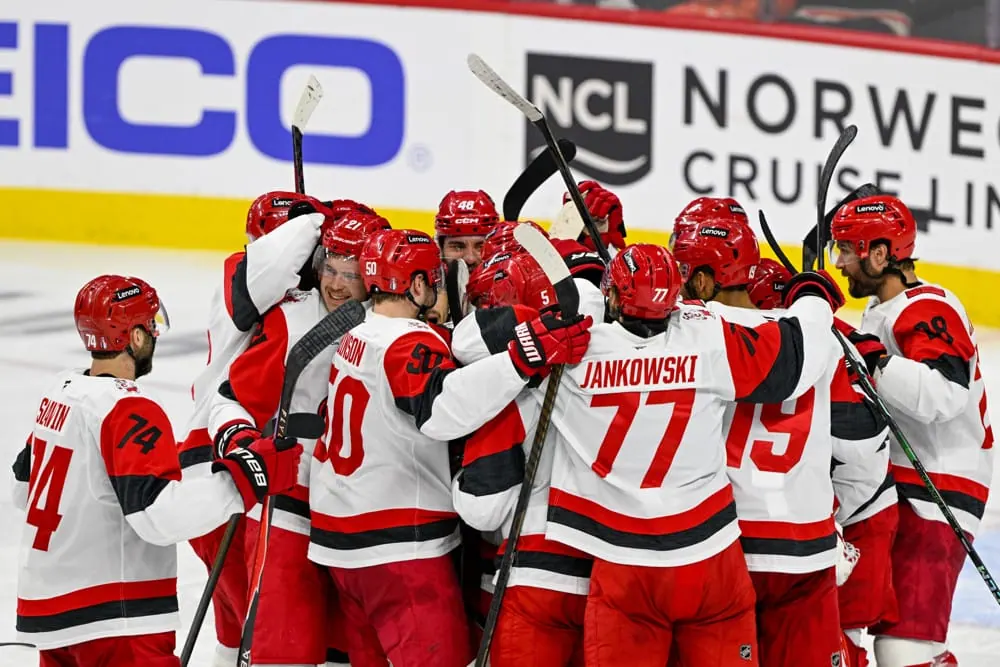


There are numbers and then there are numbers. The Carolina Hurricanes have allowed ten goals in eight playoff games. They are 8-0. They have never trailed, not for a period, not for a shift, not for a single second, in two combined best-of-seven series. Frederik Andersen has allowed two or fewer goals in each of his eight starts, making him only the fourth goaltender in NHL history to do that across the first eight games of a playoff run. The other three are Jacques Plante in 1969, Terry Sawchuk in 1952, and Clint Benedict in 1928. He has surpassed Cam Ward to become the winningest goaltender in Hurricanes/Whalers franchise history. He is 36 years old.
And here is what Logan Stankoven said after the final horn of a 3-2 overtime win in Game 4 that completed the sweep of the Philadelphia Flyers and sent Carolina to the Eastern Conference Final for the third time in four seasons: "I honestly think we have another level to get to."
The Flyers, 3.8% playoff odds in January, Battle of Pennsylvania winners, the bracket's great surprise act, scored five goals in four games against a defensive structure that has now allowed ten across eight playoff nights. They pushed Carolina in Game 2, outplaying them for the first forty minutes. They pushed back in Game 4, taking the lead, tying it, forcing overtime. They were not overmatched the way a lesser team is overmatched. They were overmatched the way every team has been overmatched by Carolina right now: by a franchise operating at the peak of what Rod Brind'Amour's system can produce, with a goaltender defying the historical record, and a Hall-Stankoven-Blake line that is the most dangerous trio in the Eastern Conference.
The brooms came out in Philadelphia on Saturday night. The crowd chanted "Let's go, Flyers" as the series ended. The Flyers deserved that send-off. Carolina deserved the 8-0. Both things are true at the same time.
Where This Carolina Run Sits in the Record Books
Only four franchises in NHL history have ever started a playoff run 8-0 or better. The 1952 Detroit Red Wings did it on the way to a Cup. The 1960 Montreal Canadiens did it on the way to a Cup. The 1969 St. Louis Blues did it before losing the Final. The 1985 Edmonton Oilers went 9-0 and won the Cup. Every one of those runs happened under a playoff format with fewer rounds and shorter series than today's.
Carolina is the first team in the history of the four-round, best-of-seven format, in place since 1987, to sweep both of its first two rounds. What the Hurricanes have done has literally never happened in the modern playoff structure. The 1969 Blues went 8-0 in two best-of-seven series, but those were rounds one and two of a three-round bracket against expansion-era opposition. Nothing Carolina has done in these playoffs has a direct historical precedent in the game as it is currently constituted.
How the Sweep Unfolded
CARThe Flyers arrived in Raleigh without Owen Tippett, their leading regular-season scorer, and walked into a building that had not lost a playoff game since the previous spring. The opening period told the story of the series in miniature: Carolina were faster, tighter, and more decisive than anything Philadelphia had encountered in the first round against Pittsburgh. Stankoven scored twice. Jackson Blake added a third, tucking a backhand inside the left post after Taylor Hall fed him through a seam in the Flyers' defensive zone that Sanheim and Michkov both failed to close. Hall had an assist on every goal.
Dan Vladař made 20 saves and was not badly tested. Andersen made 19 and earned his second shutout of the postseason, his seventh career playoff shutout, passing Cam Ward for the franchise record. The save that defined the game came 35 seconds into the third period: a shorthanded Couturier chance in tight that Andersen denied with a glove save that was already the first genuinely difficult save he had faced all night. Rick Tocchet: "We weren't quick enough for their speed. Our reaction was a little bit slow. It's a good baptism for how some of our players are going to have to play."
CARFor forty minutes, the Flyers played the best hockey of their postseason. Structure that Game 1 had stripped from them. A 2-0 lead, the first time Carolina had trailed in the entire playoffs. The crowd at the Lenovo Center was quieter than it had been all postseason. Carolina were pressed, briefly disorganised, and being out-worked by a group that understood the stakes precisely.
Nikolaj Ehlers erased the deficit, first a goal then an assist, pulling Carolina level. Then at 18:54 of overtime, Hall did what Hall has been doing throughout these playoffs. Sean Walker fed him on the left side, Hall carried the puck in and was knocked to his knees near the top of the crease. He got back up, didn't even realise he'd fallen until he watched the replay, corralled the loose puck and beat Vladař. "When you score in overtime, parts of your memory kind of go," Hall said. "I was in another time zone there for a second."
Hall stumbling onto a loose puck, finding his balance, and beating Vladař before the goalie could reset. The kind of play that teams on winning streaks make and teams in desperation cannot.
CARThe series moved to Philadelphia with the Flyers facing a 0-2 deficit and a home crowd that had celebrated their first meaningful playoff hockey in years. The building was loud from warmup. It was not enough. Jordan Staal opened the scoring with a power-play goal at 17:27 of the first, his first multipoint playoff game since May 9, 2023, and the captain's first goal of the series.
Jalen Chatfield extended it. Then, with Philadelphia generating absolutely nothing on a 5-on-3 of 1:15 in the second period while trailing 2-1, Carolina's penalty kill extinguished the chance without allowing a single shot on goal. Ehlers hit the gas on a breakaway in the third for 4-1. The Flyers had been in this building all spring playing desperate, belief-driven hockey against Pittsburgh. Carolina removed the belief part of that equation quietly and completely. Brind'Amour: "It's just how we've been approaching every game since the start of the playoffs. The fourth one is always the hardest to win."
Philadelphia's failed 5-on-3 in the second period, trailing 2-1. Two-man advantage, 1:15, zero shots on goal. The momentum it could have provided never arrived.
CARTyson Foerster, his first goal of the postseason off a Zegras feed, gave Philadelphia a 1-0 first-period lead the building received with the energy of a team that believed it was possible. Carolina gathered in the dressing room dissatisfied with their own game, and came out in the second as a different team. "We knew that wasn't the greatest first period for us," Hall said. "Us as a line, we want to get to our game and play in their end, forecheck."
Blake tied it in the second, his wrist shot from the boards caroming off Drysdale and past Vladař. Carolina appeared to take the lead when Mark Jankowski scored, but Tocchet challenged for goaltender interference and the goal was overturned. Then Hall cross-ice to Stankoven on the dot, one-timer from just outside the crease. 2-1 Carolina. Alex Bump answered 1:39 later off a Konecny turnover behind the net. 2-2. Overtime.
At 5:31, Jaccob Slavin broke up a Drysdale stretch pass at centre ice and sent Carolina back the other way three-on-two. Hall found a trailing Blake at the top of the slot. Blake's wrist shot handcuffed Vladař, popped off the glove, and crossed the line ahead of a diving clearance attempt. "I blacked out, honestly," Blake said. Hall had three assists on three Hurricanes goals. The series was over.
Slavin's defensive play to break up the Drysdale stretch pass and trigger the 3-on-2 that ended the series. An anonymous moment, a defenceman doing his job, and yet the entire overtime hinges on it. The Hurricanes win their biggest moments off their most disciplined plays.
The Goaltender Making History
It is impossible to write about this Carolina run without confronting what Frederik Andersen is doing, because what he is doing is historically unprecedented and the statistical evidence of it is overwhelming.
Four Goalies in NHL History Have Done This. Three of Them Won the Stanley Cup.
Four goalies in NHL history have allowed two goals or fewer in each of their first eight playoff starts. Jacques Plante, 1969 St. Louis Blues. Terry Sawchuk, 1952 Detroit Red Wings. Clint Benedict, 1928 Montreal Maroons, who managed nine straight. And now Andersen, in 2026, with a team that has scored more goals than it has allowed by a margin of 31 to 10 across eight playoff games.
His full 2026 postseason: 8 starts, 8-0 record, 1.19 GAA, .955 save percentage, 2 shutouts. He has passed Cam Ward (23 wins) to become the all-time wins leader for goaltenders in Hurricanes/Whalers franchise history. He played 35 regular-season games, not 43, not 60, in a deliberately managed load that Brind'Amour designed specifically to preserve him for this moment.
The preparation is being vindicated by the result. Andersen is not just the reason Carolina is 8-0. He is the reason the 8-0 is credible rather than lucky. Brind'Amour, typically understated: "He's just playing lights out."
Vladař's numbers deserve the same fair reading they received in the first round. A .926 save percentage across four games against the best defensive team in the East is excellent. He made 37 saves in Game 4. He was competitive every night. The reason Philadelphia scored five goals in four games is not that their goaltender failed them, it is that Carolina's defensive structure prevented clean looks at even strength, the penalty kill neutralised Philadelphia's man-advantage entirely, and the Hurricanes' back-end compression gave Vladař almost no margin even when he was playing well.
 #53 · RW · 12 GP
The Playoffs' Most Dangerous Trio
The Hall-Stankoven-Blake line has been the most consistently dangerous group of forwards in the 2026 playoffs. Across both rounds, they have combined for the most points of any line in the postseason. Hall's playmaking has been at a level his career peak in New Jersey, the 93-point Hart Trophy season, suggested was possible, but that this specific role for this specific team has unlocked in a way nobody quite predicted going into the postseason.
“I remember Hallsy told me this last year, what you're doing right now isn't normal. He knows what it takes to push through all those moments. As a team, we believe in each other and that's exactly what we're doing.”
— Jackson Blake, after his Game 4 overtime winner
Hall assisted on all three Carolina goals in Game 4, the first player to do that in any game of the series. He was knocked to his knees in overtime and still scored the Game 2 winner. He had a six-game point streak that ended in Game 3, when he went without a point despite Carolina winning 4-1 off Staal, Chatfield, and Ehlers, and then immediately followed it with three assists in the sweep-clinching game. He is 34 years old and playing the best playoff hockey of his career.
Stankoven's seven goals in eight playoff games made him only the second player in franchise history to score in each of his first eight postseason games, joining Brind'Amour himself, who scored in each of his first nine playoff games in 1991. The symmetry is not incidental. Blake, 22 years old, has demonstrated that his rookie regular season was not a ceiling but a floor. His overtime winner in Game 4, the shot Slavin's defensive play created, the pass Hall threaded, the wrist shot that handcuffed Vladař, is the kind of goal that defines a player's postseason reputation for years.
“I honestly think we have another level to get to. I still think our start wasn't great again tonight. I'm sure if you asked any of the guys, they would agree with me.”
— Logan Stankoven, after the series-clinching overtime win
“When you score in overtime, it seems like parts of your memory kind of go. I was in another time zone there for a second.”
— Taylor Hall, after his Game 2 OT winner while on his knees
“I blacked out, honestly. Slavvo makes an unbelievable play, and then Stanks middle-line drives and pushes those defensemen back, and Hallsy makes a play that not a lot of people can make there. Fortunately got the bounce and it went in.”
— Jackson Blake, after his Game 4 OT winner
“We squeezed as much juice from this team. I can't ask for more. We hung in there. That's a good hockey team over there. They roll four lines, they were flying.”
— Rick Tocchet, Philadelphia Head Coach
“You take the win, you take the rest. We've got to do all eight wins again just to get to the end.”
— Jaccob Slavin, Hurricanes captain
Where the Flyers Go From Here
Philadelphia was swept. The scoreline says they scored five goals in four games and lost all four. The context says they faced the most dominant team in the Eastern Conference during its most dominant stretch, with a power play that couldn't convert against the best penalty kill in the league, and without their leading scorer for the entire series.
Tocchet said "we squeezed as much juice from this team" after the series. He was not being diplomatic, he was being accurate. The Flyers over-delivered on every reasonable expectation for 2025-26. Their 3.8% playoff probability in January became a first-round series win and an eight-game postseason. The things that limited them against Carolina, the power play (1-for-19), the secondary scoring depth, Matvei Michkov's inability to contribute, are all addressable problems for a franchise with the prospect pipeline to address them.
The Michkov question hangs over the summer. Two healthy scratches in ten postseason games. One point. A minus-3. He is 23 years old and was the seventh overall pick in 2023. The talent that made that pick obvious remains, you do not get to that level of production in the KHL and at the NHL level without it. But the postseason revealed a player still learning how to translate elite skill into playoff-effective hockey. Tocchet's willingness to scratch him twice is the signal: the Flyers won't wait indefinitely. The pressure on him heading into 2026-27 is significant.
Who Awaits Carolina
Carolina will face the winner of the Buffalo Sabres vs. Montreal Canadiens second-round series. The Hurricanes have home-ice advantage against either opponent as the Eastern Conference's No. 1 seed. They will rest for at least a week while the Atlantic plays out.
Rest
Eight straight wins means no overtime exhaustion, no tired defencemen, no goaltender carrying accumulated fatigue. Carolina will enter the ECF fresher than any team has been at that stage of these playoffs.
Goaltending
Andersen at .955 SV% across eight games is better than anything either potential opponent can deploy. Lyon's .937 in Buffalo is genuine. Dobes was excellent against Tampa. Andersen is still the best of the three.
Buffalo's Structure
The Sabres' penalty kill and defensive structure under Lindy Ruff will be the most credible challenge to Carolina's power play that the Hurricanes have faced. Tage Thompson and Rasmus Dahlin can flip a series in two shifts.
Cup History
Eighteen of the 24 teams that have previously started the playoffs this well have won the Stanley Cup. Carolina has not won it since 2006. That is the only remaining number this team cares about.
8-0. Ten goals allowed. History made. And they believe they have another level to reach. Andersen is defying sixty years of precedent. The Hall-Stankoven-Blake line is the best in the playoffs. The penalty kill neutralised a Flyers power play that had found its groove against Pittsburgh. The system Brind'Amour has built over eight years is operating at its peak, at exactly the right moment, against the most credible opponents the East has provided.
Philadelphia gave everything they had. They went up 2-0 in Game 2 and forced overtime. They tied it in Game 4 and forced overtime. They went home to "Let's go, Flyers" chants from a building that found itself again this spring. Their future is genuinely bright. Their Michkov question is genuinely real.
But Carolina is the story right now. The 1985 Edmonton Oilers are the last team to do this. Those Oilers won the Stanley Cup. There are five more wins between Carolina and matching them. Stankoven said they have another level to reach. They may be right.