
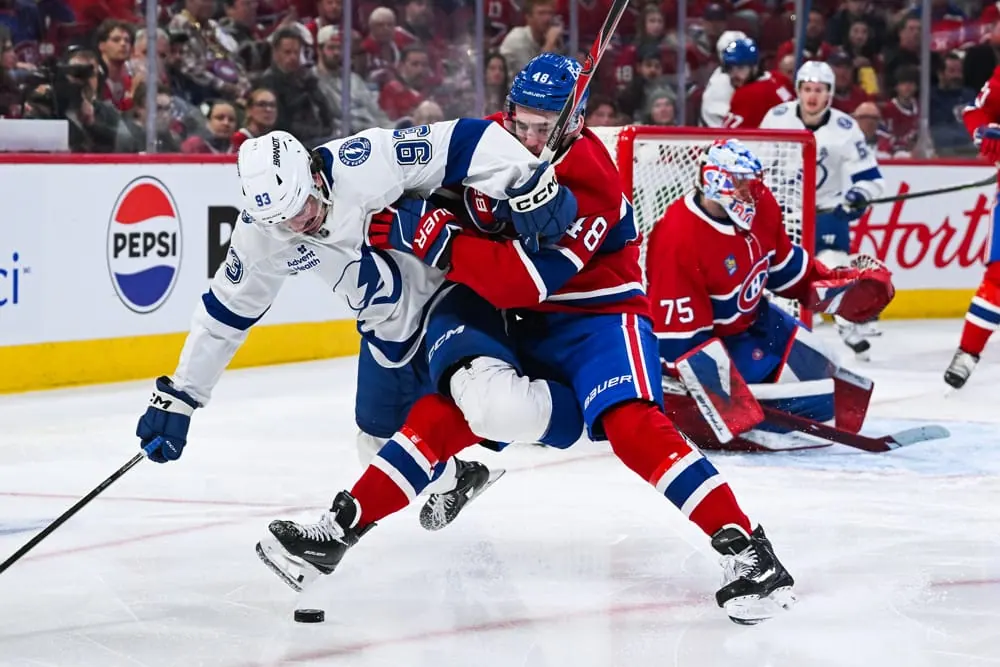

The Montreal Canadiens generated nine shots on goal in a playoff Game 7 and won the series. Read that sentence again. Then understand that it represents the lowest shot total for a winning team in a Stanley Cup playoff game since the NHL began tracking the statistic in 1959-60, according to NHL.com's recap of the game.
Jakub Dobes stopped 28 of 29 shots from the Tampa Bay Lightning. Nick Suzuki scored his first career playoff goal. Alex Newhook banked a backhand off Andrei Vasilevskiy's pad and backside for the game-winner. The Canadiens - who finished the regular season tied with Tampa at 106 points but won their Atlantic Division matchup on the strength of more regulation wins - advanced to the Eastern Conference Semifinals with a 2-1 victory on May 3 that defied every conventional measure of playoff hockey.
Seven games. Seven one-goal decisions. Four overtimes. A road team winning five times, including Montreal taking three of four at Amalie Arena. What looked like a classic first-round series across its entire run resolved on the back of a performance that will define Dobes's early career: a 32-save effort (as Phil Esposito noted when naming Dobes his Lightning Radio first star) in which Montreal was held to zero shots on goal for an entire period - the first time in NHL playoff history a team managed that feat in a Game 7 frame.
How a Series This Tight Came Down to One Goaltender
NHL.com's coverage captured the absurdity of the deciding game's flow: "The Lightning carried play against Montreal. They owned more possession, shots, shot attempts, and scoring chances. They held the Canadiens without a shot on goal in the second period (and only five total attempts)."
Montreal went 26 minutes and 55 seconds between shots on goal during that stretch. Tampa generated 12 shots in the second period alone. The Canadiens managed two shots through the first 37 minutes of regulation. Then Newhook's ricochet at 11:07 of the third period - a backhand attempt that caromed off Vasilevskiy's pad and rear end after Lane Hutson's slap shot went wide - gave Montreal a 2-1 lead they would not relinquish.
The final shot count: 29-9 for Tampa Bay. Across all situations, Montreal totaled 27 shot attempts. Tampa's shots on goal exceeded Montreal's total offensive activity for the game. The Canadiens converted 22.2% of their on-net chances. Tampa converted 3.4%. In a Game 7, those margins are everything.
Game-by-Game: How Volume Never Translated for Tampa
MTL 4, TB 3 (OT) - Montreal leads 1-0
Juraj Slafkovsky announced himself with a power-play hat trick, capping a night where Montreal won 61% of faceoffs and converted three of five man advantages. His seventh shot of the game in overtime - after four even-strength attempts through regulation - gave the Canadiens the early series edge. Nikita Kucherov picked up two assists for Tampa, but Slafkovsky's ability to find open ice on the power play became a template Montreal would revisit.
TB 3, MTL 2 (OT) - Series tied 1-1
Brandon Hagel scored twice, including the overtime winner that capped a 9-0 Tampa shot advantage in the extra frame. The Lightning poured 34 shots at Dobes and controlled possession through most of the night. Montreal's 21 giveaways and inability to generate overtime chances showed the holes in their defensive structure when Tampa could dictate pace. Hutson's power-play goal briefly steadied Montreal, but Vasilevskiy was strong enough when needed.
MTL 3, TB 2 (OT) - Montreal leads 2-1
Montreal's most complete offensive performance: 29 shots to Tampa's 17. Zachary Bolduc set up two goals. Kirby Dach scored and assisted. Then Hutson - who would finish the series as Montreal's most dynamic defender - drove the net in overtime and converted to give the Canadiens the series lead back in front of their home crowd.
TB 3, MTL 2 - Series tied 2-2
Tampa's most efficient regulation performance came in a building where Montreal won 64.9% of faceoffs and out-hit the Lightning 50-28. None of it mattered. Hagel scored twice - one even strength, one on the power play - and J.J. Moser ran Tampa's power play from the blue line with two assists. Cole Caufield converted for Montreal, but the Canadiens couldn't protect a third-period lead on home ice.
MTL 3, TB 2 - Montreal leads 3-2
The blueprint for what would happen in Game 7. Tampa fired 40 shots - their single highest total of the series - and converted on 5.0%. Montreal had 24 shots, scored three, and walked out of Amalie Arena with the series lead. Alexandre Texier scored the even-strength winner. Jake Evans won 85.7% of his faceoffs in a game where Montreal dominated the dot 66% overall. The defensive structure held despite Tampa's volume, and Dobes absorbed everything.
TB 1, MTL 0 (OT) - Series tied 3-3
Vasilevskiy's masterpiece: 30 regulation saves, four more in overtime, all in a raucous Bell Centre. Gage Goncalves scored the only goal of the night in overtime, assisted by Dominic James, and Tampa forced a seventh game. Ivan Demidov led Montreal forwards with five shots (one in OT), but the Canadiens simply couldn't solve Vasilevskiy when he matched Dobes's level.
MTL 2, TB 1 - Montreal wins series 4-3
Suzuki scored late in the first period for his first postseason goal. Dominic James - the rookie who had been Tampa's secondary scoring answer with his second power-play goal of the series - converted a Nathan D'Astous point shot redirect at 6:33 of the second to tie the game 1-1. Then Newhook's fortunate ricochet, and then 28 consecutive Dobes saves.
Phillip Danault won 64% of his 25 faceoff draws to help Montreal protect possession in the third period. Kaiden Guhle picked up two assists from the blue line. Darren Raddysh turned the puck over four times. None of Tampa's shot-share advantage - 29 shots to nine, 12-0 in the second period, 26:55 between Montreal shots on goal - translated into enough offense to overcome a 22.2% shooting night from a team that barely tested their goaltender.
What the Numbers Say About Sustainable Hockey
Montreal was outshot in five of the seven games. Their shooting percentage was better in six of the seven. That split tells the entire story: the Canadiens found ways to score on limited chances, and Dobes made sure Tampa's volume advantages didn't become series-defining runs.
As NHL.com noted in their series coverage, "Both teams have scored 14 goals in the series. Both teams are 2-1 on the road. Every game has been decided by one goal. There have been four overtime games." Through seven games, the margins were microscopic. The goaltending differential - Dobes at .966 in Game 7, Vasilevskiy at .778 - decided which team advanced.
The offensive concerns for Montreal are legitimate. Nine shots in a deciding game is not a repeatable formula. Caufield had moments but never sustained the threat Tampa needed him to answer. Demidov led Montreal forwards in shot volume in Game 6 with five but remains in search of his first playoff goal. Buffalo - the East's fourth seed with 109 points across 82 games (50-23-9 record, 283 goals for) - arrives with real scoring depth and won't allow Montreal to win games on conversion rate alone.
But the defensive structure that allowed Dobes to see shots clearly held through every environment: hostile Game 7 in Tampa, overtime pressure in Montreal, second-period barrages where the Canadiens couldn't muster a single shot. Danault's faceoff work (64% in Game 7) and Guhle's two-way reliability from the back end give Montreal the kind of foundation that travels. The question is whether the forwards can generate enough volume to complement it before Dobes is asked to carry another game like May 3.

 #38 · LW · 9 GP
What Tampa Lost When Leadership Changed
ESPN's series coverage highlighted a reality Tampa has been managing since Steven Stamkos departed for Nashville in 2024: "The Lightning have needed new vocal leaders like Brandon Hagel," who finished with six goals across the Montreal series. Hagel's two-goal performances in Games 2 and 4 kept Tampa alive when their depth couldn't match Montreal's opportunism.
But as Sportsnet's offseason analysis noted, Tampa faces the reality of "aging core challenges" after two straight frustrating postseasons. The Lightning finished the regular season 50-26-6 with 290 goals for and 229 goals against - strong possession metrics and a power play at 20.9% - but couldn't solve a Canadiens team built around youth and goaltending when it mattered.
Raddysh's four giveaways in Game 7 were emblematic of a back end that couldn't sustain clean breakouts under Montreal's forecheck. Vasilevskiy's Game 6 shutout proved he remains capable of stealing games, but he needed to replicate it more often across seven contests. Tampa generated the chances. They dominated the territorial play. The puck simply wouldn't go in when Dobes was standing in front of the net.
Player Grades
Jakub Dobes - MTL, Goaltender - Series MVP
Absorbed 40 shots in Game 5, 32 in Game 7 (28 saves). The youngest playoff team in the NHL rode him to a second-round berth, and he delivered in every moment that required it.
Nick Suzuki - MTL, Centre
Won 71% of faceoffs in Game 1, scored the opening goal in Game 7. Montreal's most consistent forward presence when offensive volume disappeared.
Lane Hutson - MTL, Defence
Power-play goal in Game 2, overtime winner in Game 3. Created the chance that led to Newhook's Game 7 winner. Montreal's most dynamic defender.
Juraj Slafkovsky - MTL, Forward
Hat trick in the series opener set the tone. Power-play execution in Game 1 proved to be the template for Montreal's special teams success.
Brandon Hagel - TB, Forward
Six goals across the series, including two two-goal performances that kept Tampa alive. The Lightning's most dangerous forward when they needed someone to finish.
Andrei Vasilevskiy - TB, Goaltender
Saved Tampa's season in Game 6 with a 34-save shutout. Couldn't replicate it often enough across seven games to overcome Dobes's consistency.
Phillip Danault - MTL, Centre
Won 64% of faceoffs in Game 7, allowing Montreal to control possession in the third period when Tampa was pushing. The kind of quiet excellence that makes goaltending easier.
Darren Raddysh - TB, Defence
Two assists in Game 4, but four giveaways in Game 7 is a brutal final line in a one-goal game. Tampa's back end couldn't match Montreal's structure.
What Comes Next
Montreal opens the second round in Buffalo on Thursday, May 7, carrying the confidence of a team that won three times at Amalie Arena and never looked smaller in hostile territory. The Sabres present a different challenge - more offensive depth, better even-strength scoring, a power play that can punish defensive lapses. The Canadiens will need to generate more than their Tampa average (21.4 shots per game across the series) to survive a team built to score.
But Dobes has proven he can steal games when Montreal's structure holds. Suzuki, Hutson, and Slafkovsky have shown they can convert on limited chances. Danault and Evans give the Canadiens the kind of faceoff dominance that allows controlled exits and defensive-zone stability. The machine works. The question is whether it can work against a Buffalo team that won't shoot 3.4% on 29 attempts in a deciding game.
A series that deserved seven games. A goaltender who deserved to win it. A Game 7 that will be remembered for decades as the night Montreal won on nine shots and walked out of Tampa with a future.