
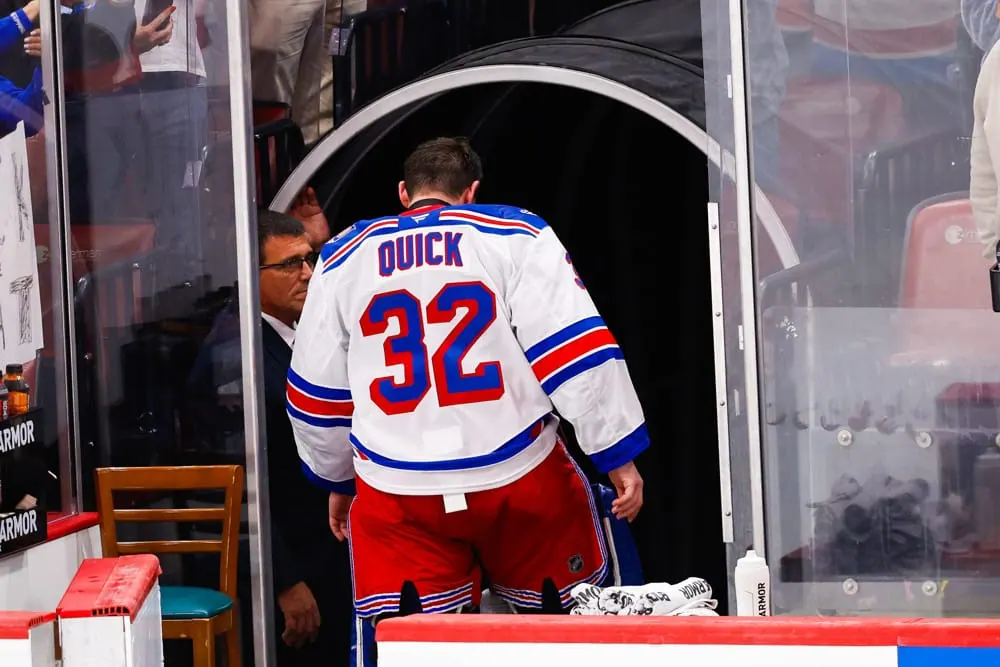
He had already gone down the tunnel. The final buzzer had sounded, the Florida Panthers had beaten the New York Rangers 3-2, and Jonathan Quick, 40 years old, number 32 on a jersey that his teammates had worn during warmups as a tribute, had done what goalies do at the end of every game: he disappeared into the corridor before the handshake ritual could begin.
Then Sergei Bobrovsky came looking for him.
The Panthers goaltender, two-time Stanley Cup champion and the goaltender who had taken the torch in the same net Quick once dominated, asked some of the Rangers to send word. Florida was waiting. The whole team. They had come to the Rangers' side of the ice to form one last handshake line, not because it was required, not because any protocol demanded it, but because Bobrovsky understood something that gets lost in the noise of highlight reels and advanced statistics: what it costs to be Jonathan Quick for nineteen years.
Quick returned from the tunnel. Bobrovsky embraced him first. The Panthers and Rangers stood in the corridor of ice and said goodbye to a man who, for the better part of a decade, was the best goaltender in the Western Conference and one of the most important players in two of the most improbable championship runs in modern NHL history.
"Both of them have got a couple of rings," Panthers coach Paul Maurice said of Bobrovsky and Quick. "They both get it. I think that's just wonderful when the players respect the players the way we do."
Jonathan Quick retired that Monday night in Sunrise, Florida with 410 wins, 65 shutouts, three Stanley Cups, one Conn Smythe Trophy, and a permanent place in the history of American ice hockey. He is the most decorated American-born goaltender in the sport's history. He is a first-ballot Hall of Famer. And his career is one of the most complete, complicated, and instructive stories in the modern NHL, a story about what athletic genius looks like, what it costs physically, and what it means to adapt, endure, and find new ways to be relevant when the body that made you irreplaceable starts to rebel.
The Kid from Hamden
Jonathan Douglas Quick was born on January 21, 1986, in Milford, Connecticut, and raised in nearby Hamden. He grew up watching the New York Rangers, a detail that would become quietly meaningful at the very end of his career. He played for the Mid Fairfield youth hockey association, transferred to Avon Old Farms, a Connecticut prep school known for its hockey programme, and then attended the University of Massachusetts Amherst.
The Los Angeles Kings selected him in the third round of the 2005 NHL Draft, 72nd overall. By the standards of what he would eventually become, it was one of the great draft bargains in franchise history. He was not a highly-touted prospect. He was not a slam-dunk first-round talent. He was a big, aggressive, somewhat unorthodox goaltender from Connecticut with a college pedigree and an unconventional playing style that coaches in that era weren't entirely sure how to categorise.
He made his NHL debut on December 6, 2007, stopping 15 shots in an 8-2 win against the Buffalo Sabres. He played his first full Kings season in 2008-09, going 21-18-2 with a 2.48 GAA and a .914 save percentage. By his mid-twenties he was the Kings' undisputed starter. By 26, he was the best goaltender in the world.
The Style: Chaos With a Blueprint
To understand Quick's career, both the peaks and the injuries, you have to understand what kind of goaltender he was. And he was, by any technical standard, an unusual one.
The modern NHL goaltending blueprint, refined through the 1990s and 2000s, is the butterfly system: drop to the knees, seal the lower portions of the net, use size and positioning to reduce available shooting angles, and move efficiently along the crease. It works because it is repeatable, consistent, and relatively forgiving of minor errors. Most elite goalies of Quick's era played some version of it.
Quick played something different. His style was intensely aggressive and deeply physical. He challenged shooters at the top of his crease rather than sitting back. He had exceptional lateral quickness and athleticism that allowed him to cover ice in ways that pure butterfly goalies couldn't. He used his left pad, his signature weapon, to make saves that looked improbable from almost any angle. His positioning was occasionally unorthodox. His angles sometimes looked wrong. And then the puck would hit him and he'd be back in position and you'd wonder how.
The athleticism that made him extraordinary also made him, structurally, more vulnerable than goalies who played a more controlled system. Every time he went into a full split to make a lateral save, every time he launched himself across the crease to cover a post, he was asking his body to perform at the upper limit of what human joints are designed to withstand. He performed those tasks thousands of times across nineteen seasons. The bill came due repeatedly.
Aggression as Tactical Architecture
Quick challenged shooters up in his crease, reducing angles before shots were taken rather than reacting to them. Combined with elite lateral quickness, it made him the dominant goaltender of his generation, a physically suffocating presence who controlled territory other goalies conceded.
What the Splits Take From You
The groin injuries of 2013, 2016-17 (59 games missed), and the knee surgery of 2018-19 are a direct consequence of a style that demanded full-extension saves repeatedly across a decade. His athleticism was not separable from his vulnerability. The same explosiveness that made him great is what eventually required surgical intervention.
How He Survived Long Enough to Win Three Cups
Post-injury Quick became more positionally disciplined without abandoning his aggressive instincts. His crouch deepened. His lateral movement became more calculated. His crease depth modulated based on game situation. He learned to read plays earlier, compensating for reduced explosiveness with improved anticipation.
What It Means Historically
Quick's 2011-12 season remains one of only two in NHL history (since shots were tracked from 1955-56) with a sub-2.00 GAA, a .929+ save percentage, and ten or more shutouts. The other belongs to Bernie Parent in 1973-74. That company tells you everything about how singular his peak was, and how much of it was built on a playing style the textbooks said was too dangerous to sustain.
The Championships: 2012, 2014, and the 8th-Seed Miracle
The 2011-12 Stanley Cup Playoffs. The Los Angeles Kings entered as the eighth seed in the Western Conference. They had barely made it. Most people expected them to lose in the first round to the Vancouver Canucks, who were one of the best teams in the league and had the Sedin twins and Roberto Luongo at their best.
What happened next is one of the most statistically dominant goaltending performances in playoff history.
Quick's 2012 Playoff Run: One of the Best Statistical Playoffs by a Goaltender, Ever
16-4 record. 1.41 GAA. .946 save percentage. 3 shutouts. 509 saves on 538 shots in 20 games. In 10 of the Kings' 16 wins, he held opponents to one goal or fewer. Among goalies to appear in at least 15 games in a single postseason, Quick's 1.41 GAA and .946 save percentage are NHL records that still stand today.
He also set a record that has never received the attention it deserved: 12 consecutive road wins across the 2011 and 2012 playoffs, surpassing Billy Smith's record of 10. The Kings, as the eighth seed, won on the road in Vancouver, in St. Louis, in Phoenix, and in New Jersey. They were supposed to lose most of those games. Quick didn't let them.
The Kings won the Cup in 20 games. They never played a Game 7. They defeated the top three seeds in the Western Conference in sequence. And the Kings' offence that year ranked 29th out of 30 teams in goals per game during the regular season. When a team with the league's lowest-scoring offence wins a championship, that tells you exactly where the production came from.
The Conn Smythe Trophy was unanimous. Quick received it from commissioner Gary Bettman after the Kings' 6-1 Game 6 win over New Jersey. He was 26 years old. He was the best player in the most important two months of hockey that season. And he wasn't even close to being done.
Two years later, the 2014 run delivered a second championship, and for Quick personally, a performance that was quieter than 2012 but no less meaningful. He went 16-10 with a 2.58 GAA and .911 save percentage across 26 games, but the surface numbers undersell what he did. He was the goaltender for the extraordinary comeback from 3-0 down against San Jose in the first round, the seven-game wars against Anaheim and Chicago, and the Finals against the Rangers, winning the games the Kings absolutely had to have. The team Quick grew up watching, the team he idolised as a kid in Connecticut, was the team he dispatched in five games to win his second Cup.
Justin Williams won the Conn Smythe that year. It was deserved. But the fact that Quick's .945 save percentage across 26 games was not enough to win the award a second time tells you something about the level he was performing at.
The Injury Years: When the Body Finally Said No
Between the 2014 Cup and the moment he was traded out of Los Angeles, Jonathan Quick missed significant chunks of four separate seasons. Each injury was connected, in some way, to the physical demands of his style. Each required a different kind of recovery. And each left him with a slightly different relationship to what he could ask of his body.
The injury years changed Quick, and that is not a criticism, it is the most interesting part of his story. A lesser athlete or a less intelligent one would have tried to play exactly the same game he always played and broken down completely. Quick did something harder. He adapted.
Post-surgery, his crease positioning became more economical. He read plays earlier so he needed less lateral explosiveness to make the same saves. He preserved energy across 60 minutes rather than burning it in bursts. His even-strength save percentage in 2021-22, his final full-time season with the Kings, was .926, ranking seventh in the NHL among goalies with a qualifying number of games. He had not lost the ability to be elite. He had simply learned to access it differently.
“Even in his last season as a full-time starter, Quick was tied for seventh in 5-on-5 save percentage and ranked ninth in 5-on-5 close situations. When a game is tied or within one goal, he was still elite.”
— NHL Edge Advanced Stats Analysis, 2022
The Departure: Trading a King
On March 1, 2023, Jonathan Quick played his final game as a Los Angeles King. He had been with the franchise for sixteen seasons, selected in the 2005 Draft, developed through their system, carried them to two championships, absorbed years of rebuilding around him, and remained their starter even as the team cycled through rosters and coaching staffs around him. He was the most important player in the most important games in Kings history.
He was also 37, carrying a cap hit the franchise was trying to clear, and in a year where Pheonix Copley had taken over starting duties by January. The trade sent him to the Columbus Blue Jackets on March 1 along with a conditional first-round pick. Columbus traded him to the Vegas Golden Knights one day later for a backup goaltender and a seventh-round pick.
Quick later admitted that until the trade, he thought he would retire a King. The words land differently than they might for another player, sixteen seasons is not a brief attachment. The Kings were not a waystation. They were his franchise, his identity, the organisation that gave two of his best decades meaning. Losing that before he chose to lose it was, by his own account, difficult to process.
Vegas needed him because their goaltenders were injured. Logan Thompson was out. Laurent Brossoit was out. They acquired Quick as a measure of last resort, a veteran insurance policy for a team that would go on to win the Stanley Cup that spring. He made his first Vegas start on March 5. He won it, stopping 25 of 28 in a 4-3 win over Montreal.

2.49 GAA · .911 SV%
780 Regular Season Games
2012 Conn Smythe · 2× Cup

Won Stanley Cup as part of roster
Received Cup from Alec Martinez
Ring No. 3

Backup to Igor Shesterkin
Grew up watching Rangers
Defeated them in 2014 Final
Vegas 2023: The Ring He Didn't Expect
The 2023 Stanley Cup playoffs belong, in the historical record, to Adin Hill. Quick watched from the press box for the first round. When Brossoit was injured midway through the second round series against Edmonton, Quick dressed as the backup behind Hill. He never played in the playoffs. He remained there, on the bench, in the room, in the conversations, the preparation, the institutional memory of what playoff hockey demands and how to sustain it.
When the Golden Knights won the Cup in five games over Florida, Quick received the trophy from former Kings teammate Alec Martinez, the man who had scored the overtime winner to clinch the 2014 championship in Game 5. Two men who had grown up as Kings, who had won together in a different decade, standing together in a Vegas arena with the Stanley Cup passing between them.
Bruce Cassidy, the Golden Knights' coach, was deliberate in his praise for what Quick contributed without playing. The presence of a three-time champion, a man who had been in the room when the pressure was maximum and the margin was zero, matters in ways that don't appear in box scores. The younger players in that locker room had access to something most backup goalies cannot provide: a living museum of what a championship requires.
The Rangers Years: Coming Full Circle
On July 1, 2023, Quick signed a one-year, $925,000 contract with the New York Rangers. The number was essentially league minimum, a veteran taking a backup role behind Igor Shesterkin, one of the best goaltenders in the current NHL. The salary was not the point. The franchise was.
Quick grew up in Connecticut. The Rangers were the team on the television. He watched them play as a kid, rooted for them, learned the game partly through their lens. And then in 2014, he beat them in five games to win his second Stanley Cup, playing some of the most composed hockey of his career as the Kings eliminated the team he had grown up watching. The irony is not lost, you could not write that arc as fiction without someone rejecting it as too neat.
He played three seasons in New York as Shesterkin's primary backup. He was not a starter anymore, and he knew it. He recorded his 60th career shutout on November 22, 2023, in a 1-0 win over Pittsburgh. In March 2024, he surpassed Ryan Miller to become the winningest American-born goaltender in NHL history. In February 2025, he became the first American-born goaltender to win 400 games. He reached those milestones in a backup role, with the same work ethic that coaches from Dean Lombardi to Mike Sullivan had described in identical terms: professional, precise, relentless in preparation.
Sullivan, who was coaching Quick in his final season with the Rangers, said it plainly after the retirement announcement: "I think he is one of the very best of his generation, and he has so much evidence to prove it. Every time I have spoken to the media about Quick, I have mentioned that I think he is a first-ballot Hall of Famer. I believe that, and he has the resume to prove it."
The Final Night: Sunrise, Florida
He told Chris Drury and Mike Sullivan quietly, as the season wound down. He didn't want a production, no press conference, no tearful announcement, no farewell tour. He is, by all accounts, a private man. He told his GM and coach privately so they could plan accordingly, arrange starts, make sure his family could be there.
On April 13, 2026, the morning skate in Sunrise, Florida, he told reporters. The texts began immediately. The day became, as he described it, a trip down memory lane, former teammates, coaches, opponents, people from every chapter of nineteen NHL seasons sending words he had to work through in the hours before puck drop.
His Rangers teammates came out for warmups wearing jerseys with his name and number 32 on the back. "That was cool," he said. "That was special from those guys." He made 14 saves. The Rangers lost 3-2. He had wished he had a couple more. He always does.
After the buzzer, he went down the tunnel. And then Bobrovsky sent someone to find him.
The Panthers gathered on the Rangers' side of the ice. Quick returned. Bobrovsky embraced him first. A handshake line that nobody asked for and everybody needed, goalies who had both carried franchises, who had both received the Cup, who both understood what that cost at the cellular level.
The Rangers hadn't made the playoffs this season. Quick's final years were in a building process that hadn't yet arrived. That's a familiar feeling for a man who spent the middle of his Kings career in rebuild years, who suited up for nineteen seasons through all varieties of circumstance. He was not a player who required winning to show up. He was a player who showed up, and winning sometimes followed.
The Career in Numbers: What He Actually Built
| How Quick Compares | American-Born Goalies | All-Time | ||
|---|---|---|---|---|
| Category | Quick | Ryan Miller | Mike Richter | Tom Barrasso |
| Career Wins | 410 | 391 | 301 | 369 |
| Career Shutouts | 65 | 44 | 24 | 38 |
| Stanley Cups | 3 | 0 | 1 | 2 |
| Playoff Shutouts | 10 | 3 | 9 | 5 |
| Conn Smythe Trophies | 1 | 0 | 0 | 0 |
Voice of a Career
“Tonight will be my last game in the League, and I am looking forward to it. When I knew what the decision was going to be, it just felt right. Felt like the right time. I put some thought into it.”
“Team played great. I wished I'd had a couple more saves for them. But it was still special, to see the way these guys played. It's an honor to play my last game with this group here.”
“The organizations I have been part of have been great to me. There's tons of people who I am grateful to for what they have done for me and my family over the years. I was fortunate to be part of some really great hockey teams.”
“I think he is one of the very best of his generation, and he has so much evidence to prove it. I have mentioned that I think he is a first-ballot Hall of Famer. He has the resume to prove it.”
“Sergei had the lead there. He has a better understanding and respect for what Jonathan Quick has done in his career. Both of them have got a couple of rings. They both get it.”
“He earned the respect of his teammates, coaches and staff members through his work ethic and dedication to his craft. The entire Rangers organization wishes him all the best in retirement.”
“The guys came in and reminded me to get out there.”
What He Actually Was
Three Stanley Cups. One Conn Smythe. Two Jennings Trophies. Two Vezina nominations. Three All-Star appearances. An Olympic silver medal. 410 wins, 65 shutouts, 829 games, 92 playoff games. The all-time wins and shutouts leader among American-born goaltenders. A 4-1 record in Game 7s. A .946 save percentage and 1.41 GAA in a single playoff run that are still, over a decade later, the best combined numbers in NHL playoff history for a goalie who played at least 15 games.
The Hockey Hall of Fame's criteria for goaltenders requires no debate in Quick's case. He is a first-ballot inductee, Sullivan said it plainly, and Sullivan is not prone to hyperbole. The question is not whether Quick gets in, but where he sits in the historical hierarchy of the position. And the honest answer is: very high. Higher than his era's reputation suggests.
Part of Quick's underappreciation is the same geographical problem that diminished other Kings of his era, Los Angeles, late starts, East Coast coverage gaps, and a style of play that looked smooth when it was actually heroic. Part of it is that his career peak was followed by injury years that created a misleading narrative of decline. Part of it is that his 2012 Conn Smythe run was so singular that people struggled to contextualise it against the rest of his career, as if one achievement had consumed the others.
But the record speaks without ambiguity. In the most important games of his franchise's history, the ones where the Kings had no business winning, where the whole thing could have ended in the first round in 2012 and nobody would have been surprised, Quick refused to let it end. He stopped shots nobody expected stopped. He held leads when the offence couldn't produce. He was, in the truest sense of what a goaltender is supposed to do, the reason those championships happened.
And then, when his body made the style that produced those performances too expensive to maintain, he adapted. He found new ways to be elite. He took his knowledge into a backup role and gave younger players and franchises access to what championship experience actually looks like from the inside. He played nineteen seasons, the same number on his jersey, with the same preparation and the same respect for the craft that he brought on the night he made his debut in 2007.
He went back out of the tunnel when Bobrovsky called for him. That matters. You do not have to go back out. The buzzer has sounded. The game is over. Career is over. You could stay in the tunnel and nobody could say a word. But he came back out, and he stood in the handshake line, and he accepted the goodbye that hockey people, the ones who understand what he endured across nineteen years, wanted to give him.
That is who Jonathan Quick was. That is who he will always be.
Jonathan Quick
2007, 2026
Nineteen seasons. Three Stanley Cups. A Conn Smythe. Records that may never be broken. The most decorated American-born goaltender in the history of the game. He came back out of the tunnel when they called for him. Some things don't need more explanation than that.