

 Pittsburgh Penguins
 Carolina Hurricanes
 Buffalo Sabres
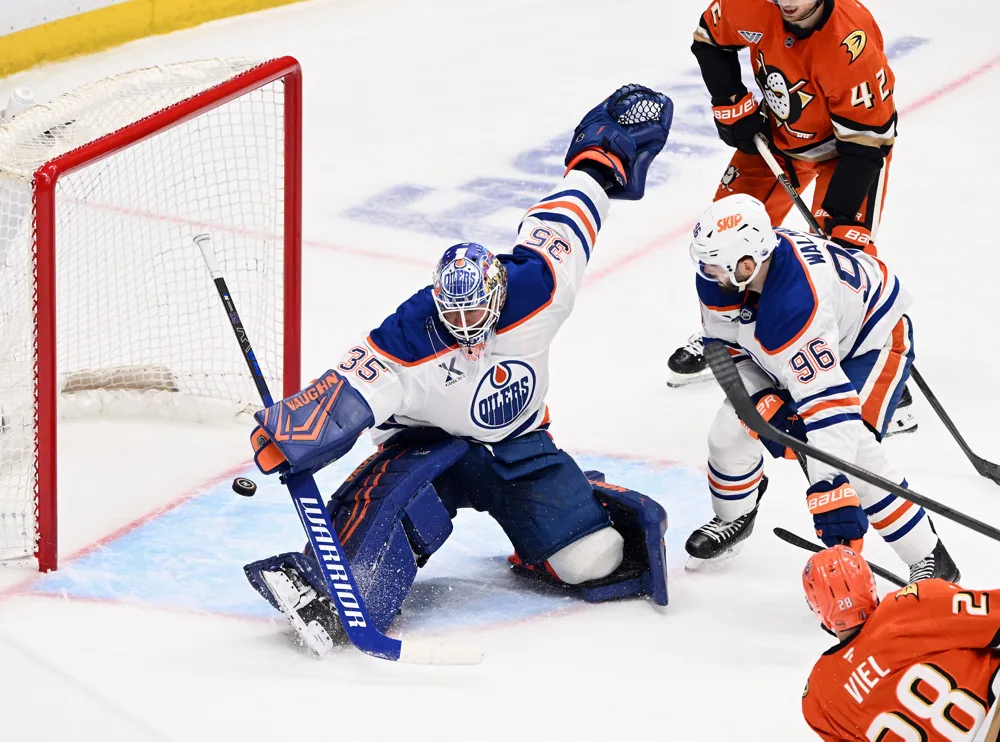
The Edmonton Oilers' 2025-26 ended in the first round for the first time since 2021, in six games against the Anaheim Ducks, with Connor Ingram stopping 87.6 percent of the shots he faced. Nobody who has watched this team for the last four years needed the series to tell them where the problem was. Edmonton has reached two Stanley Cup Finals and lost both, and in every one of those springs the question was the same: who is in the net, and is he good enough.
The regular season answered it in the plainest terms the numbers allow. At 5-on-5 the Oilers generated 182 expected goals, fourth in the NHL and behind only Colorado and Anaheim in the Western Conference. They allowed 170 expected goals against. A 52 percent team, comfortably. Then the pucks were counted. Edmonton scored 175 and allowed 188. It was outscored at even strength by 13 goals while out-chancing opponents by 12, and the biggest piece of that 25-goal swing, 18 goals of it, happened in the crease. Only five teams got worse goaltending relative to the shots they faced.
So the summer was always going to be about the goalie. Here is what Edmonton did: it re-signed nothing in the crease, let Ingram and Calvin Pickard walk in free agency, kept Tristan Jarry and the two years left on his contract, signed Frederik Andersen for one year at $2.8 million three months before he turns 37, and sent a 2028 third-round pick to Buffalo for Devon Levi, who did not play an NHL game last season. Then it hired Mike Babcock. That is the plan.
The trade that made it worse
Start with December, because the crease problem Edmonton is trying to fix this September is partly one it manufactured last winter. On December 12 the Oilers sent Stuart Skinner and Brett Kulak to Pittsburgh for Jarry and Samuel Poulin. Skinner had been the goalie for both Cup runs, had an .891 save percentage in Edmonton at the time of the trade, and had lost the room's confidence in a way that is hard to quantify and easy to see. Jarry was the reset.
The reset went the wrong way. Jarry finished the season with 98 goals against on 93.9 expected, minus-4.1, and an .882 save percentage that was the worst full-season mark of his career. Skinner went to a Pittsburgh team that gave up chances at much the same rate and finished the year with 142 goals against on 150.3 expected, plus-8.3, the best figure of his career. The two men Edmonton chose between were separated by twelve and a half goals in the wrong direction, and the Oilers are still paying the one who lost.
That chart is the whole argument. Edmonton's crease for 2026-27 consists of the goalie who was the worst of the four it used last season, a 37-year-old coming off the worst full year of his career, and a 24-year-old whose last NHL stint was nine games at .872. The two goaltenders who were above water are gone, one by choice and one by trade.
Jarry: five years, four declines
Jarry's contract was the reason Pittsburgh wanted out, and the Oilers took it on knowing it. He is signed through 2027-28 at $5.375 million, and the trajectory on the deal has been one direction since the day it was signed.
There is no version of this where a 31-year-old whose save percentage has fallen by 37 points in five years suddenly reverses. Goaltenders who decline like this at Jarry's age sometimes stabilise, and Edmonton's defence is better than Pittsburgh's, which will help his raw numbers. But 19 of his 33 starts came behind the Oilers' defence last year, and the minus-4 did not improve when he got there, and the defence in front of him now has Darnell Nurse replaced by Shakir Mukhamadullin, a 46 percent player on a San Jose team that was 48 percent, and free agent Ryan Shea on five years at $4 million. That is not an obvious upgrade in the shots Jarry will face.
Andersen: the right idea four years late
Andersen is the more defensible signing, because the money is short and the resume is real. He was .922 in 2021-22, .932 in 16 games in 2023-24, and he has been a legitimate starter on very good Carolina teams. One year at $2.8 million for a goalie with that history is the kind of contract a contender should sign.
The problem is the year that just happened. Andersen played 35 games last season and produced an .874 save percentage and minus-3.3 goals against expected behind a Carolina defence that is among the best in the league at limiting chances. He turns 37 on October 2, and he will do so on the sidelines: an undisclosed injury in offseason training has him missing all of camp, so the season opens with Jarry and Levi. Goaltenders in their late 30s who post an .874 do not usually have a .920 left in them, and the reason Carolina let him go after five seasons is not a mystery. Edmonton is paying $2.8 million for the 2021 version of Andersen and will get the 2026 one.
Levi: the lottery ticket that already lost once
Levi is the interesting one, because he is 24 and cost a third-round pick, and third-round picks are the correct price for a goalie who might become something. His NHL record is 39 games, a .894 save percentage and a 3.29 goals-against average, and his last stint with Buffalo was nine games at .872, after which the Sabres sent him to Rochester and did not bring him back. In the AHL his save percentage has fallen three years running, from .927 to .919 to .904, and last season's .904 came on a league-leading 3,029 minutes, which is a workload that tells you Rochester trusted him and a number that tells you why Buffalo did not.
A .904 in the AHL does not translate to an NHL starter. It might translate to a competent third goalie, which is what Edmonton appears to have bought, and at $812,500 that is fine. It is not a plan for the crease. If Levi is the answer in March, the season has gone badly enough that the question no longer matters.
The Babcock part
I will keep this short, because the point of this piece is the numbers and the coaching hire is not about numbers. Mike Babcock has not coached an NHL game since 2019 and left Columbus before coaching one in 2023. Edmonton has hired him to run a roster built around two of the best players in the world, with a crease that ranks among the least reliable in the league, in a market that does not forgive. Whatever Babcock brings, and he has won a Stanley Cup and two Olympic golds, he cannot stop pucks. He inherits the same problem Kris Knoblauch had, with fewer options for solving it.
The case for the plan, stated fairly
Ingram's plus-1.7 was one competent season on an .899 save percentage, and Skinner's plus-8.3 came in a Pittsburgh system where the expected-goals model credits a goalie for surviving chaos. Neither was the long-term answer, and both cost money the Oilers needed for the skaters. Jarry is under contract whether Edmonton likes it or not, so the choice was to build around him or eat the deal, and building around him with a cheap veteran and a cheap lottery ticket is a rational way to spend $3.6 million. If Andersen finds one more .910 season, which he has done as recently as 2023-24, and Jarry stabilises behind a better defence than Pittsburgh's, the Oilers have an average crease, and an average crease behind the fourth-best chance team in the league wins 100 points. That is the bet.
Where this lands
Cheap, short and flexible. Andersen has a real pedigree, Levi is a free swing at 24, and Jarry was already on the books. The skaters are a 52 percent team; average goaltending is all they need.
Edmonton lost 18 goals in its own net at 5-on-5, traded away the goalie who finished plus-8, let the one who finished plus-2 walk, and replaced them with a 37-year-old coming off an .874 and a prospect whose AHL numbers have fallen three years running. The goalie with two years left on his contract has declined for four straight seasons.
What it means
The Oilers will be a very good team at 5-on-5 again, because McDavid, Draisaitl, Bouchard and Ekholm make that true regardless of who is behind them. The question is the same as it has been since 2022, and the answer is the same too. Watch two things. The first is the team's goals saved above expected at 5-on-5, which was minus-18 last year: if it is still negative at the New Year, nothing has changed. The second is whether Jarry is starting in December. If he is, Edmonton has either fixed him or given up on the alternative, and the numbers say the second is more likely. Either way, the deadline will be about a goalie again, and this time the Oilers will be shopping with a third-round pick already spent.