
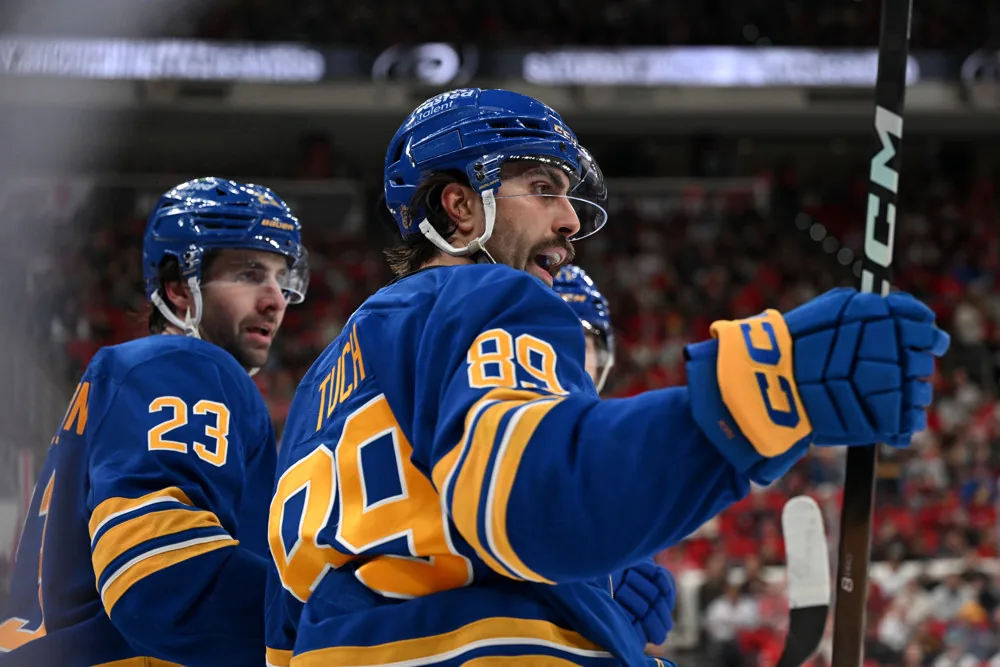

 Buffalo Sabres
 St. Louis Blues
The Washington Capitals finished three points out of the playoffs last season, and the number that explains how close they came is not a forward's. Logan Thompson faced 169 expected goals across all situations and allowed 140. Twenty-nine goals saved above what the quality of the shots said he should have allowed, the best figure of any goaltender in the league, a hair ahead of Jeremy Swayman in Boston and well clear of Ilya Sorokin and Andrei Vasilevskiy. Take Thompson out and put a league-average goaltender in the Washington crease and the Capitals are a minus-six team instead of a plus-23 one, and the three points they missed by become a double-digit gap.
That is the context for a summer in which Washington gave Alex Tuch the richest contract signed by any team this offseason, eight years and $84 million running through his age-37 season, and paid Connor McMichael, prospect Milton Gastrin and the 16th pick for Jordan Kyrou. Both are top-six wingers. Both were bought to score. And the thing that nearly sank the Capitals last season, the thing Thompson spent 58 games covering for, was not scoring. It was a defence that ranked 25th of 32 in the chances it allowed, and it is going into 2026-27 with essentially the same names on it.
What Thompson was covering
At 5-on-5 last season Washington generated 175 expected goals and allowed 175. It was a 50 percent team, dead even on chances, which is neither good nor bad. The split behind that even number is the problem. The Capitals created chances at 2.62 per 60 minutes, 10th in the league, a top-third offence. They allowed chances at 2.62 per 60, 25th in the league, a bottom-third defence. Not one of the six defencemen who played 500 minutes was on the ice for fewer than 2.45 expected goals against per 60, and two of the three who played the most, Jakob Chychrun and Martin Fehervary, were at 2.67 and 2.70.
Thompson turned that into 147 goals against at 5-on-5 on 175 expected. Twenty-eight goals of suppression, second in the league at team level behind Boston, on a defence that was giving up chances at a bottom-eight rate. The Capitals outscored opponents 179-147 at even strength while breaking exactly even on chances, and 28 of those 32 goals of margin belong to the goaltender.
Goaltending at that level does not repeat on schedule. Thompson is 29, he is signed at a reasonable number through 2030-31, and he might well be very good again. But 29 goals above expected is the top of the distribution, not the middle of it, and a front office that plans around it happening twice is planning around a coin landing on its edge. The rational summer for a team in Washington's position is to cut the chances against, so that the goaltender does not need to be the best in the league for the team to make the playoffs. What the Capitals did instead was buy goals.
Tuch: real finishing, wrong bill
Let me be fair to Tuch first, because the case against the contract is not that he is a bad player. He is a very good one. He scored 33 goals and 66 points in 79 games for a Buffalo Sabres team that won 109 points, and he did it for the fourth time in four years: 36 goals, then 22 in an injury-shortened year, then 36, then 33. He shot 16.9 percent last season and 15.9 percent across the four years combined, on 801 shots, which is a large enough sample that the finishing is a skill and not a streak. The Anthony Mantha problem, a shooting percentage the model does not believe, is not Tuch's problem. He was a 10 percent shooter for five years in Vegas and early Buffalo and then became a 16 percent shooter at 26, and he has stayed one.
Here is what the contract is actually buying, though, once the goal total is set aside. At 5-on-5 Tuch scored 1.08 goals per 60 minutes, 18th among the 136 wingers who played 800 minutes. That is good. It is also almost exactly what Alex Ovechkin produced at 40, at 1.13, and it is Tuch's ceiling, not his floor, because his individual expected goals per 60 ranked 69th. He is a top-15 even-strength scorer on the strength of top-five finishing applied to middle-of-the-pack chances, and finishing is the skill that goes first.
Then there is his on-ice line, which is the part Washington should have looked at hardest. Tuch was on the ice for 66 goals for and 41 against at 5-on-5 last season, plus-25, a number that in isolation looks like a franchise winger. The chances behind it were 49.2 expected goals for and 46.4 against, plus-2.8. Twenty-two goals of that plus-25 were finishing and goaltending, and Buffalo had both in abundance: the Sabres were 23 goals above expected as shooters at 5-on-5, the second-luckiest team in the league, and 14 goals above expected in the crease. Tuch was a 51 percent player on a team that turned 50 percent into 109 points. He was not the reason it did.
And the contract runs to 2034. Tuch is 30 now. The last two years of this deal pay $10.5 million to a 36- and 37-year-old whose game is built on finishing chances that other people create, and the cap problem Buffalo declined to take on, by taking David Kampf and a third-round pick rather than the contract, now belongs to Washington. The Sabres, coming off the best season in their modern history, looked at eight years of Alex Tuch and let him go for a fourth-line centre.
Kyrou: the better player, the better price, the actual fix
The second acquisition is the one that addresses the problem, and it is telling that it cost less. Kyrou's 2025-26 was, on its face, a down year: 18 goals, 46 points in 72 games, 10.4 percent shooting after 15.1 the season before. I covered the St. Louis end of this trade and the Blues' reasons for making it. The Washington end is better than the box score.
At 5-on-5 Kyrou was on the ice for 2.01 expected goals against per 60 minutes. That is the single number the Capitals needed to import. It would have been the best mark on the roster by a distance, better than any Washington defenceman, and it came on a St. Louis team that was a 49 percent team overall. Kyrou's own share was 59 percent, the product of generating 2.89 expected goals per 60 while allowing 2.01, which is an elite two-way line, and one that has nothing to do with shooting luck. McMichael, the player going the other way, was on the ice for 2.94 against per 60 and a 47 percent share. Swapping McMichael's minutes for Kyrou's is worth roughly 15 expected goals against over a season on its own, and that is the kind of arithmetic that lets a goaltender be merely good.
Put the two side by side and the shape of the summer is clear. Washington acquired one winger who fixes the thing that was wrong, and paid for him with a first-round pick and a useful young forward on a contract that ends when he is 32. It acquired another winger who adds to the thing that was already fine, and paid for him with the longest and richest contract of the offseason, ending when he is 37. The Kyrou trade should have been the headline. Tuch got it.
The rest of the summer, briefly
Boone Jenner came from Columbus on four years at $5.75 million, a 33-year-old centre who was a 50 percent player on a 2.74 expected goals against per 60, which is to say he is another Washington forward. Vincent Desharnais came in on four years at $4.2 million, and his 2.15 expected goals against per 60 in San Jose is a promising number in 765 minutes on a bad team, though four years is a long bet on a third-pair defenceman. And Ovechkin signed for one more year, at 41, on a deal that pays him $1 million in salary and the rest in bonuses, which is the one contract on the list nobody can argue with.
None of that changes the blue line that mattered. Chychrun, Fehervary, Matt Roy, Rasmus Sandin: the core of the group that allowed chances at the 25th-best rate in the league is the group that will be asked to do it again, with van Riemsdyk gone to Pittsburgh, Timothy Liljegren (four games a Capital after the deadline) and Desharnais as the depth pieces and a 33-year-old centre in front of them. Thompson will be asked to be the best goaltender in the league again. The forwards will score more, because Tuch and Kyrou are better than McMichael and Kampf, and that will be the story if it works.
The case for the contract, stated fairly
Tuch is exactly the kind of player a team with Ovechkin's window buys: big, proven, 30-plus goals in three of four years, a right wing who can play with anyone, and available without giving up the 16th pick that went to St. Louis. Washington was three points from the playoffs with McMichael in those minutes and Kampf a two-game footnote; with Tuch and Kyrou in them the Capitals should be a playoff team, and if Thompson is very good again they are more than that. The salary cap is rising, so $10.5 million in 2030 buys less than it does today. And there is no version of the summer in which the Capitals replaced their whole defence; the trade market for top-four defencemen was thin, and it was Kyrou or nothing on that front. The contract is the price of a 33-goal winger in a rising-cap league, and Buffalo's refusal to pay it tells you about Buffalo's plans, not Tuch's value.
Where this lands
Kyrou brings the league-class chance suppression Washington lacked, at a fair price. Tuch is a real finisher with four years of proof, on a right wing the Capitals needed, without surrendering a first. The forward group is clearly better and Ovechkin's last window is open.
Washington missed the playoffs with the best goaltending season in the NHL covering for the 25th-ranked defence. It re-signed no defenceman of consequence, bought a 30-year-old finisher on an eight-year deal whose plus-25 was plus-3 by chances, and paid more for him than for the winger who actually fixes the problem.
What it means
The Capitals will score more this season. Tuch and Kyrou in for McMichael is a clear upgrade, and if Washington makes the playoffs the summer will be graded on that. Watch two other numbers instead. The first is expected goals against per 60 at 5-on-5, which was 2.62 last year: if it does not move toward 2.45, the defence has not been fixed, and Kyrou's minutes are the only ones that will show it. The second is Thompson's goals saved above expected. If he is at plus-15 in April instead of plus-29, which is still a very good season, Washington is a team that broke even on chances, allowed them at a bottom-third rate, and gave the eight-year contract to the forward who was not the fix. That team is closer to 90 points than 100, and it has a $10.5 million winger turning 31.