
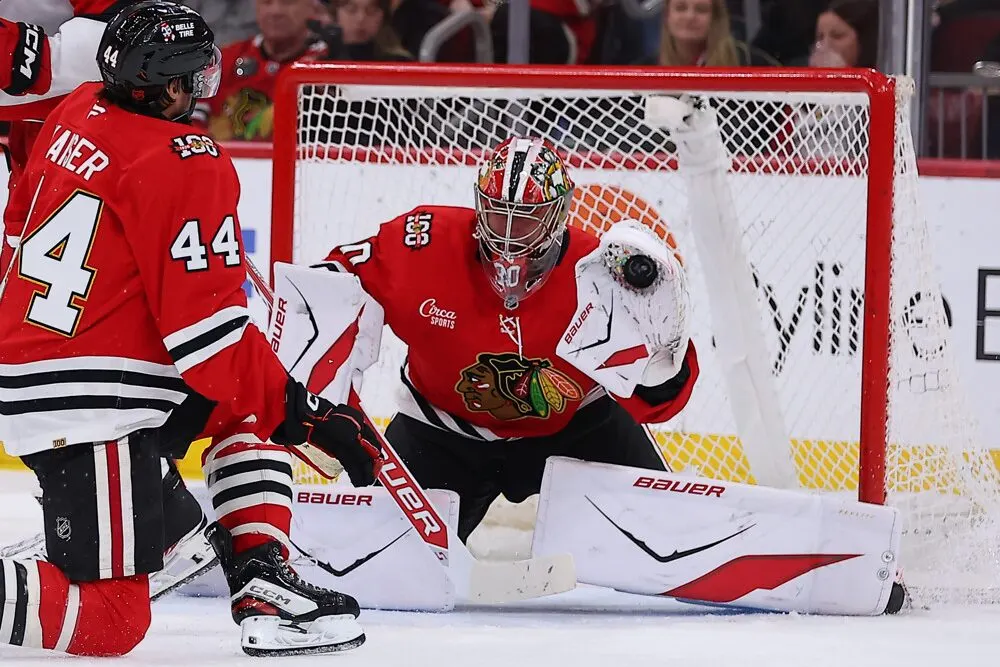

Every conversation about Chicago starts and ends with Connor Bedard, and this offseason added the Patrick Kane homecoming chatter to the nostalgia file. Fair enough; stars sell. But the most important thing that happened to the Blackhawks' rebuild last season happened at the other end of the ice, wearing a mask, and it has gone almost completely undiscussed. Chicago found its goaltender, and finding a goaltender is the single hardest, most failure-prone step in any rebuild in hockey.
| Metric | Number | The read |
|---|---|---|
| Spencer Knight goals saved above expected | +10.9 | Top-tier work in 54 games |
| Chicago 5-on-5 expected-goals share | 44% | Among the worst structures in the league |
| Goals against | 270 | And it would have been far worse |
| Connor Bedard | 73 points | The offence is arriving separately |
Start with the context, because it is what makes the number remarkable. Chicago was a 44 percent team that gave up 270 goals, one of the worst defensive structures in the league, the kind of environment that ruins goaltenders and swallows careers. Spencer Knight faced that nightly barrage for 54 games and saved 10.9 goals above expected anyway, a top-tier figure that most netminders on contending teams did not touch. Goaltending numbers compiled behind a bad team are the most honest kind. There is nowhere to hide, and Knight did not need anywhere.
Why this is the hard part
Rebuilds acquire forwards almost automatically; draft high enough for long enough and the Bedards and Frank Nazars arrive. What wrecks rebuilds is the crease. Goaltending development is notoriously nonlinear, blue-chip goalie prospects fail at a rate that would embarrass any other position, and teams routinely reach the end of a five-year teardown with a young core ready to win and nobody to stop the puck. The league is littered with rebuilds that stalled at exactly that step, burning assets on stopgap veterans while the window creaked open without them. Chicago just skipped the queue. A 25-year-old posting elite numbers behind a terrible team is the rebuild lottery ticket nobody prices correctly.
The Bedard connection
This matters most because of what it means for the timeline of the main project. Connor Bedard's 73-point season confirmed the offensive future, and Nazar and the rest of the young forwards are queuing up behind him. The traditional failure mode for a team in Chicago's position is that the forwards mature on schedule, the games start mattering, and the crease leaks the whole thing away, forcing a panicked overpay for a veteran goalie at the worst possible moment. Knight's emergence deletes that scenario. When the young core is ready, the net already is, and that synchronization is rarer and more valuable than any single prospect in the system.
The caution the sample demands
Now the honest wobble: goaltending is the most volatile position in the sport, and 54 games of excellence is a foundation, not a guarantee. Goalies oscillate year to year in ways skaters do not, Knight's workload behind this roster will stay brutal while the structure matures, and a regression season would say as much about the 44 percent team in front of him as about the man in the net. Chicago should treat the crease as promisingly settled, not permanently solved, which means continuing to develop depth behind him rather than filing the position under finished. The claim is not that Knight is guaranteed. It is that Chicago now holds the asset every rebuild dies looking for.
What it changes about the timeline
Practically, Knight moves Chicago's competitive clock forward. A rebuild with a solved crease can afford to be aggressive a year early, adding real players around the kids while the goaltending holds the floor, and the Blackhawks' cap sheet gives them room to do exactly that. It also changes the risk calculus on the structure: a team this bad territorially normally cannot contemplate playoff talk, but elite goaltending is the great equalizer for young teams learning to defend, the bridge that keeps games winnable while the details get coached in. The Kane chatter brings the headlines. Knight brings the timeline.
The market context that makes it sweeter
To appreciate what Chicago is holding, look at what everyone else pays for the same commodity. The goaltending market this offseason has been a lesson in scarcity: contenders circling the same few available starters, the Hellebuyck trade watch dragging into its third month because Winnipeg knows exactly how rare the asset is, teams committing large multi-year money to netminders coming off mediocre seasons purely because the alternative is nothing. Against that backdrop, a 25-year-old posting elite numbers on an entry-level cost structure is worth more in surplus value than almost any skater contract in the league. Chicago acquired that asset in a trade the league graded as a footnote at the time, which is how the best goaltending bets always look until they pay.
The development infrastructure question matters from here. Young goaltenders who break out behind bad teams face a specific hazard: overwork. The temptation with a rebuilding roster is to ride the one thing that works for 65 starts, and workloads like that have bent more young careers than any mechanical flaw. Chicago's path requires the discipline to cap Knight's starts in the high 50s, invest in a backup who can genuinely absorb 25 games, and treat the asset like the franchise cornerstone it is rather than a tarp over the roster's holes. The teams that ruined their young goaltenders all had good reasons in the moment.
And there is a draft-capital dividend hiding in this too: a rebuild that no longer needs to spend premium picks or cap space chasing goaltending gets to concentrate everything on the skater group. Every future first-rounder, every deadline sale, every cap dollar can now go toward the 44 percent problem, which is the coachable, buildable kind of problem. Solved creases compound quietly. Chicago's already is.
Where this lands
The Blackhawks' rebuild has been narrated entirely through Bedard, which is understandable and incomplete. The hardest checkpoint in any teardown, the one that quietly kills more rebuilds than bad drafting ever has, is finding a real goaltender before the young core needs one, and Chicago cleared it last season while the league was watching the highlight reels. Spencer Knight saved 10.9 goals above expected behind one of the worst structures in hockey at 25 years old. When Chicago's window opens, remember that this was the season it became possible, and the crease was where it happened.